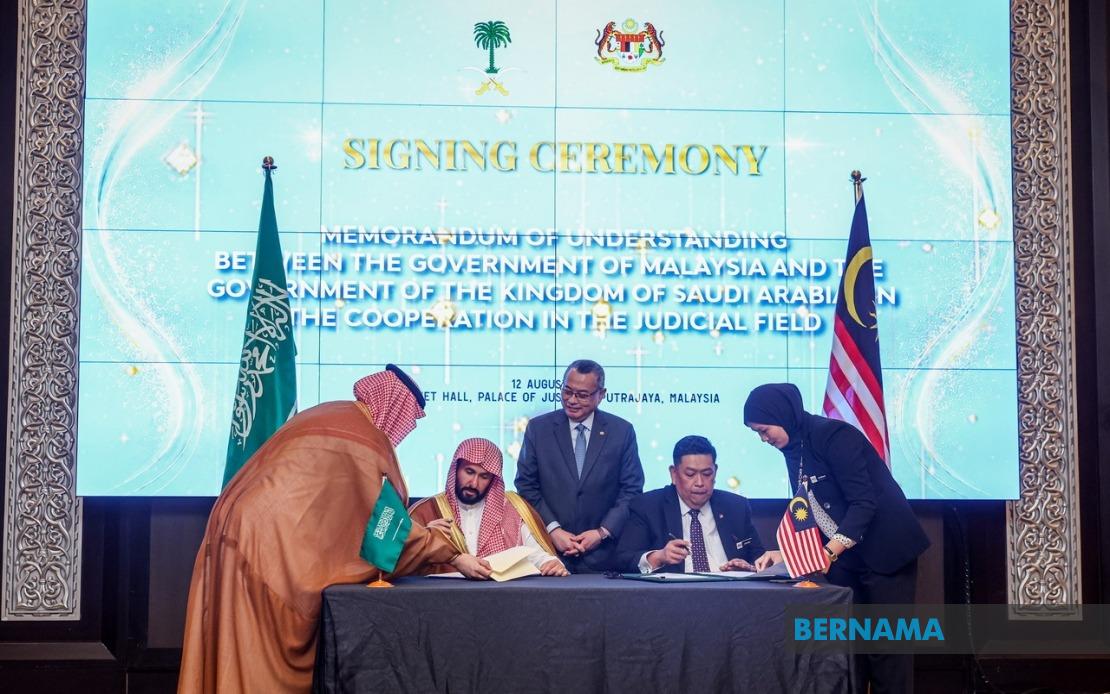
Malaysia and Saudi Arabia have taken a significant step to strengthen their judicial ties by formalising a comprehensive memorandum of understanding that charts a path for deeper institutional collaboration across multiple dimensions of their legal systems. The agreement, signed at the Palace of Justice in Putrajaya on August 12, represents a deliberate effort by both nations to move beyond cordial diplomatic relations into concrete operational partnerships that could reshape how their respective judiciaries function.
Chief Registrar of the Federal Court Azhaniz Teh Azman Teh and Saudi Arabian Minister of Justice Sheikh Dr Waleed Mohammed Alsmani exchanged signatures for the accord, with Chief Justice Tun Wan Ahmad Farid Wan Salleh witnessing the ceremony. The presence of Malaysia's most senior judicial officer underscores the importance both countries attach to this arrangement, signalling that the cooperation extends to the highest levels of the Malaysian judiciary.
The framework outlined in the MoU encompasses several interconnected areas designed to create lasting institutional synergies. Civil case management represents a foundational component, as both nations seek to learn from each other's approaches to managing caseloads and streamlining court proceedings. This exchange holds particular relevance for Malaysia, where court backlogs remain a persistent challenge affecting access to justice and public confidence in the system. Saudi Arabia's experience with managing a judiciary serving over 30 million people across a vast geography offers valuable lessons that Malaysian courts could adapt.
Judicial technology and digitalisation emerge as perhaps the most forward-looking pillar of this cooperation. Malaysia has invested heavily in its e-Court system, which represents a significant modernisation of court operations. By formalising knowledge-sharing in this sphere, the MoU acknowledges that judicial innovation is no longer a peripheral concern but central to contemporary jurisprudence. The exchange enables Saudi Arabia to potentially benefit from Malaysia's technological infrastructure while allowing Malaysian courts to remain abreast of alternative approaches to digital justice delivery.
Beyond infrastructure and technology, the agreement contemplates a broader exchange of practical experience and judicial information. This dimension proves particularly valuable in regions where judges and court administrators operate within similar Islamic legal frameworks and share common cultural touchpoints. The circulation of institutional knowledge, best practices, and lessons learned from both successes and challenges can accelerate reform efforts in both jurisdictions without requiring each nation to navigate every potential pitfall independently.
A particularly notable aspect of the visit involved focused dialogue on Malaysia's judicial approach to sexual offences against children. This specialised discussion reveals how bilateral judicial cooperation increasingly concentrates on protecting vulnerable populations. Malaysia's experience developing judicial mechanisms and procedural safeguards for child witnesses in sexual abuse cases addresses a global challenge. By sharing this expertise with Saudi Arabia, Malaysia positions itself as a knowledge leader in judicial child protection, enhancing its standing within the Islamic world and contributing to broader efforts to strengthen protections for children across the region.
The e-Court system demonstration during the visit exemplifies Malaysia's readiness to export judicial innovation. This digitalisation initiative transforms how courts schedule proceedings, manage documents, and facilitate remote appearances. For Saudi Arabia, observing a functional digital court ecosystem in a comparable Muslim-majority nation provides confidence that technological modernisation can advance without compromising judicial independence or Islamic legal principles. Such proof-of-concept demonstrations carry particular weight in encouraging adoption elsewhere.
The institutional visit component of the MoU framework deserves emphasis, as face-to-face engagement between judges, registrars, and court administrators creates trust and understanding that documents alone cannot establish. When Malaysian and Saudi Arabian judicial officers interact directly, observe each other's courtrooms, and discuss operational challenges candidly, they build relationships that facilitate smoother problem-solving when future disputes or misunderstandings arise. These personal connections often prove invaluable in cross-border judicial matters affecting citizens of both nations.
For Malaysia specifically, deepening judicial ties with Saudi Arabia carries strategic implications. Saudi Arabia's economic clout and its central position in the Islamic world mean that enhancing cooperation strengthens Malaysia's influence within broader Muslim networks. As Malaysia positions itself as a regional hub for Islamic finance and Islamic jurisprudence, judicial cooperation with the Kingdom amplifies its credentials. Conversely, Malaysian courts gain access to Saudi judicial expertise in commercial matters affecting the Kingdom's enormous trading relationships across Southeast Asia.
The timing of this MoU reflects broader patterns in Southeast Asian diplomacy, where nations increasingly recognise that institutional cooperation across borders addresses contemporary challenges that transcend purely bilateral concerns. Migration, cybercrime, family law matters involving parties from both jurisdictions, and commercial disputes requiring input from both legal systems all demand frameworks like this memorandum. By establishing structured channels for cooperation, both nations reduce friction and create predictable processes for handling cross-border judicial matters.
Looking forward, the success of this arrangement will depend on meaningful implementation rather than ceremonial gestures. Regular exchanges must translate into concrete changes in judicial practice. Judges from both nations must engage in substantive professional development rather than perfunctory visits. Technology transfer must move beyond demonstrations to actual adoption and adaptation. The Malaysian Judiciary's stated commitment to successful implementation suggests serious intent, but monitoring progress and addressing implementation challenges will determine whether this MoU evolves into a model for other bilateral judicial relationships throughout the region or remains primarily symbolic.
The broader significance lies in how this cooperation demonstrates that judicial systems, often perceived as purely domestic institutions, increasingly operate within international frameworks. As economic integration deepens and citizens move across borders more freely, courts cannot function in isolation. Malaysia and Saudi Arabia's willingness to formalise cooperation acknowledges this reality and positions both judiciaries as forward-thinking institutions capable of navigating an interconnected world while maintaining judicial independence and the rule of law.

