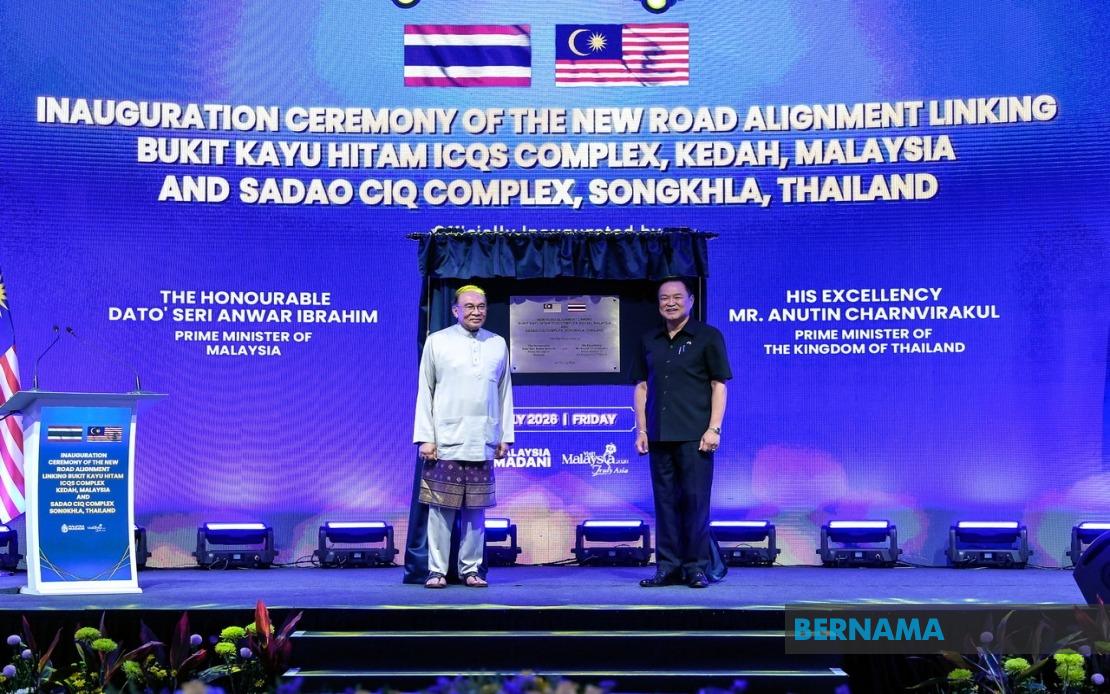
Prime Minister Datuk Seri Anwar Ibrahim and Thailand's Prime Minister Anutin Charnvirakul jointly inaugurated a new road alignment at the Malaysia-Thailand border on July 10, signalling a significant acceleration in regional economic integration. The project connects the Bukit Kayu Hitam Immigration, Customs, Quarantine and Security Complex in Kedah with the Sadao Customs, Immigration and Quarantine Complex in Thailand, representing what both leaders characterised as a watershed moment in bilateral relations. The ceremony, held at the border crossing in Bukit Kayu Hitam, underscored the two nations' commitment to transforming their traditional diplomatic engagement into concrete economic infrastructure that will benefit communities on both sides of the frontier.
The strategic importance of this initiative extends well beyond the physical opening of a new thoroughfare. Anwar framed the development as part of a larger vision to establish a special economic border zone encompassing northern Malaysia—including Perlis, Kedah, Kelantan, Perak and Penang—and southern Thailand. Such a designation would represent a departure from conventional cross-border arrangements, positioning the area as a focused zone for integrated economic activity rather than merely a point of passage for goods and people. The Malaysian Prime Minister acknowledged that building such a framework demands sustained political will and careful coordination, noting that the ambition cannot be realised through hasty decisions but requires deliberate, patient implementation.
The economic rationale behind the project reflects both countries' recognition that their border regions have historically lagged their respective capital regions. Northern Malaysia and southern Thailand together represent populations with significant untapped commercial potential and geographic advantages for trade flows within Southeast Asia. By investing in hard infrastructure—the new road itself—alongside softer institutional reforms, the two governments are attempting to create conditions where businesses naturally gravitate toward border areas to establish operations, processing facilities, or distribution hubs. This approach differs from older models of border management that treated cross-border areas primarily as security checkpoints.
Central to unlocking these opportunities is the commitment both nations have made to expedite resolution of longstanding bureaucratic obstacles. Anwar specifically highlighted customs procedures, immigration protocols, fisheries disputes, and trade-related issues as areas where rapid resolution is now a priority. The symbolism of resolving matters described as taking years or even decades of negotiations is not lost on traders and businesses awaiting streamlined processes. When customs procedures can be accelerated and immigration clearances simplified, even marginally, the cumulative effect on business confidence and transaction volumes can be substantial. The Thai Prime Minister's decision to visit the border area personally, rather than confining discussions to Bangkok, underscored that both leaderships understand these improvements require sustained engagement with ground realities.
The bilateral trade target of USD30 billion by 2027 serves as a concrete metric for evaluating the initiative's success. Malaysia and Thailand currently trade significantly, but this figure represents an ambitious growth trajectory that would require both nations to capture additional regional trade flows and deepen their own commercial interdependence. The new road and associated institutional reforms are positioned as enablers of this target rather than guarantees. Achieving the figure will demand complementary private sector investment, possibly including special incentives for businesses locating in the border zone, and continued political commitment when difficulties inevitably arise. For Malaysian businesses, particularly those in logistics, agriculture, light manufacturing, and cross-border services, the target suggests growing opportunities.
For the five Malaysian states mentioned—Perlis, Kedah, Kelantan, Perak and Penang—the project carries distinct implications. Penang, already Malaysia's second-largest economic centre, may benefit from serving as a hub for value-added activities drawing on inputs and markets from the border zone. Kedah, where Bukit Kayu Hitam is located, stands to gain most directly from improved cross-border connectivity. Kelantan and Perlis, two of Malaysia's less industrialised states, could potentially attract investment seeking to serve the Thailand market or tap Thai supply chains. Perak's manufacturing base might find new opportunities in cross-border collaboration. This geographic distribution suggests the government envisages the special economic zone as dispersing benefits across multiple northern states rather than concentrating development in a single location.
The broader Southeast Asian context should not be overlooked. Malaysia and Thailand are both ASEAN members, and improving their bilateral infrastructure and institutions serves ASEAN's larger objectives of deepening regional integration. A functioning Malaysia-Thailand border zone could serve as a model for other ASEAN border regions seeking to unlock economic potential. Conversely, success here could strengthen the narrative around ASEAN integration, countering perceptions that regional cooperation remains superficial. Vietnam, Indonesia, and other ASEAN members are watching to understand what institutional arrangements and infrastructure investments are required to genuinely enable cross-border economic activity.
Anwar's emphasis on understanding the needs of communities outside major cities carries political significance alongside economic logic. Border communities often feel marginalised by national development strategies that concentrate on metropolitan areas. By framing the initiative partly as a response to the aspirations of people in Bukit Kayu Hitam and surrounding areas, the Malaysian Prime Minister positioned the project as responsive to grassroots concerns rather than merely a top-down infrastructure imposition. This framing may help build local political support for the disruptions and changes that the development process will inevitably entail.
The mechanics of establishing the special economic border zone remain largely undefined in public statements, but Anwar's remarks suggest a phased approach. The new road opens first; administrative reforms follow; and then, presumably, incentive frameworks and regulatory adjustments would follow to make the zone genuinely attractive to investors. This sequencing makes sense logically—infrastructure first, then institutions—but requires sustained follow-through over years. Previous border development initiatives in Southeast Asia have sometimes stalled when political attention shifted. Maintaining momentum will depend partly on whether private sector interest materialises quickly enough to justify continued government investment.
Thailand's stake in the arrangement parallels Malaysia's. Southern Thailand includes provinces like Satun, where Sadao is located, as well as Songkhla, Pattani, Yala and Narathiwat. Some of these provinces have experienced economic challenges and security concerns in recent years. A functioning border zone offers potential employment and investment opportunities that could benefit these areas. From Thailand's perspective, the initiative also represents a opportunity to deepen ties with Malaysia at a time when regional geopolitical competition is intensifying. The fact that Anutin, Thailand's Deputy Prime Minister as well as Prime Minister, attended the launch reflected Bangkok's seriousness about the project.
The ceremonial aspects of the launch—Anwar and his wife welcoming Anutin and his wife, the joint officiating—emphasise personal relationships between the leaders. In Southeast Asian diplomacy, such personal connections often translate into political will to overcome obstacles and maintain momentum on difficult initiatives. Both Anwar and Anutin have invested political capital in the project, making retreat or deprioritisation more costly for either leader. This personal element, while sometimes dismissed as mere symbolism, often proves decisive in determining whether bilateral initiatives advance or stall.
Looking forward, the success of the Malaysia-Thailand border zone initiative will depend on several factors beyond the infrastructure itself. Private sector confidence must translate into actual investment decisions. The regulatory and tax frameworks underpinning the zone must prove genuinely attractive compared to other locations. The two governments must maintain their commitment through inevitable disputes and complications. And communities in the border areas must experience tangible improvements in livelihoods and economic opportunity. The July 10 launch represents a necessary beginning, but the harder work of implementation lies ahead. For Malaysia and Southeast Asia more broadly, however, the project offers a compelling test case for whether regional governments can move beyond traditional approaches to border management and create zones where cross-border economic integration genuinely flourishes.

