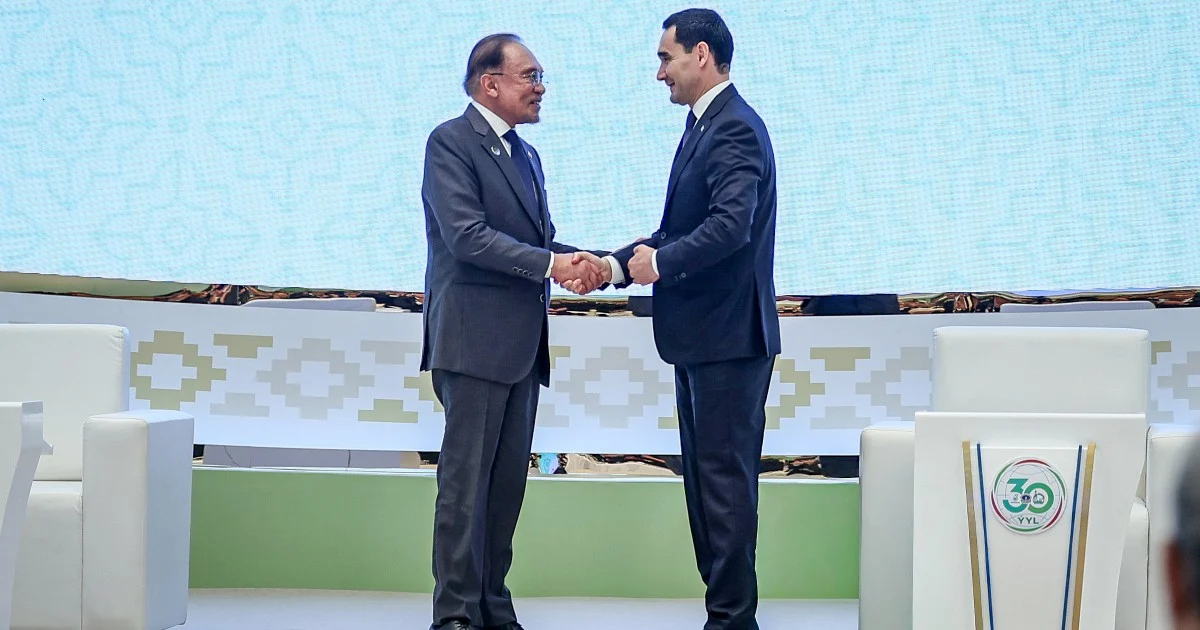
Malaysia and Turkmenistan have committed to broadening their partnership across multiple sectors, with particular emphasis on energy cooperation, the outcome of an official state visit by Prime Minister Datuk Seri Anwar Ibrahim to the Central Asian nation. The two countries have signalled their intent to move beyond symbolic gestures toward concrete collaboration that could reshape their economic relationship and position both nations more favourably within their respective regions.
The agreement to deepen energy sector cooperation represents the cornerstone of the bilateral framework, reflecting Malaysia's strategic interest in diversifying its energy sources and Turkmenistan's position as a significant hydrocarbon producer. This focus on energy aligns with Malaysia's broader energy security objectives and transition goals, as the Southeast Asian nation seeks to balance its petroleum and natural gas dependencies while exploring new partnerships. For Turkmenistan, engagement with Malaysia offers access to Southeast Asian markets and technological expertise in downstream energy applications, creating mutual benefit beyond simple resource extraction arrangements.
Beyond energy, the two countries have identified trade and investment as critical pillars for deepening economic ties. Malaysia's business community has long sought opportunities to expand into Central Asian markets, where competition from European and Chinese enterprises remains fierce. Turkmenistan's geographic position along historical Silk Road corridors presents Malaysian investors with potential gateways to broader Central Asian commerce, while Turkmen investors may find Malaysia's developed financial infrastructure and manufacturing capabilities attractive for their own expansion plans.
Transportation cooperation forms another significant element of the renewed partnership. Improved logistics corridors between Malaysia and Turkmenistan could facilitate goods movement and reduce shipping times for Malaysian exporters targeting Central Asian and onward markets. This extends beyond bilateral trade to position Malaysia as a strategic hub in broader Asian supply chains, reinforcing its role as a connector between Southeast Asia and the wider Eurasian market. The development of transportation links also has geopolitical implications, as it strengthens Malaysia's standing as a reliable partner for landlocked or connectivity-challenged nations.
Educational and technology exchanges outlined in the agreement could yield longer-term benefits by building human capital and facilitating knowledge transfer between the two societies. Malaysian universities and research institutions stand to gain exposure to Central Asian academic traditions and student cohorts, while Turkmen scholars and professionals may access advanced training in fields where Malaysia maintains competitive advantages, such as petroleum engineering, petrochemicals, and digital technologies. These exchanges create people-to-people networks that often prove more durable than government-to-government agreements.
Prime Minister Anwar Ibrahim's personal engagement in this diplomatic initiative signals Malaysia's commitment to elevating its presence in Central Asia, a region traditionally dominated by Russian and Chinese influence. By establishing direct channels at the highest political level, Malaysia demonstrates that engagement with Turkmenistan forms part of a deliberate strategy rather than opportunistic diplomacy. This approach may also serve as a model for Malaysia's broader Central Asian outreach, potentially leading to similar frameworks with Kazakhstan, Uzbekistan, and Kyrgyzstan.
For Turkmenistan, the Malaysian engagement offers diversification benefits as the country navigates a complex geopolitical landscape. While Turkmenistan maintains significant energy partnerships with Russia and China, collaboration with Southeast Asian nations provides economic flexibility and reduces dependency concentration. Malaysia's experience managing multicultural societies and religious sensitivities could also inform Turkmen policymaking in areas of social cohesion and tolerance.
The timing of this agreement holds particular significance given regional geopolitical tensions and the broader push for Asian countries to build independent economic linkages. Both nations share interests in non-aligned foreign policies and economic diversification, positioning them as natural partners in an increasingly multipolar world. The agreement reflects a recognition that traditional power blocs cannot indefinitely monopolise economic relationships in either Central Asia or Southeast Asia.
Implementing these commitments will require institutional frameworks and working groups to translate high-level agreements into tangible outcomes. Success will depend on establishing clear timelines, measurable targets, and dedicated personnel from both governments and private sectors. Malaysia's experience with bilateral investment treaties and energy contracts can serve as a template for structuring these arrangements, while Turkmenistan's regulatory environment must provide sufficient predictability to attract Malaysian investors.
The economic implications for Malaysia extend beyond bilateral flows. Closer ties with Turkmenistan strengthen Malaysia's position as a credible Southeast Asian representative in Central Asian affairs, potentially opening doors for expanded ASEAN engagement in the region. This could yield spillover benefits across multiple sectors and establish Malaysia as an essential node in pan-Asian economic networks that circumvent traditional Western-dominated trade routes.
Looking ahead, the durability of this partnership will depend on sustained political engagement and tangible progress on energy and investment fronts. If successfully executed, the Malaysia-Turkmenistan framework could serve as a template for broader Southeast Asian-Central Asian cooperation, addressing longstanding geographic gaps in regional integration and creating new economic opportunities across the Eurasian landmass.

