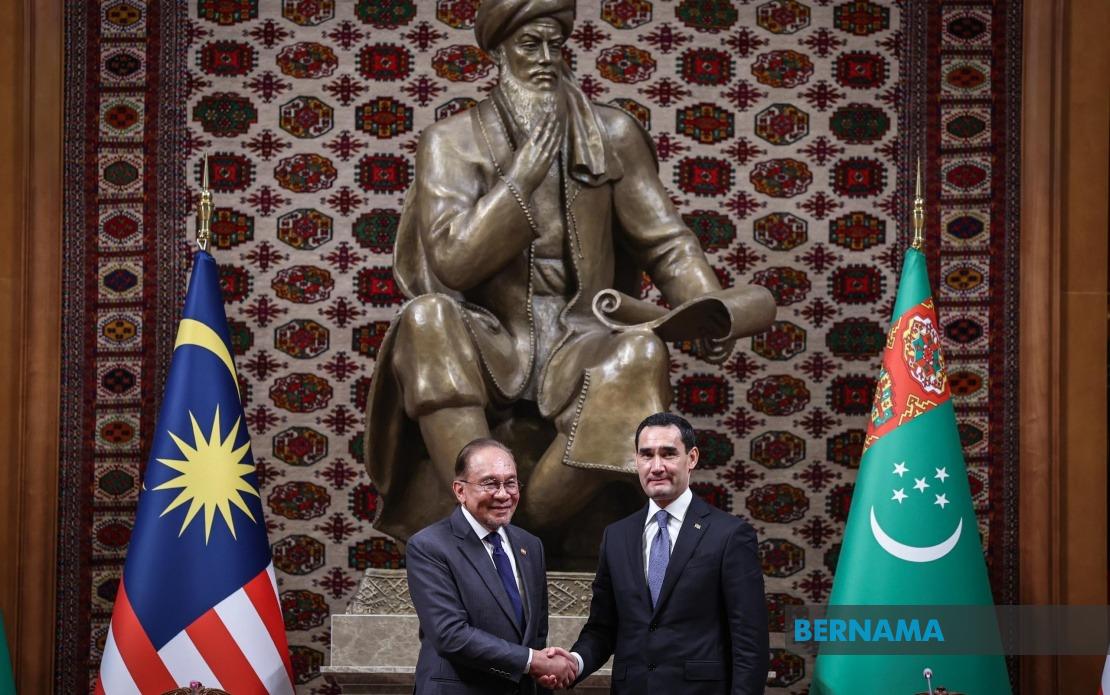
Prime Minister Datuk Seri Anwar Ibrahim has announced a comprehensive upgrading of Malaysia's relationship with Turkmenistan, marking a significant expansion of ties between the two nations. Following bilateral discussions with Turkmenistan President Serdar Berdimuhamedov at the Presidential Palace in Ashgabat on Friday, the two leaders committed to a partnership framework that prioritises mutual strategic interests and tangible benefits for their respective populations. The declaration represents Malaysia's growing engagement with Central Asian nations and reflects Anwar's broader foreign policy emphasis on building structured, long-term alliances beyond traditional Southeast Asian circles.
The agreements sealed during this visit underscore the breadth of potential cooperation between Kuala Lumpur and Ashgabat. The two countries exchanged four key documents, including a landmark Air Services Agreement that promises to enhance direct connectivity between Malaysia and Turkmenistan. Additional memoranda of understanding were signed between Malaysia's Institute of Diplomacy and Foreign Relations and Turkmenistan's Institute of International Relations, between the Ministry of Transport and Turkmenistan's State Service, and notably between the Academy of Sciences Malaysia and the Academy of Sciences of Turkmenistan. This multifaceted approach demonstrates a conscious effort to build relationships across governmental, scientific, and economic institutions rather than relying solely on top-level political engagement.
The scope of bilateral discussions encompassed sectors with substantial relevance to Malaysia's economic diversification agenda. Anwar highlighted energy cooperation as a priority area, recognising Turkmenistan's significant hydrocarbon resources and potential as a supplier or investment partner. Trade and investment frameworks featured prominently, offering Malaysian companies opportunities in Central Asia whilst opening Turkmenistan's market to Malaysian goods and services. The inclusion of the halal industry and Islamic banking reflects Malaysia's comparative advantage in these domains and positions the nation as a knowledge provider and standards setter in an increasingly globalised Islamic economy.
Educational and technological collaboration emerged as another cornerstone of the partnership. By facilitating exchanges between the two countries' academic and research institutions, both nations aim to foster innovation and build human capital. The focus on science and technology cooperation is particularly significant given Malaysia's aspirations to become a regional innovation hub and Turkmenistan's interest in modernising its economy. Tourism development was also discussed, potentially opening new markets for Malaysian tourism operators whilst allowing Turkmen visitors to experience Southeast Asian destinations. This sector-by-sector approach creates multiple pressure points for deepening engagement and provides various constituencies within both governments with incentive to see the partnership succeed.
Anwar's emphasis on implementing agreements through disciplined, transparent and effective mechanisms signals a recognition that formal documents alone guarantee nothing without proper institutional follow-through. The two delegations appear to have acknowledged that previous bilateral frameworks sometimes suffered from inconsistent execution or waning attention. By explicitly committing to structured implementation, the leaders are attempting to establish mechanisms for regular monitoring and accountability. This pragmatic acknowledgment reflects lessons learned from Malaysia's experience with other bilateral partnerships and represents a more mature approach to diplomatic engagement than rhetoric alone would suggest.
The visit constitutes Anwar's first official journey to Turkmenistan since assuming office as Malaysia's 10th Prime Minister in November 2022, making this engagement part of his broader strategy to expand Malaysia's international footprint and diversify the country's economic partnerships. The inclusion of Minister of Investment, Trade and Industry Datuk Seri Johari Abdul Ghani, Minister of Economy Akmal Nasrullah Mohd Nasir, and senior government officials underscores the economic substance underlying this diplomatic initiative. The delegation's composition signals that this is not a ceremonial visit but rather a mission aimed at generating concrete commercial opportunities and institutional linkages.
For Malaysia's strategic positioning, this partnership carries implications extending beyond bilateral relations. Central Asia represents a region of significant geopolitical importance, situated at the intersection of Chinese, Russian, and Western interests. By establishing deeper ties with Turkmenistan, Malaysia enhances its diplomatic relevance in broader regional frameworks and positions itself as a bridge between Southeast Asia and Central Asia. This aligns with Malaysia's historical role as a non-aligned nation seeking to maintain pragmatic relationships across diverse geopolitical blocs whilst advancing its own developmental interests.
The focus on air connectivity warrants particular attention given its role as a facilitator for tourism, business travel, and cultural exchange. Improved flight routes between Malaysia and Turkmenistan could stimulate people-to-people contact, reduce transaction costs for businesses engaging with both markets, and create employment opportunities for Malaysian airlines and aviation services providers. The Air Services Agreement essentially removes bureaucratic barriers that previously constrained movement between the two countries, suggesting both sides view this infrastructure enhancement as sufficiently important to prioritise in their negotiations.
Turkmenistan's invitation to Anwar and the receptiveness demonstrated by President Berdimuhamedov suggest that the Central Asian nation is itself actively seeking to expand its international engagement profile and forge partnerships with nations in other regions. Turkmenistan's geographic position as a major energy exporter and its cultural heritage straddling Islamic and Turkic traditions create natural points of connection with Malaysia. The partnerships Malaysia offers in Islamic finance, halal certification, and Islamic education represent genuine value propositions for Turkmenistan as it seeks to position itself more prominently within Muslim-majority networks whilst modernising its economy.
The joint statement signed by both leaders, though not extensively detailed in the announcement, presumably sets out broader principles guiding the relationship and identifies priority areas for near-term attention. Such statements typically include language regarding respect for sovereignty, non-interference in internal affairs, peaceful resolution of disputes, and commitment to international law. These boilerplate provisions gain significance when examined in context of Malaysia's broader diplomatic approach under Anwar, which has emphasised multilateralism, respect for international norms, and pragmatic engagement with diverse political systems.
The two-day visit structure allowed for informal interaction between delegations beyond formal meetings, potentially facilitating relationship-building among mid-level officials and business representatives who will ultimately implement the agreed frameworks. Such opportunities for unofficial diplomacy often prove as valuable as formal bilateral sessions in establishing the personal relationships and mutual understanding that sustain long-term partnerships. Malaysian officials gained direct exposure to Turkmen counterparts' perspectives, capabilities, and constraints, information that will prove invaluable in calibrating realistic expectations and timelines for the various cooperative initiatives.
Moving forward, the success of this partnership will depend substantially on institutional follow-through and sustained attention from both governments. The agreements signed represent intentions and frameworks rather than automatic outcomes. Regular high-level visits, active work by the designated liaison agencies, and genuine commitment to removing obstacles will determine whether this partnership evolves into meaningful cooperation or remains largely symbolic. For Malaysia specifically, demonstrating capacity to implement and deliver on bilateral commitments will enhance its credibility as a reliable partner in future negotiations with other nations, particularly in Central Asia where Malaysia has historically maintained limited presence.
This initiative reflects Anwar's strategic vision of positioning Malaysia as a bridge nation capable of fostering productive relationships across diverse regions and civilisational zones. By investing diplomatic capital and governmental attention in partnerships beyond Southeast Asia, Malaysia expands its options, reduces its dependence on any single regional framework, and creates new avenues for economic growth and knowledge exchange. The Turkmenistan engagement exemplifies a forward-looking approach to foreign policy that recognises Malaysia's potential to play a meaningful role in broader Asian and global affairs whilst maintaining its core regional commitments and identity.

