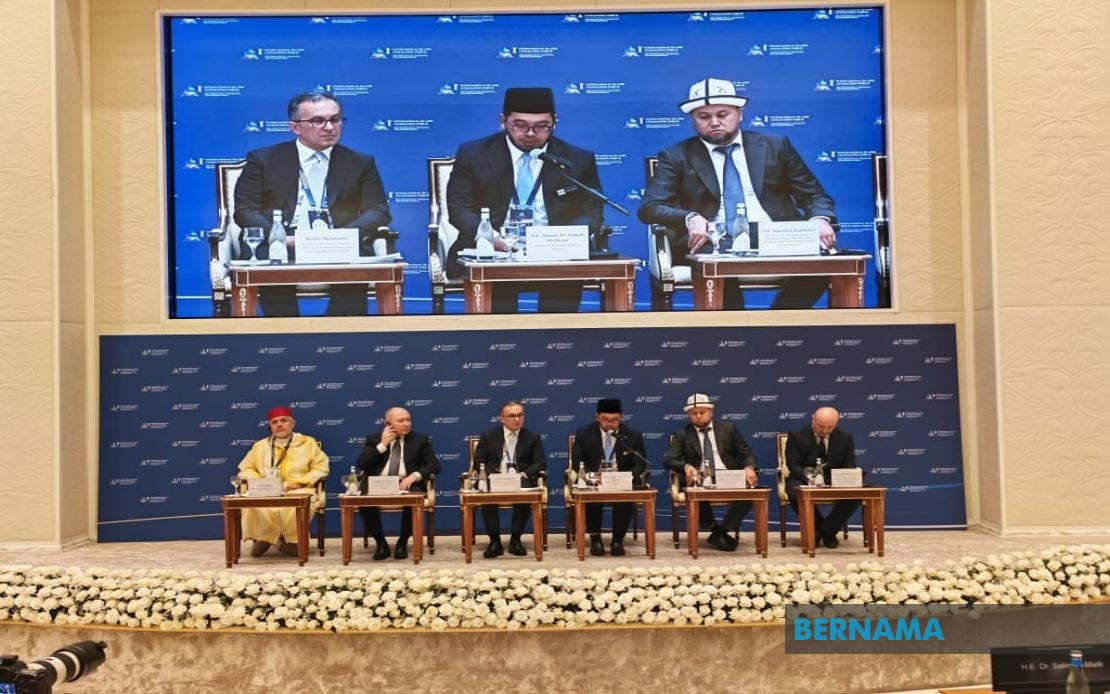
Malaysia has positioned itself as a voice urging the broader Islamic world to transform the humanitarian catastrophe unfolding in Gaza into a watershed moment for civilisational self-examination and renewal. Speaking at the International Islamic Civilisation Forum in Tashkent, Uzbekistan, Datuk Dr Zulkifli Hasan, the Minister in the Prime Minister's Department (Religious Affairs), articulated a vision that extends far beyond immediate humanitarian concerns, instead framing the tragedy as an impetus for the Muslim world to recalibrate its identity and purpose in an increasingly fragmented global order.
Zulkifli's intervention carries particular significance given Malaysia's positioning as a bridge between Southeast Asia and the wider Islamic community. He contended that the extensive civilian suffering in Gaza has created not merely a humanitarian emergency but a profound moral reckoning for international law and justice systems. His remarks suggest that Malaysia perceives the crisis as exposing fundamental inconsistencies in how global institutions apply foundational principles of human rights and dignity, a critique that resonates deeply within developing nations that often feel marginalised in international decision-making processes.
The minister's central thesis challenges the Muslim world to move beyond a reactive posture defined primarily by opposition to external pressures or perceived threats. Rather than allowing Islamic civilisation to be characterised by its responses to geopolitical developments orchestrated by more powerful actors, Zulkifli advocated for a proactive repositioning. This represents a subtle but important shift in diplomatic framing—one that seeks to empower Muslim-majority nations to define their own narrative and trajectory rather than remaining perpetually responsive to international events beyond their control.
Zulkifli emphasised that contemporary global challenges demand more than technological prowess or economic expansion. He argued that societies increasingly yearn for moral authority, principled leadership grounded in enduring values, and ethical frameworks capable of guiding technological advancement. In this formulation, Islamic civilisation possesses inherent resources often overlooked in secular Western discourse—namely, centuries of accumulated wisdom regarding justice systems, ethical governance, and human flourishing. This framing positions the Islamic world not as a civilisation playing catch-up with modernity, but as a repository of knowledge essential for humanity's future.
Central to Zulkifli's vision is the concept of genuine renewal rooted in intellectual innovation, moral commitment, and shared responsibility. He envisioned an Islamic renaissance that would restore ethics to the governance function, ground knowledge acquisition in wisdom rather than mere technical acquisition, and anchor development in purposeful direction aligned with both spiritual principles and human welfare. This multi-dimensional approach to renewal suggests that Malaysia views the Islamic world's contribution to global affairs as encompassing not merely diplomatic or economic dimensions, but fundamentally intellectual and moral ones.
Drawing on historical precedent, Zulkifli invoked the classical Islamic civilisation's renowned openness to knowledge acquisition from diverse sources—Greek, Persian, Indian, and Chinese traditions. He projected this historical openness onto contemporary challenges, proposing that modern Muslim societies assume active roles in shaping ethical frameworks governing emerging technologies including artificial intelligence, biotechnology, and quantum computing. This positioning is particularly relevant for Southeast Asian nations seeking to participate meaningfully in technological governance rather than merely implementing standards established elsewhere. The implication is that Islamic thought systems can contribute distinctive and valuable perspectives to global conversations about how innovation should serve humanity rather than subordinating human interests to technological imperative.
Environmental stewardship emerged as another pillar of Zulkifli's renewal vision. He referenced Islam's conceptualisation of humanity's role as custodian of creation, suggesting that ecological responsibility flows directly from theological principle. This emphasis gains urgency in the Southeast Asian context, where environmental degradation poses acute threats to development trajectories and where Islamic-majority nations possess both moral authority and practical interest in promoting sustainable approaches to economic activity.
The minister explicitly cautioned against framing Islamic civilisational revival as a competitive or zero-sum endeavour pitting Islamic societies against others. Instead, he advocated conceptualising renewal as an opportunity for positive contribution to human flourishing through genuine dialogue, collaborative partnership, and mutual respect across civilisational boundaries. This framing proves particularly important for Malaysia, a multicultural and multireligious nation that cannot afford divisive civilisational narratives. It also reflects recognition that addressing contemporary global challenges—from climate change to pandemics to technological governance—requires inclusive coalitions rather than antagonistic blocs.
Zulkifli highlighted the specific partnership potential between Malaysia and Uzbekistan, grounding his broader vision in concrete bilateral cooperation. He characterised the relationship as bringing together complementary strengths: Uzbekistan's distinguished heritage in Islamic scholarship paired with Malaysia's experience in Islamic governance systems, Islamic finance architecture, and the practical demonstration of peaceful multicultural coexistence. This conjunction of strengths positions both nations as potential models and knowledge-brokers capable of advancing ethical innovation and sustainable development across the wider Muslim world. The notion of serving as a bridge between Central Asian and Southeast Asian Islamic communities suggests ambitions for expanded Malaysian influence in shaping discourse and practice within the broader Islamic sphere.
For Malaysia specifically, the remarks signal continuity in its diplomatic orientation—balancing deepened engagement with Muslim-majority nations while maintaining constructive relationships with partners from all civilisational traditions. This balanced approach reflects Malaysia's own multicultural composition and its strategic interest in avoiding polarisation. However, the strong emphasis on Islamic civilisation's potential contribution to global governance frameworks and emerging technology regulation suggests Malaysia intends to punch above its weight diplomatically, positioning itself and the broader Muslim world as indispensable partners in shaping humanity's technological and ethical future rather than merely responding to agendas established elsewhere. The Gaza tragedy, in this framing, becomes not merely a humanitarian catastrophe but a clarifying moment forcing systemic reassessment of whose voices matter in global decision-making.

