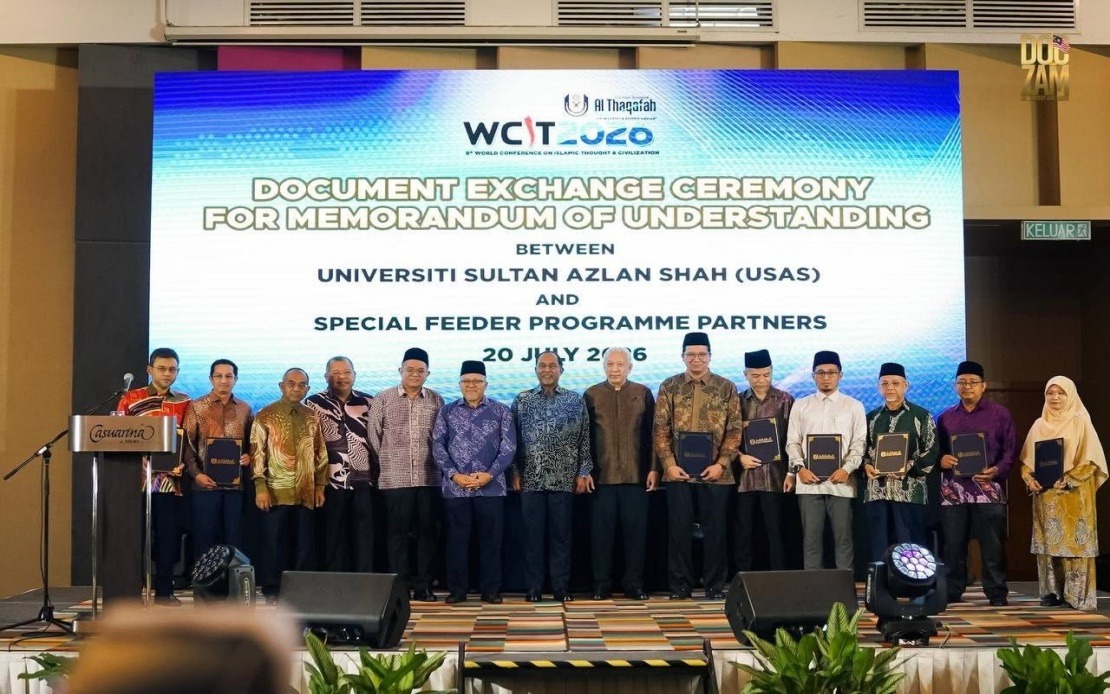
Malaysia is positioning itself as a vital intermediary in global intellectual exchange and a centre of academic excellence, particularly within the Islamic world, according to Higher Education Minister Datuk Seri Dr Zambry Abdul Kadir. Speaking at an event marking the 8th World Conference on Islamic Thought and Civilisation (WCIT2026), Zambry articulated a vision where Malaysia transcends geographical and political boundaries to become a node connecting diverse scholarly perspectives and fostering collaborative networks across continents. This strategic positioning aligns with broader regional aspirations to cement Southeast Asia's standing as a destination for world-class research and thought leadership.
The conference, now underway, brings together over 180 international delegates encompassing academics, researchers, and intellectual leaders from multiple nations united by a shared commitment to strengthening discourse within Islamic scholarship and addressing contemporary global challenges through the lens of Islamic principles and heritage. The gathering at Universiti Sultan Azlan Shah (USAS) in Ipoh signals Malaysia's intention to host platforms where knowledge transcends institutional silos and national boundaries, creating spaces where intellectual capital can flow freely and generate actionable solutions benefiting both the Islamic community and humanity broadly.
Zambry's remarks underscore a fundamental conviction that the contemporary Islamic world requires far more than historical reflection or institutional nostalgia. Instead, he advocates for a future anchored in empirical knowledge, rigorous research methodologies, technological innovation, ethically grounded leadership, and higher education institutions capable of competing at global standards. This perspective reflects a pragmatic acknowledgement that cultural pride and intellectual advancement are not mutually exclusive—rather, they are interdependent when pursued through systematic academic rigour and evidence-based inquiry.
Central to the minister's message is an assertion that education and scholarship must remain insulated from the distorting influences of partisan politics, armed conflict, and technological determinism. Knowledge, he contends, constitutes humanity's collective inheritance, transcending claims of ownership by any single nation, religious tradition, or civilisation. This framing is particularly significant for Malaysian audiences, given the nation's multicultural composition and its historical experience navigating competing ideological narratives.
Zambry drew pointed historical parallels to underscore the stakes involved in protecting institutions of learning and cultural memory. He referenced the destruction of Baghdad during the Mongol invasions, the fall of Granada marking the end of Al-Andalus, the siege of Sarajevo during the Balkans conflict, and the ongoing Israeli-Palestinian dispute. In each instance, the loss extended beyond physical infrastructure; entire intellectual traditions, archives, and futures were erased. The invocation of these historical traumas serves as a cautionary framework, suggesting that contemporary threats to universities and libraries represent existential dangers to civilisational continuity and progress.
The timing of WCIT2026 carries particular resonance within regional and global contexts. Southeast Asia has emerged as an increasingly important player in international affairs, and Malaysia's willingness to host major intellectual forums positions the country as more than a geographic location—it becomes a symbolic space where competing worldviews encounter one another in structured, productive dialogue. For Malaysian stakeholders in education, policy, and international relations, this signals an investment in soft power grounded in academic credibility and intellectual influence rather than coercive or merely commercial mechanisms.
Higher education institutions across Malaysia stand to benefit from amplified international visibility and enhanced networking opportunities with leading scholars and research centres globally. The conference model, bringing together specialists across theology, philosophy, science, governance, and social studies, creates potential pathways for collaborative research projects, student and faculty exchanges, and shared initiatives addressing pressing contemporary issues from sustainable development to artificial intelligence governance through Islamic ethical frameworks.
The minister's emphasis on values-driven, integrity-centred leadership reflects broader concerns about the quality and ethical foundations of knowledge production in increasingly polarised times. Educational institutions worldwide face mounting pressure to serve narrow ideological agendas, commercial interests, or state propaganda. Malaysia's stated commitment to education transcending such instrumentalisation positions the nation as offering an alternative model—one where scholarship pursues truth and social benefit as primary objectives.
Looking forward, the resolution and proposals emerging from the three-day WCIT2026 will likely address contemporary policy challenges relevant to Southeast Asian governments and institutions: how to integrate traditional Islamic principles with modern scientific inquiry, how to foster inclusive societies without compromising distinct identities, how to advance technological adoption while preserving human dignity, and how to build educational systems that produce graduates capable of thriving in complex, rapidly changing environments. The outcomes will offer valuable reference points for Malaysian policymakers and university administrators navigating comparable tensions.
For the broader region, Malaysia's active role in convening such forums positions Southeast Asia as intellectually generative territory rather than merely consuming external ideas and frameworks. As other nations in the region—from Indonesia to Singapore to Thailand—grapple with similar questions about education's purposes and higher learning's societal role, Malaysian initiatives create templates and generate evidence about what collaborative, values-conscious scholarship can achieve. The commitment articulated by the Higher Education Minister thus extends beyond rhetorical flourish; it represents a substantive investment in knowledge infrastructure and intellectual diplomacy with implications reshaping the region's academic landscape for years ahead.

