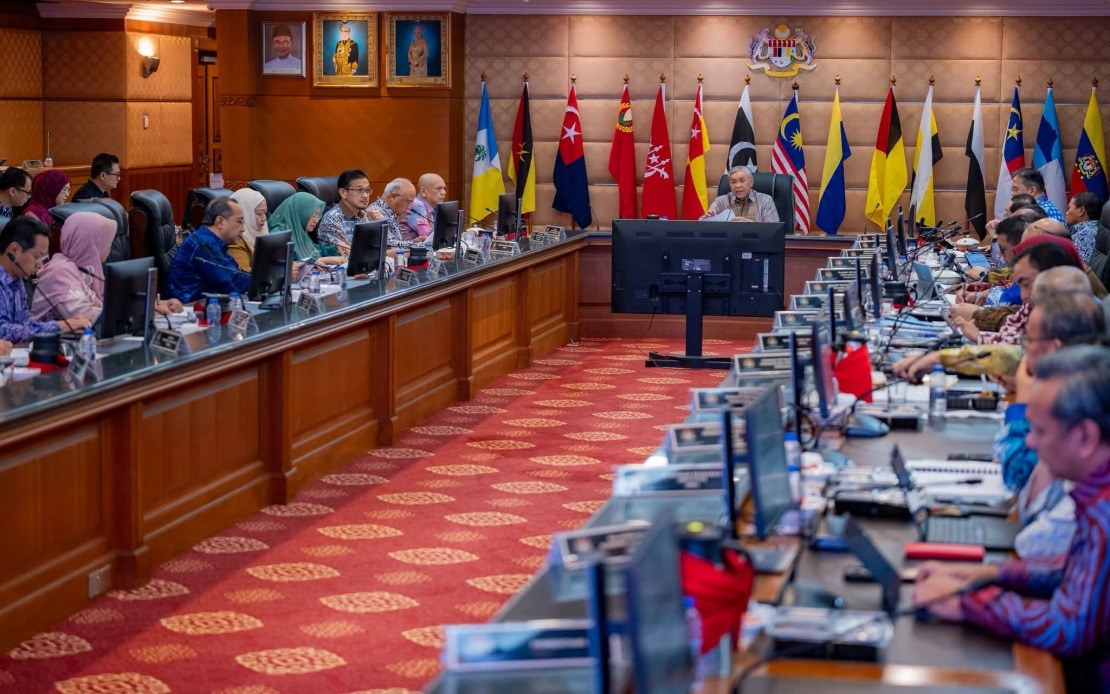
The National Cost of Living Action Council convened in Putrajaya on Tuesday for its 18th executive session, with Deputy Prime Minister Datuk Seri Dr Ahmad Zahid Hamidi steering discussions on a delicate balancing act that will define the government's approach to managing food affordability in the coming months. At the heart of deliberations lies the contentious question of how Malaysia can reform its domestic rice sector without leaving low-income families exposed to sudden price shocks, a particular concern given the staple's fundamental role in household budgets across the nation.
The council's central proposal represents a middle path between competing pressures: maintaining the viability of local rice farmers and millers while ensuring that consumers—especially those already stretched financially—do not absorb the full impact of any policy recalibration. Rather than imposing abrupt changes, the framework envisions a transitional period underpinned by subsidised rice supplies, effectively creating a cushion that allows markets and purchasing patterns to adjust gradually. This approach acknowledges a hard truth facing Malaysian policymakers: the country's rice sector has long operated under structural constraints, with domestic production costs regularly exceeding regional benchmarks, a gap traditionally bridged by government support.
Ahmad Zahid articulated a notably expansive interpretation of what addressing cost-of-living pressures entails, moving beyond the conventional focus on retail prices to encompass the entire ecosystem affecting household welfare. Production costs, distribution networks, nutritional access, and the interconnected challenges of healthcare and education financing all featured in the council's analysis. This systemic framing reflects growing recognition within government circles that price stability alone cannot solve deeper affordability challenges, particularly when families struggle simultaneously with multiple essential expenses. The rice roadmap thus becomes one component of a larger strategic vision rather than an isolated intervention.
Among the most significant decisions reached was agreement to recommend expanding the Sumbangan Asas Rahmah scheme, the government's targeted assistance programme, to encompass fresh produce beyond its current scope. The inclusion of fruits, vegetables, and fresh protein represents a deliberate pivot toward nutritional outcomes rather than mere caloric sufficiency. For Malaysian policymakers and health advocates, this signals tacit acknowledgement that cost-of-living pressures have driven many lower-income families toward less nutritious, cheaper alternatives, with potential long-term implications for public health and productivity. The recommendation now advances to the main NACCOL forum chaired by Prime Minister Datuk Seri Anwar Ibrahim for final consideration, suggesting the proposal carries sufficient backing to progress further through the approval process.
The council's deliberations occurred against a backdrop of mounting external pressures on Malaysia's agricultural and logistics sectors. Geopolitical tensions, particularly the unfolding situation in West Asia, have injected fresh uncertainty into global supply chains that Malaysian importers and producers depend upon. Additionally, escalating regulatory compliance costs for food imports and the ripple effects of subsidy rationalisation programmes have squeezed margins throughout the supply chain. Senior officials have acknowledged these headwinds constitute genuine inflationary risks that could eventually transmit to consumer prices if left unmonitored. Continuous surveillance of these factors has thus become embedded in the council's operational mandate, with relevant agencies tasked to track emerging threats and recommend mitigation strategies.
Support mechanisms for primary producers received specific attention during the meeting. Farmers and fishermen, whose livelihoods depend directly on input costs and market access, face particular vulnerability to external shocks. The council agreed to refine existing targeted assistance frameworks benefiting these groups, though the statement provided limited specifics regarding the nature or magnitude of enhancements. For the agricultural sector, this signals government commitment to preventing producer distress from translating into supply disruptions or further retail price acceleration, a calculus that remains central to food security management across Southeast Asia.
On the healthcare front, the council reviewed progress on the RESET strategy, a multi-pronged initiative designed to restrain private sector medical cost inflation while simultaneously broadening public system capacity and treatment options. With 11 separate initiatives under this umbrella, the programme attempts to address a recognised gap in Malaysia's healthcare landscape: public facilities frequently operate at capacity while private providers remain inaccessible to middle and lower-income households. The strategy recognises that healthcare costs constitute a growing component of household expenditure and that uncontrolled inflation in this sector undermines broader cost-of-living relief efforts regardless of progress in other domains.
Education support emerged as another pillar receiving reinforcement. Ahmad Zahid highlighted that 13 distinct tertiary education assistance schemes distributed RM589.6 million to 62,937 Form Six and university students during the preceding year, representing substantial government investment in human capital development. However, the deputy prime minister's emphasis on the need to reinforce such support suggests these existing mechanisms may be insufficient relative to underlying demand or erosion of purchasing power among eligible populations. The framing positions education accessibility not merely as welfare but as essential infrastructure for talent development and economic competitiveness, an argument that resonates with Malaysia's aspirations toward higher-value economic participation.
The Cost of Living Action Plan 2030, the overarching framework within which these initiatives operate, represents a deliberate shift toward integrated, cross-sectoral policymaking rather than ad-hoc interventions. By coordinating action across rice markets, food welfare, healthcare, agriculture, logistics, and education, the government aims to achieve multiplicative rather than additive impact. This approach carries implications for how Malaysian agencies structure interdepartmental collaboration and allocate analytical resources toward monitoring complex interactions among policy domains. For observers of Malaysian governance, the move toward systematic planning signals institutional learning from earlier experiences where disparate initiatives occasionally worked at cross-purposes.
The rice policy discussion itself encapsulates broader tensions within emerging economies attempting to balance multiple constituencies with conflicting interests. Local farmers require protection and viable incomes to remain in production, yet consumers—particularly low-income households—need affordable staples. International market access and competitiveness pull in opposite directions from domestic social protection imperatives. Malaysia's chosen path of graduated transition with safety-net provisions represents a pragmatic if inherently costly compromise, one that postpones definitive choices while building political consensus. Whether this approach ultimately succeeds depends heavily on implementation fidelity and external economic conditions beyond government control, particularly global rice price movements and regional geopolitical stability.

