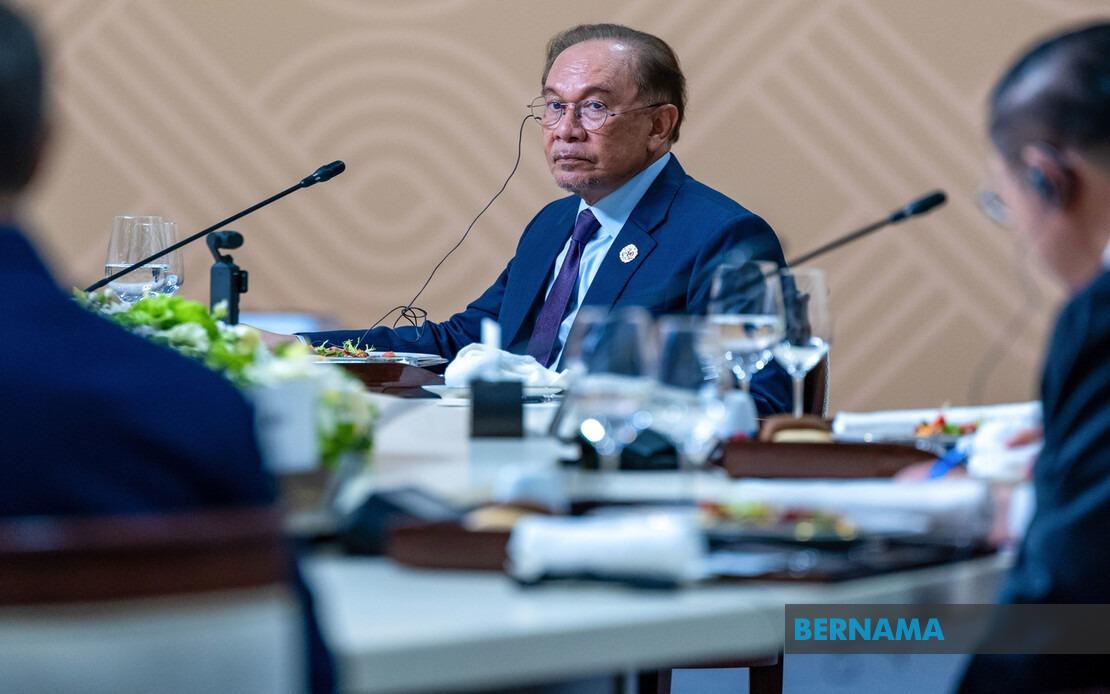
Prime Minister Datuk Seri Anwar Ibrahim's whirlwind four-day journey spanning Tashkent, Kazan, and Ashgabat represents far more than a routine diplomatic schedule. The visits underscore Malaysia's calculated repositioning within an international economic landscape undergoing fundamental transformation, where traditional power structures are fracturing and new corridors of opportunity are emerging. Each stopover, though geographically distant, reflects a coherent strategy to expand Malaysia's external economic footprint precisely when global conditions demand greater strategic flexibility and diversified revenue streams.
The timing of this regional tour cannot be separated from the broader upheaval reshaping global commerce and geopolitics. Since the conclusion of the Cold War, few periods have witnessed such rapid reconfiguration of international economic rules. Trade wars, targeted sanctions regimes, and weaponised export controls have displaced the consensual frameworks that once governed cross-border commerce. Major powers increasingly deploy economic tools as instruments of statecraft, fundamentally altering the calculus for countries dependent on open markets and unfettered supply chains. Malaysia's vulnerability to these shifts—as a trading nation reliant on connectivity and market access—necessitates a fundamentally different approach to economic security than previous generations required.
For a country of Malaysia's size and position, navigating this environment demands more than reactive policies. It requires active construction of multiple, reinforcing economic partnerships that collectively provide buffers against the inevitable disruptions of a multipolar world. The strategic challenge is not choosing between one alignment and another, but rather cultivating sufficient depth and breadth across diverse relationships to ensure that no single disruption can cripple national prosperity. This principle animated the Prime Minister's engagements throughout Central Asia and the Caucasus, where Malaysia has historically maintained limited but growing commercial connections.
The Tashkent stopover exemplified how modern economic diplomacy operates beyond formal agendas. What began as a scheduled courtesy call with President Shavkat Mirziyoyev evolved into substantive discussions on cooperation frameworks initiated during Malaysia's previous 2024 official visit. These conversations encompassed multiple economic sectors and established concrete deliverables for completion, illustrating how diplomatic momentum, once generated, can be systematically converted into institutional arrangements that serve mutual interests. The evolution from protocol visit to working engagement reflected both leaders' recognition that bilateral potential exceeded initial expectations.
Malaysia's participation in the ASEAN-Russia Commemorative Summit in Kazan demonstrated a different diplomatic calculation entirely. The gathering provided a platform for engaging not merely with the Russian state apparatus but with political and business leaders throughout the broader Eurasian economic region. The bilateral discussions between Malaysia and the Republic of Tatarstan proved particularly instructive, revealing how contemporary economic networks increasingly bypass capitals to engage directly with regional innovation hubs, industrial clusters, and technological centres. Tatarstan's emergence as one of Russia's most dynamic sectors—encompassing biotechnology, advanced manufacturing, and digital innovation—presents partnership opportunities that transcend traditional state-to-state frameworks. Conversations spanning halal industries, Islamic finance, maritime capabilities, and industrial cooperation illustrated how Malaysia can leverage its distinctive institutional and religious positioning to unlock commercial opportunities that competitors cannot access.
The broader ASEAN-Russia Strategic Programme on Trade and Investment Cooperation 2026-2035, unveiled during this summit, carries particular significance for Malaysia's medium-term economic strategy. The document signals mutual recognition that future competitiveness depends increasingly on technological capability, innovation capacity, and economic adaptability rather than on natural endowments or labour cost advantages alone. For Malaysia, this framework potentially opens sectors—from digital technologies and advanced manufacturing to agricultural innovation and food security systems—where the nation possesses distinctive capabilities or emerging strengths.
Yet the Ashgabat visit represented perhaps the most strategically consequential leg of the journey, given Malaysia's deep historical engagement with Turkmenistan's energy sector. Petronas's three-decade operational presence in the country transcends typical foreign investment patterns. The corporation has evolved into a significant contributor to Turkmenistan's industrial infrastructure, technological advancement, and human capital development, with cumulative investments approaching USD12 billion. This is not a recent commercial arrangement driven by short-term profit motives but rather a patient, long-term partnership built upon institutional trust and mutual understanding of each party's strategic needs and constraints.
The landmark agreements concluded during the visit—effectively providing Petronas with substantial stakes in some of the world's largest natural gas fields—represent a qualitative escalation in bilateral commitment. The expanded production-sharing arrangements and new exploration activities signal both parties' confidence that collaboration will deepen across the next operational cycle. From Malaysia's perspective, securing long-term hydrocarbon supplies and diversifying energy partnerships carries obvious economic importance, but the geopolitical dimension deserves equal attention. Recent global crises have starkly demonstrated how regional disruptions reverberate through energy markets, shipping networks, and production costs across vast distances. Partnership diversification functions as insurance against such cascading vulnerabilities, ensuring that Malaysia's energy security does not depend excessively on any single geographic source or political arrangement.
The overarching theme connecting all three destinations, repeatedly emphasised by Prime Minister Anwar in bilateral discussions, transcends conventional trade and investment metrics. Contemporary economic diplomacy operates simultaneously across multiple interconnected domains: food security intersects with technological capability; energy cooperation intertwines with industrial development and infrastructure investment; digitalisation creates innovation opportunities while raising governance and dependency concerns. This multidimensional character explains why discussions in Tashkent, Kazan, and Ashgabat extended beyond purely commercial matters to encompass education and research collaboration, development of halal ecosystems, and expansion of financial services capabilities.
Malaysia's particular positioning—as a Muslim-majority nation with Islamic financial expertise, a sophisticated halal certification system, and technological capabilities in specific sectors—creates distinctive diplomatic advantages unavailable to many competitors. These advantages prove particularly valuable in Central Asian and Caucasian contexts, where Islamic heritage runs deep and interest in Islamic finance and halal standards continues expanding. Weaponising these comparative strengths, as Malaysia is doing, converts religious and cultural identity into concrete commercial opportunity rather than allowing such dimensions to remain peripheral to economic strategy.
The diversification principle underlying these engagements deserves emphasis precisely because it is often misunderstood. Expanding partnerships with new actors in distant regions does not diminish the importance of Malaysia's longstanding relationships with major trading partners, regional allies, or established investment sources. Rather, such diversification reflects rational insurance-seeking behaviour by a middle power navigating increasingly uncertain conditions. Countries that successfully position themselves within multiple, reinforcing economic networks enjoy substantially greater flexibility and resilience than those whose prosperity depends on narrowly concentrated partnerships. For Malaysia, this imperative becomes more acute as technological competition intensifies, supply chains face politicisation, and geopolitical competition increasingly intersects with economic policy.
ASEAN's demonstrated commitment to preserving strategic autonomy—engaging diverse external partners while refusing exclusive bloc alignment—aligns precisely with Malaysia's individual national interests. The principle of ASEAN centrality, though sometimes rhetorically overstated, reflects a genuine insight: maintaining open channels of engagement across competing centres of influence allows smaller nations to calibrate their positioning dynamically as international circumstances evolve. Malaysia's tour through Central Asia should be understood as operationalising this broader regional commitment at the bilateral level, systematically constructing relationships that prevent excessive dependence on any single partner or alliance structure.
As global economic architecture continues fragmenting into more explicitly competing systems and standards, Malaysia's approach of patient relationship-building across diverse regions emerges as a forward-looking strategy. The visits to Tashkent, Kazan, and Ashgabat represent not exotic diversions from serious economic policy but rather the essential work of securing national prosperity in a world where the old certainties have dissolved. Prime Minister Anwar's leadership in this effort signals that Malaysia understands the fundamental nature of contemporary economic competition: victory flows not to those who choose single partners or ideology, but to those who skilfully balance multiple relationships and continuously adapt as circumstances shift.

