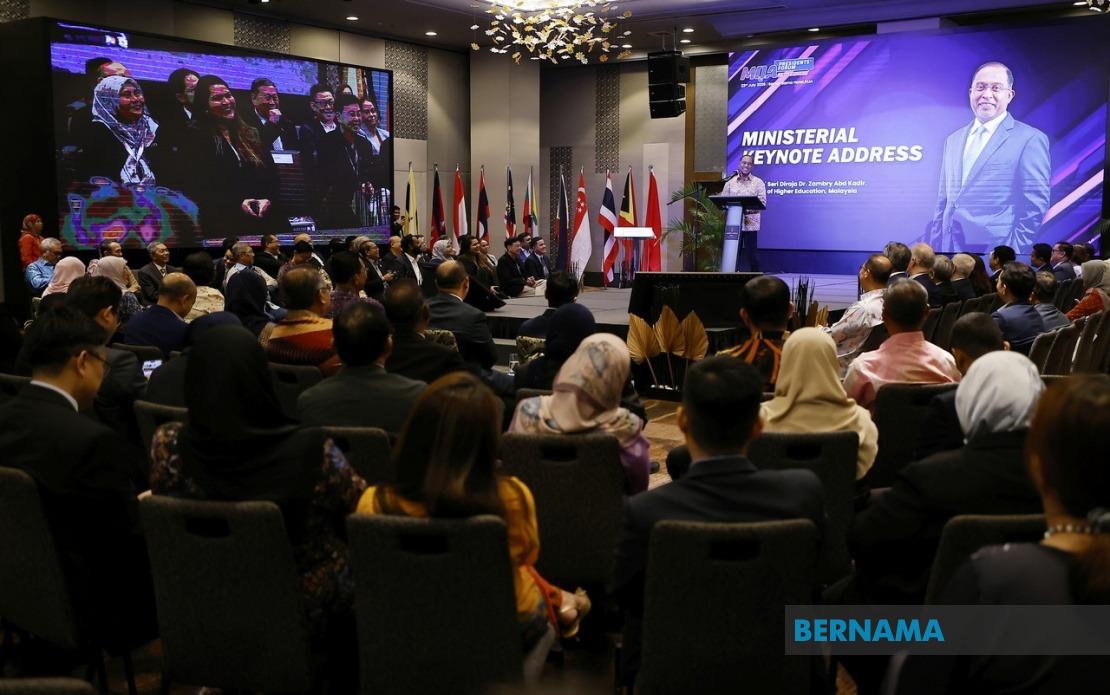
The government remains committed to preserving academic freedom within Malaysia's higher education institutions, according to Higher Education Minister Datuk Seri Dr Zambry Abd Kadir, who delivered the affirmation during remarks at a public lecture in Putrajaya on July 23. Speaking at an event featuring Columbia University professor Joseph A. Massad discussing Muslim identity in a globalised world, Zambry underscored the ministry's view that universities should function as forums where varied perspectives can be examined through open, respectful and responsible debate.
The minister's statement reflects broader efforts by the Malaysian government to position the nation's tertiary education sector as a site for genuine intellectual engagement. Zambry articulated a vision where knowledge advancement emerges not from consensus but from sustained dialogue that crosses institutional boundaries, academic disciplines and cultural backgrounds. This framing proves particularly significant in a regional context where university autonomy and scholarly independence remain contested issues, with competing pressures from political actors, commercial interests and social movements frequently testing institutional resilience.
Zambry explicitly linked academic freedom to what he termed intellectual responsibility, suggesting that liberty of expression within universities carries corresponding obligations for rigour, evidence-based reasoning and ethical conduct. The formulation attempts to navigate a delicate balance: defending unfettered inquiry while acknowledging that discourse conducted without standards or grounding in factual reality may undermine rather than advance knowledge. This framework addresses legitimate concerns about the proliferation of misinformation and pseudoscience in digital environments, where Malaysian universities increasingly operate.
The minister's remarks gain particular salience given Malaysia's demographic composition and historical experience with religious and ethnic sensitivities. Zambry emphasised that the country's plural and multicultural character makes intellectual dialogue across worldviews not merely desirable but essential. He argued that informed engagement with differing perspectives strengthens mutual understanding and social cohesion, positioning academic freedom as a tool for navigating rather than exacerbating social divisions.
The invitation extended to Professor Massad, a prominent scholar and controversial figure whose work on sexuality and Islam generates substantial debate, exemplifies the practical implementation of this commitment. The lecture series brings internationally recognised academics to Malaysian campuses, exposing students and faculty to cutting-edge scholarly conversations on matters of global consequence. Such initiatives potentially elevate the intellectual standing of Malaysian institutions within international academic networks while providing local researchers and students exposure to diverse methodological approaches and theoretical frameworks.
Zambry's acknowledgment that differing opinions remain inevitable, particularly in contemporary contexts shaped by artificial intelligence and social media proliferation, demonstrates awareness of current challenges to scholarly discourse. He identified these technological and informational transformations as forces complicating rather than simplifying intellectual life. The reference to social media's role signals recognition that universities no longer operate as insulated intellectual spaces but exist within dynamic public spheres where ideas circulate rapidly and often become weaponised for political purposes.
The minister noted that Malaysian society has traditionally embraced a principle of principled disagreement, characterising the national disposition as one capable of maintaining substantive differences while preserving underlying consensus on fundamental shared interests. His formulation—"We agree to disagree. We disagree on many things, but we also agree on many things"—encapsulates a political philosophy rooted in pragmatic coexistence rather than forced conformity. This rhetorical strategy positions academic freedom not as a radical or destabilising concept but as consonant with existing Malaysian values and institutional practices.
Looking forward, the Higher Education Ministry signalled its intention to continue hosting distinguished visiting scholars and facilitating international academic exchange. This commitment addresses a persistent concern within Malaysian tertiary education: the potential for institutional isolation and intellectual stagnation if universities fail to maintain robust connections with global scholarly communities. By deliberately recruiting and hosting prominent international academics, the ministry seeks to counteract brain drain, elevate local research standards and ensure Malaysian universities remain competitive destinations for talented students and researchers across the region.
The policy implications extend beyond ceremonial statements. Supporting academic freedom requires institutional changes including transparent governance structures, faculty recruitment and promotion systems based on scholarly merit rather than political affiliation, and adequate funding insulated from short-term political pressures. Malaysian universities have faced ongoing challenges in these areas, with reports documenting political interference in campus hiring, restrictions on student activism and concerns about self-censorship among faculty members wary of disciplinary consequences. Zambry's public commitment therefore functions partly as accountability mechanism, signalling expectations for institutional conduct that subordinate officials and university leaders must navigate.
For Southeast Asian observers, Malaysia's positioning of academic freedom deserves careful attention. The region encompasses diverse approaches to university governance and intellectual inquiry, ranging from relatively permissive environments to highly controlled systems. Malaysia's middle-ground approach—defending scholarly autonomy while emphasising responsibility—reflects particular regional pressures and historical trajectories. The outcome will substantially influence whether Malaysian universities attract or lose talented researchers, whether local scholarship achieves regional and global influence, and ultimately whether the higher education system serves as engine for innovation and human development or becomes increasingly marginalised from cutting-edge knowledge production occurring elsewhere in the world.

