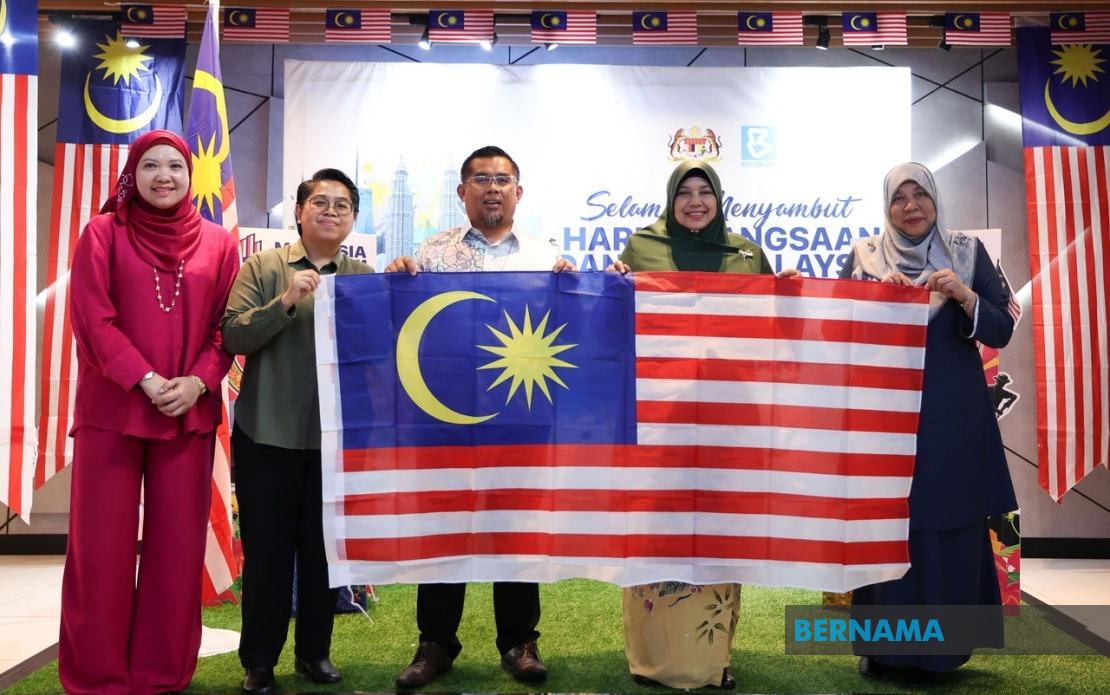
The 2026 National Day and Malaysia Day (HKHM) celebrations will take on a renewed character, with the Communications Ministry orchestrating a comprehensive slate of 16 side programmes explicitly designed to cultivate patriotic sentiment and reinforce social cohesion across the country. Harun Ali, secretary of the Communications Ministry's Management Services Division, outlined these initiatives during an interview on Bernama Radio's Fokus 30 programme, emphasizing that the government views these celebrations as a vehicle for deepening national consciousness among all demographic strata of Malaysian society.
The breadth of offerings signals a deliberate shift away from purely ceremonial observances toward participatory experiences that invite community engagement. The slate encompasses Kembara Merdeka Jalur Gemilang, a touring initiative; the National Month Decoration Competition, which invites residential and commercial participation; Ekspresi Merdeka, designed for creative expression; the Kita MADANI Carnival, alongside numerous localized cultural and community-oriented activities. This diversified approach reflects recognition that national identity consolidation operates most effectively when citizens of varying ages, professions, and backgrounds can find entry points aligned with their interests and capabilities.
A particularly significant departure from established precedent involves relocating the primary Merdeka Eve Celebration from the administrative center of Putrajaya to Stadium Merdeka, a venue freighted with historical resonance. This symbolic repositioning anchors the nation's observance to a site intrinsically linked to Malaysia's independence narrative, a choice laden with pedagogical intent. The relocation underscores an apparent strategic decision to ground contemporary celebrations in historical continuity rather than administrative convenience.
Prime Minister Datuk Seri Anwar Ibrahim will deliver a special Merdeka Address at Stadium Merdeka as the clock approaches midnight, positioning this moment as an opportunity to articulate governmental vision while catalyzing emotional connection to the nation's founding struggle. Harun emphasized that such addresses serve instrumental purposes beyond ceremonial ornamentation—they function as mechanisms for synchronizing national resolve and reminding citizens of the sacrifices underpinning their contemporary freedoms.
Among innovations introduced specifically for 2026, "Melukis Senja" stands out as a technologically sophisticated attraction. This aerial spectacle, executed by Aero 3, combines acrobatic manoeuvres with pyrotechnic effects and smoke-trail artistry across Putrajaya's skyline. The integration of aviation-based visual performance represents an escalation in experiential sophistication, offering citizens tangible evidence of coordinated national endeavor and technological capability—elements that psychological research suggests reinforce collective identity and pride.
For Malaysian readers accustomed to observing National Day from their homes or workplaces, this expanded programming architecture creates multiple pathways for participation. The National Month Decoration Competition, for instance, democratizes contribution by enabling households and businesses to serve as sites of patriotic expression. Kembara Merdeka Jalur Gemilang, through its touring format, brings official celebrations into peripheral regions that might otherwise experience national observance as a distant phenomenon centered in the capital. This geographic distribution of programming acknowledges Malaysia's sprawling territorial extent and the necessity of ensuring inclusivity across urban and rural communities.
Harun's framing emphasized that these initiatives collectively embody governmental commitment to rendering HKHM celebrations genuinely accessible and resonant across social segments rather than confining such observances to state machinery and formal structures. His rhetorical emphasis on the non-trivial "price" of independence carries particular weight in contemporary contexts where younger Malaysians increasingly distance themselves from historical narratives of struggle. By reiterating that independence represents achievement rather than birthright, officials attempt to cultivate appreciation for political stability and sovereignty that might otherwise be taken as inevitable.
The explicit appeal for Malaysians to display the Jalur Gemilang constitutes more than aesthetic exhortation; it represents an attempt to normalize visible patriotic expression within everyday life. In Malaysian society, where public displays of national symbols have occasionally become politicized, such appeals carry subtle implications about whose nationalism is deemed legitimate or representative. The framing as a demonstration of "love for the country" and "pride and gratitude for being part of the Malaysian community" seeks to position flag-flying as an inclusive gesture transcending sectarian or political divisions.
From a Southeast Asian perspective, Malaysia's approach to national celebrations mirrors broader regional trends toward experiential, participatory models of national identity construction. Countries throughout the region increasingly recognize that sustainable social cohesion demands active engagement rather than passive observation. Malaysia's 2026 programming thus reflects broader currents in how nations across Asia are rethinking civic nationalism for contemporary audiences skeptical of purely top-down patriotic messaging.
The ceremonial handover of Jalur Gemilang flags to Bernama staff—the national news agency—carries symbolic weight regarding information architecture and patriotic narrative dissemination. By positioning media institutions as participants rather than mere chroniclers, authorities signal integrated approaches to ensuring celebrations receive appropriate amplification and framing. For Malaysian media audiences, this coordination underscores how official celebrations operate within broader ecosystems of institutional coordination.
For those seeking logistical details regarding HKHM 2026 programming, authorities have established an official website serving as an information hub. This digital infrastructure reflects contemporary administrative expectations that citizens will access celebration schedules through online platforms rather than traditional paper-based announcements, a shift with implications for information equity and accessibility across different demographic groups.
The 2026 HKHM preparations ultimately represent more than procedural event management. They constitute a comprehensive statement about how Malaysia's government conceptualizes the relationship between ceremonial occasions and national cohesion, emphasizing that such moments must be carefully choreographed to activate multiple constituencies and create memorable experiences capable of reinforcing patriotic sentiment across generational and geographic divides.

