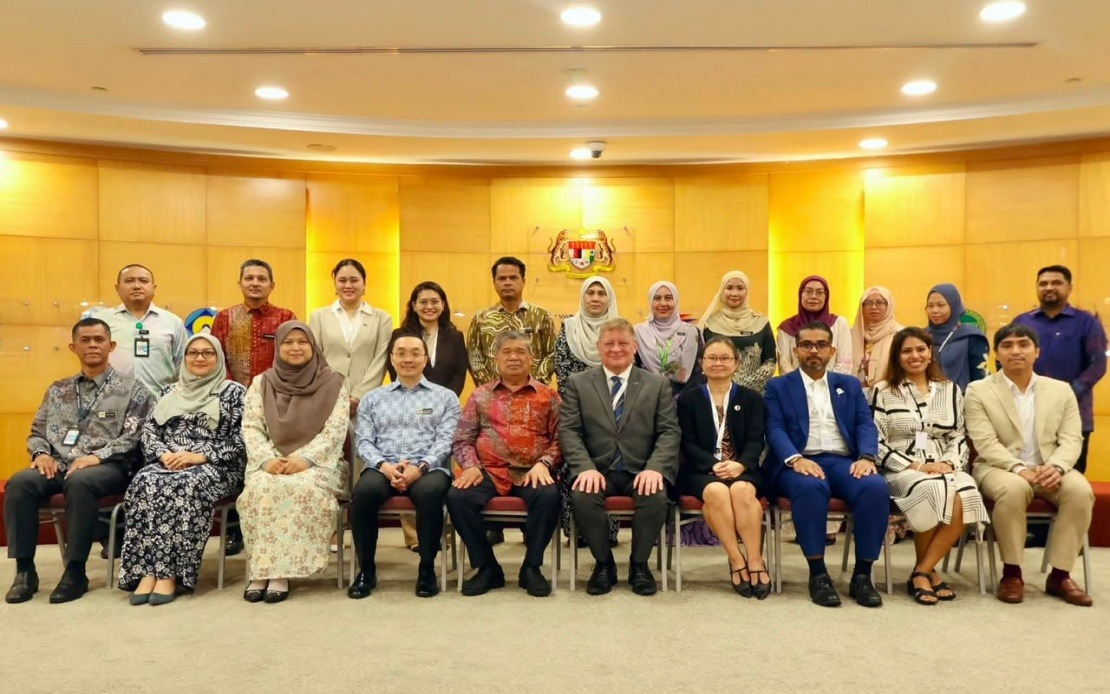
Malaysia is positioning itself to leverage European expertise and investment in transforming its agricultural landscape, as evidenced by a high-level meeting between Minister of Agriculture and Food Security Datuk Seri Mohamad Sabu and EU-ASEAN Business Council executive director Chris Humphrey at Wisma Tani in Putrajaya. The engagement underscores the government's determination to modernise the nation's farming systems through partnership with one of the world's most technologically advanced and economically integrated trading blocs.
The dialogue centred on four strategically important areas that reflect Malaysia's evolving agricultural priorities. First among these is the rollout of the National Agro-Food Policy 2.0 (DAN 2.0), a comprehensive framework designed to anchor domestic food production and resilience against international market volatility. Complementing this policy push is the integration of cutting-edge agricultural technologies and artificial intelligence into farming practices—an initiative that acknowledges how mechanisation and data-driven decision-making have become essential to competitive food production in the 21st century. For Malaysian stakeholders, this embrace of AI-powered agriculture signals a shift from traditional subsistence farming towards precision agriculture capable of maximising yields while managing environmental constraints.
Equally significant to the bilateral discussion was the strengthening of Malaysia's dairy supply chain, a sector historically dependent on imported ingredients and feed. The European Union possesses world-leading expertise in integrated dairy production systems, from animal husbandry through processing and distribution. By formalising cooperation in this arena, Malaysia aims to reduce its vulnerability to supply disruptions and build indigenous capacity that could eventually support regional markets across Southeast Asia. Additionally, both parties devoted attention to animal health and biosecurity standards—measures that safeguard not only domestic herds but also Malaysia's export credentials, particularly for halal meat products that command premium prices in global markets where compliance with rigorous sanitary protocols is non-negotiable.
Minister Mohamad Sabu articulated clearly that the European Union ranks among Malaysia's foremost partners in commercialising agricultural innovation and transferring technological know-how. This framing is significant because it acknowledges a persistent gap between Malaysia's aspirations for high-productivity farming and its current capacity in areas like biotechnology, precision irrigation, and post-harvest management. The EU's regulatory frameworks and research institutions have generated methodologies and tools that, when adapted to Malaysia's tropical climate and soil conditions, could substantially lift productivity and quality. Such collaboration also carries defensive value for Malaysia's negotiating position in international trade forums where agricultural standards and environmental compliance increasingly determine market access.
Both parties recognised that upgrading Malaysia's agri-food system carries implications that extend well beyond domestic borders. Global food security has become more precarious owing to climate variability, geopolitical tensions disrupting logistics networks, and the rising costs of energy and raw materials. By partnering with European companies to modernise infrastructure and adopt sustainability practices, Malaysia positions itself as a reliable supplier within Southeast Asia and beyond. The statement released by the Ministry of Agriculture and Food Security emphasised that this strategic pivot is indispensable for addressing climate change, buffering supply chain disruptions, and ensuring that all Malaysians have continuous access to affordable nutrition.
Minister Mohamad also directed attention to capacity-building initiatives targeting local farmers and breeders, sectors that often lack formal training in compliance with international quality benchmarks and sanitary standards. The Sanitary and Phytosanitary (SPS) measures administered by the World Trade Organisation have become an increasingly significant determinant of agricultural trade flows. By working with EU institutions to upskill Malaysia's farming communities in these requirements, the nation can unlock export pathways previously foreclosed by technical non-compliance. Such initiatives also facilitate the exploration of emerging markets where Malaysian agricultural products—from tropical fruits to processed foods—can command premium valuations if they meet stringent buyer specifications.
The meeting also crystallised support from both Malaysia and the EU for the ongoing Malaysia-European Union Free Trade Agreement (MEUFTA) negotiations. From Malaysia's perspective, a comprehensive trade pact with the EU offers substantial gains in agricultural sectors where European tariffs have historically protected domestic producers. Conversely, EU firms see opportunity in supplying Malaysia and its ASEAN neighbours with processed foods, agricultural machinery, and biotechnology solutions. The MEUFTA is not merely a commercial instrument but a vehicle for deepening institutional ties that can expedite technology transfer and harmonise regulatory standards across sectors.
Strategic cooperation between EU enterprises and Malaysian companies emerged as a priority theme, with particular emphasis on deploying technology to revamp the nation's agro-food supply chain from farm to consumer. This approach acknowledges that piecemeal improvements in individual segments—better seeds, improved fertilisers, more efficient distribution—yield limited returns unless integrated into coherent systems. European companies bring expertise in supply chain orchestration, traceability, and quality assurance that Malaysian firms can adopt and eventually export as competitive services throughout Southeast Asia. Such institutional learning creates spillover benefits that extend to logistics providers, packaging manufacturers, and food safety auditors.
Minister Mohamad seized the opportunity to invite the EU-ABC delegation to the Agriculture, Horticulture and Agro-Tourism Exhibition (MAHA) 2026, scheduled to take place from 28 August to 6 September at the Malaysia Agricultural Expo Park in Serdang, Selangor. This invitation serves a dual purpose: it showcases Malaysia's agricultural achievements to international investors and policymakers while creating networking opportunities for Malaysian farmers and agribusinesses to connect with European counterparts. MAHA 2026 will likely highlight innovations already underway in domestic farms and processing facilities, amplifying the signal that Malaysia is actively modernising its agricultural foundation.
The broader context for this ministerial engagement involves Southeast Asia's demographic trajectory and rising incomes, which together project growing food demand across the region over the coming decades. Malaysia, as a middle-income nation with limited arable land, faces structural constraints that mandate efficiency improvements and value-addition rather than expansion into marginal farmland. Partnership with the EU provides access to proven solutions for intensifying production sustainably. For Malaysian consumers and businesses alike, the stakes are high: a modern, resilient agri-food system delivers lower food inflation, higher nutritional quality, and reduced dependence on price volatility in global commodity markets. The ministerial meeting thus represents not merely diplomatic pleasantries but a calculated effort to embed Malaysia within global networks of agricultural excellence.

