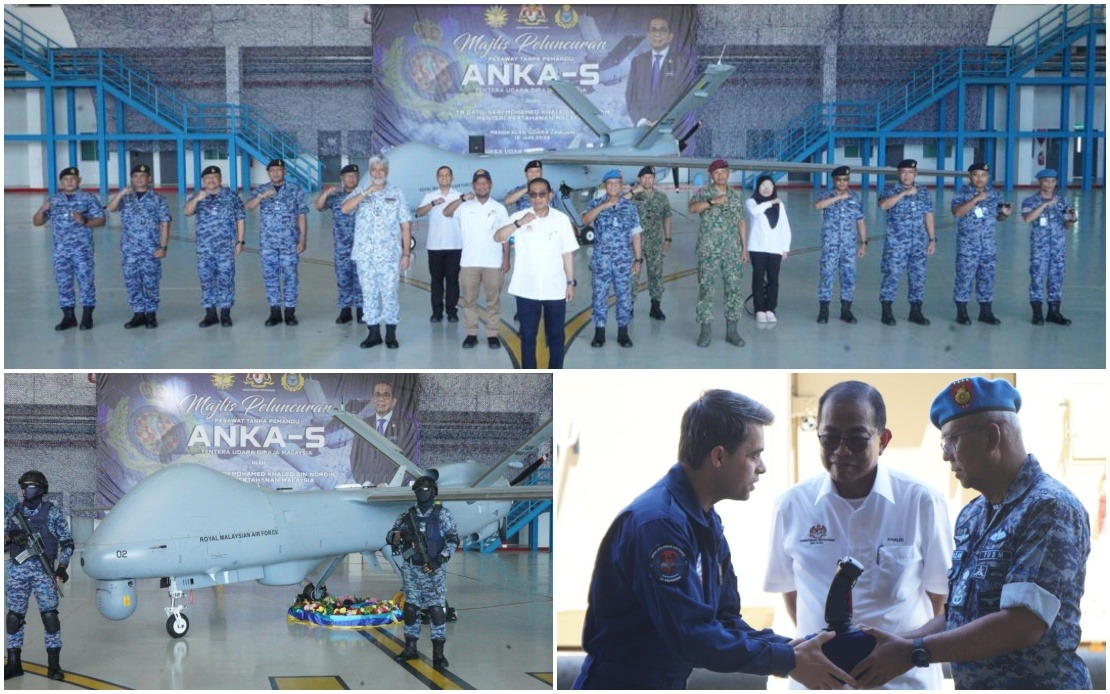
Malaysia has taken a decisive step to modernise its maritime defence infrastructure with the operational deployment of the ANKA-S Unmanned Aircraft System (UAS) by the Royal Malaysian Air Force (RMAF), marking a significant advancement in the nation's ability to monitor strategic waterways and protect national interests. Defence Minister Datuk Seri Mohamed Khaled Nordin, speaking at the official launch ceremony at RMAF Labuan Air Base on June 16, characterised the move as essential to maintaining sovereignty and security in one of the world's most strategically sensitive maritime zones. The acquisition represents a calculated investment in technological capability that addresses existing gaps in surveillance coverage that have long constrained Malaysia's capacity to respond swiftly to potential security threats.
The government acquired three ANKA-S aircraft at a total cost of RM423.8 million, a figure encompassing not merely the aircraft themselves but also the associated ground control stations and comprehensive two-year training programmes for operating personnel. This substantial financial commitment underscores the seriousness with which Malaysian defence planners view the need for enhanced surveillance infrastructure in contested maritime areas. The medium-altitude, long-endurance classification of these systems positions them as workhorses in contemporary military operations, capable of extended missions that would strain conventional manned aircraft platforms. The deployment of this initial tranche at Labuan provides strategic positioning to monitor activity across the South China Sea, where Malaysia's maritime interests intersect with those of multiple regional and extra-regional powers.
The technical specifications of the ANKA-S platform render it particularly suited to Malaysia's geographic and strategic circumstances. These aircraft can maintain continuous flight operations exceeding 24 hours at operational altitudes reaching 30,000 feet, enabling persistent surveillance across vast ocean expanses without the logistical burden and cost implications of sustained manned aircraft operations. The capability to conduct operations under diverse weather conditions and from positions difficult for others to detect fundamentally transforms Malaysia's intelligence-gathering potential. Rather than relying on reactive patrols that consume enormous fuel and maintenance resources, the RMAF can now position these systems for targeted monitoring of high-priority areas, substantially reducing operational expenditure while simultaneously enhancing coverage frequency and reliability.
The system's ability to accurately identify and track vessel profiles addresses a critical operational requirement in Malaysia's maritime domain. Equipped with advanced sensor suites, the ANKA-S can characterise vessels with sufficient precision to enable informed decision-making regarding resource allocation and response protocols. This represents a quantum leap from the previous situation where the RMAF possessed limited capacity for sustained, long-range surveillance and relied heavily on reactive intelligence from other sources. The intelligence advantage conferred by continuous, real-time monitoring of maritime activity cannot be overstated in a region where incidents can escalate rapidly and where early warning capability directly translates to strategic advantage. Malaysian maritime authorities can now employ response assets far more efficiently, dispatching naval and air resources directly to verified intrusion locations rather than conducting broad-based patrols that consume resources whilst delivering minimal intelligence returns.
Minister Khaled explicitly addressed the question of weaponisation, confirming that despite the ANKA-S platform's inherent capability to carry ordnance, Malaysia has deliberately chosen not to equip these aircraft with weapons systems. This decision carries significant symbolic weight within regional security dynamics, constituting a deliberate signal regarding Malaysia's defensive security posture and commitment to non-threatening military operations. In a region where military capabilities frequently become lightning rods for political tension and where neighbouring countries scrutinise each other's arms acquisitions for aggressive intent, Malaysia's conscious restraint in this regard reinforces messaging about peaceful intentions whilst preserving future operational flexibility should strategic circumstances shift. The emphasis on surveillance and reconnaissance rather than strike capability aligns with Malaysia's diplomatic positioning as a stakeholder in regional stability rather than as a provocateur seeking to alter maritime power balances through military superiority.
The government has signalled its commitment to expanding this surveillance capability through consideration of a second acquisition phase comprising three additional ANKA-S systems. This proposal, to be submitted within Malaysia's existing national development planning framework, would effectively double the operational capacity for maritime surveillance and substantially enhance the RMAF's ability to maintain persistent coverage across its vast area of responsibility. The contemplated expansion reflects confidence in the initial deployment's operational effectiveness and indicates growing recognition within defence planning circles that unmanned systems represent a cost-effective means of addressing surveillance challenges that have persisted for decades. The sequencing of acquisitions allows the RMAF to operationalise and fully integrate the initial platform before expanding the fleet, reducing risk whilst ensuring institutional learning occurs before committing additional resources.
The strategic implications of this capability enhancement extend beyond immediate surveillance benefits to encompass broader questions of maritime domain awareness and regional security architecture. Malaysia, as a substantial maritime nation with significant exclusive economic zone responsibilities and complex maritime boundaries with neighbouring states, has long operated at a disadvantage in terms of surveillance coverage relative to larger military powers. The ANKA-S deployment partially redresses this imbalance, enabling Malaysia to monitor its maritime zones with substantially greater thoroughness than previously possible. For Southeast Asian regional stability, enhanced Malaysian maritime surveillance contributes to a more transparent security environment wherein activities that might otherwise remain obscured become visible, potentially reducing miscalculation risks and supporting more informed diplomatic engagement on maritime issues.
The operational deployment of these systems at Labuan Air Base positions them to monitor both regional and international chokepoints critical to Malaysia's security and economic interests. The South China Sea serves as a crucial maritime corridor through which enormous volumes of regional trade traverse annually, with Malaysia's own shipping interests deeply embedded within these traffic patterns. The ability to monitor this vital waterway contributes not merely to national security in the narrow military sense but also to economic security by enhancing the RMAF's capacity to respond to piracy, maritime smuggling, and other transnational threats that jeopardise legitimate maritime commerce. The Data Exploitation Centre established to process intelligence collected by these systems represents an equally important investment in the human and institutional capacity required to convert raw surveillance data into actionable intelligence.
The presence of senior military and defence leadership at the official launch, including Chief of Navy Admiral Tan Sri Dr Zulhelmy Ithnain, Chief of Air Force Gen Tan Sri Muhamad Norazlan Aris, and other high-ranking officials, underscores institutional commitment to the ANKA-S programme across Malaysia's defence establishment. This broad-based support suggests that procurement decisions reflect consensus among military professionals regarding operational requirements and represent validated responses to genuine capability gaps identified through professional defence planning processes. The attendance of these senior figures also communicates to the international community that Malaysia views this capability development as significant enough to merit ceremonial and symbolic emphasis, reinforcing the importance attached to enhanced maritime security postures in contemporary regional security contexts.
For Malaysian citizens and regional observers, the ANKA-S deployment represents tangible evidence of government investment in national defence modernisation directed at persistent, real-world security challenges. The choice to invest RM423.8 million in surveillance capabilities rather than in weapons systems that might provoke regional tensions reflects a strategic preference for defensive posturing grounded in realistic threat assessment. Whether through its ability to identify unauthorised maritime intrusions, monitor fishing vessel activities, or track merchant shipping in Malaysian waters, the ANKA-S system directly serves Malaysia's national interests. The subsequent expansion under consideration would further solidify Malaysia's capacity to exercise effective sovereignty over its maritime domain, a fundamental requirement for any nation claiming substantial ocean territory and corresponding resources.
Looking forward, the ANKA-S programme exemplifies how technologically advanced, relatively modest-cost systems can provide strategic nations with capabilities that significantly enhance maritime domain awareness without requiring massive capital investments in large, expensive military platforms. For a nation like Malaysia operating within defined defence budgets and facing diverse security challenges across extensive maritime territories, unmanned aircraft systems represent prudent investment choices that deliver measurable operational benefits. The deliberate choice not to weaponise these systems whilst maintaining future flexibility, combined with transparent government communication regarding capability intentions, establishes a model for responsible military modernisation that serves national interests whilst respecting regional sensibilities about military buildups and arms races. As the ANKA-S systems integrate fully into RMAF operations and generate intelligence on maritime activities within Malaysian waters and beyond, they will provide decision-makers with information advantages currently lacking, ultimately enhancing national security outcomes and regional maritime stability.