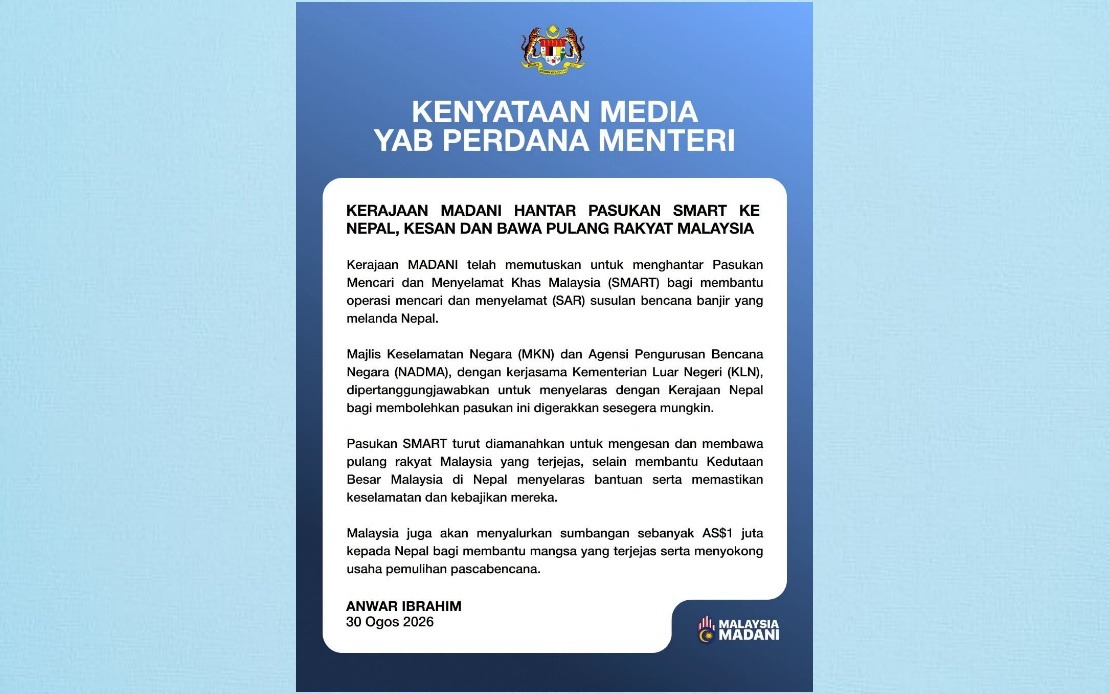
Malaysia's MADANI Government has committed significant resources to assist Nepal following a natural disaster that has claimed lives and displaced thousands across the South Asian nation. Prime Minister Datuk Seri Anwar Ibrahim announced that the Special Malaysian Disaster Assistance and Rescue Team (SMART) will be deployed to help coordinate search and rescue operations in the country, marking a substantial humanitarian response from the region.
The decision represents a coordinated effort across Malaysia's disaster management infrastructure. The National Security Council and the National Disaster Management Agency have been assigned responsibility for liaising with Nepal's government to expedite the team's arrival and ensure seamless integration with local relief efforts. The Foreign Ministry is playing a central coordinating role, working to establish the necessary channels and secure clearances for Malaysian personnel to operate effectively on the ground.
One critical dimension of the deployment centres on locating and supporting Malaysian citizens affected by the disaster. According to the Foreign Ministry, 55 Malaysians have remained uncontactable since the catastrophic event struck Rasuwa district on August 26, when severe flash floods and devastating landslides swept through the mountainous region. The SMART team has been explicitly tasked with tracing these individuals, determining their circumstances, and facilitating their return home should they require evacuation or assistance.
Beyond rescue and recovery, the Malaysian contingent will work closely with the Malaysian Embassy in Nepal to coordinate the delivery of humanitarian assistance and ensure the wellbeing of nationals sheltering in the country. This multi-faceted approach acknowledges that disaster response extends beyond the initial emergency phase, encompassing welfare provision, logistical support, and ongoing liaison with affected communities.
Financially, Malaysia is contributing US$1 million to support Nepal's immediate relief efforts and longer-term reconstruction. This monetary commitment, while modest in absolute terms, reflects Malaysia's recognition of its regional responsibilities and demonstrates solidarity with a neighbouring nation experiencing significant humanitarian hardship. The funds are intended to assist those directly impacted by the flooding and support government-led recovery initiatives aimed at rebuilding damaged infrastructure and restoring livelihoods.
The floods that triggered this response were among Nepal's most destructive in recent years. The combination of intense rainfall and unstable terrain in Rasuwa district created conditions for rapid flooding and large-scale landslides, overwhelming local emergency services and leaving thousands requiring immediate assistance. The concentration of casualties and displacement in this single district illustrates the vulnerability of mountainous communities to extreme weather events exacerbated by climate patterns and geographical factors.
For Malaysia, the deployment of SMART underscores the country's capacity and willingness to mobilise specialised personnel for regional crises. The team comprises trained rescue professionals with experience in disaster response across challenging terrain—expertise particularly valuable in Nepal's rugged topography. Their deployment also serves broader diplomatic objectives, strengthening ties between Kuala Lumpur and Kathmandu while demonstrating Malaysia's commitment to humanitarian principles across Southeast Asia and South Asia.
The incident highlights broader questions about disaster preparedness in the region. Nepal's mountainous geography, while culturally and economically significant, poses persistent challenges for emergency response, particularly when remote districts are cut off by landslides or flooding. Malaysian expertise in disaster management, developed through experience with flooding in Peninsular Malaysia and Sabah, may offer valuable lessons for Nepalese authorities grappling with similar environmental challenges.
For the 55 uncontactable Malaysians, the deployment offers concrete hope. Many may have been undertaking religious pilgrimages, trekking expeditions, or business activities in Nepal when disaster struck. The SMART team's presence on the ground significantly increases the likelihood of locating survivors and understanding what happened to those missing, providing closure to families anxiously awaiting news from the disaster zone.
The response also reflects evolving regional cooperation frameworks. Malaysia's ability to rapidly mobilise resources and coordinate with Nepal's government demonstrates the maturity of diplomatic relationships in South and Southeast Asia. As climate change intensifies extreme weather events across the region, such collaborative disaster response mechanisms are becoming increasingly essential for safeguarding lives and supporting affected populations.

