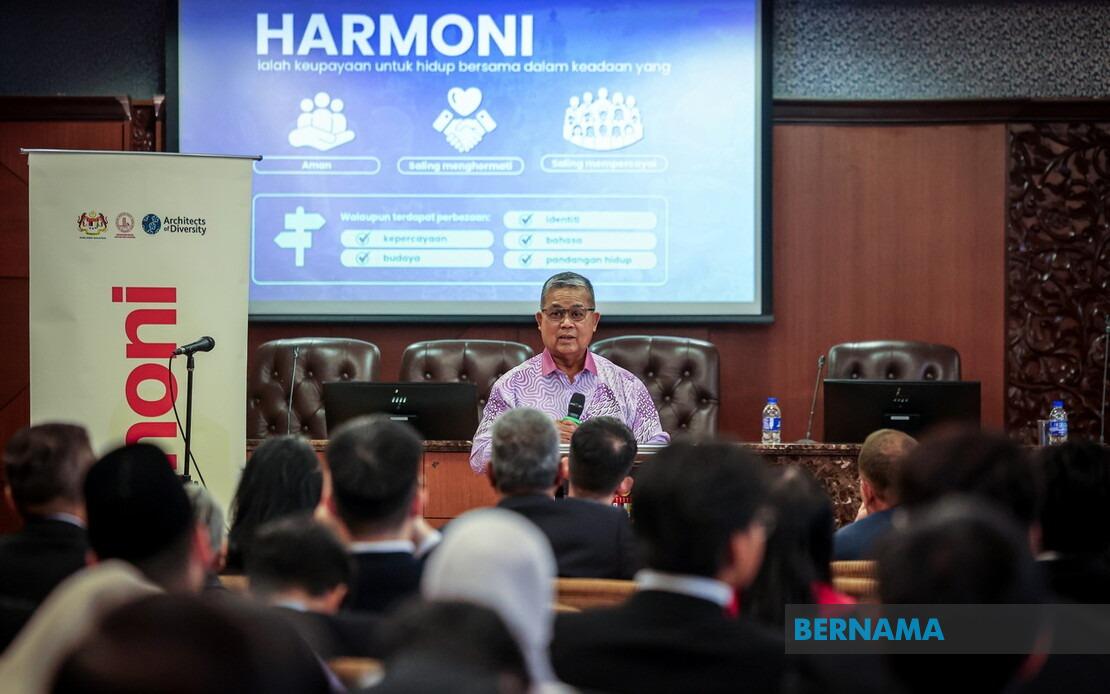
The Department of National Unity and National Integration (JPNIN) is embarking on a comprehensive research initiative designed to create a Community Tension Index that will provide systematic measurement of social cohesion across Malaysia while identifying and tracking flashpoints related to racial and religious sensitivities. Minister of National Unity Datuk Aaron Ago Dagang unveiled the project at the 2026 Harmony Symposium organised by the Malaysian Parliamentary Cross-Party Group on Racial and Religious Harmony at Parliament today, signalling government recognition that national unity requires sophisticated monitoring tools in an increasingly fragmented information ecosystem.
The development of this index represents a strategic shift towards data-driven governance in managing communal relations. Rather than responding to incidents after they occur, JPNIN intends to harness the index as an early warning mechanism that will inform policy interventions before tensions escalate into broader social conflict. By establishing baseline measurements of community attitudes and identifying emerging pressure points, the government hopes to deploy resources more effectively towards preventing divisive outcomes and maintaining the delicate balance that Malaysia's multicultural society depends upon.
Aaron emphasised the timeliness of this initiative by highlighting the concerning volume of online content that has surfaced promoting division along religious, royalty and racial lines. Between January 1, 2025 and January 31, 2026, the Malaysian Communications and Multimedia Commission (MCMC) removed 1,493 pieces of such content through enforcement actions. This figure underscores a troubling reality: threats to national harmony have substantially migrated from physical spaces into the digital realm, where they can spread with unprecedented speed and reach audiences far beyond traditional community boundaries.
The digital environment presents particular challenges for social cohesion because of how social media algorithms operate. Aaron noted that contemporary platforms naturally create what researchers term "filter bubbles" and "echo chambers"—mechanisms where users encounter predominantly content that aligns with their existing beliefs and values. These algorithmic systems inadvertently amplify polarisation by narrowing the diversity of perspectives available to individuals and significantly constraining space for substantive, constructive dialogue across community lines. The net effect widens gaps in mutual understanding and erodes the common ground necessary for coexistence.
This technological dimension adds complexity to Malaysia's traditional intercommunal challenges. Whereas previous generations of Malaysians negotiated differences through formal structures like component political parties and through informal community networks where diverse groups intersected in shared physical spaces, today's younger citizens increasingly inhabit fragmented digital ecosystems where exposure to "the other" is optional rather than inevitable. The Community Tension Index must therefore account not only for offline grievances but also for the velocity and intensity with which digital content can mobilise sentiment and reshape perception of group relationships.
Beyond the index itself, JPNIN has commenced a broader institutional reconfiguration designed to strengthen the architecture of national unity. The ministry has been conducting engagement sessions with diverse stakeholders to canvass preliminary opinions regarding a proposed National Harmony Commission (SKN). This institution, should it be established, would function as a dedicated mechanism for early intervention in potential conflicts, offering formal channels for mediation and dispute resolution conducted according to principles of fairness and constructive problem-solving.
The commission's mandate would encompass investigation of matters that threaten national harmony, providing both preventive and remedial capacity. Rather than leaving harmony maintenance diffused across multiple ministries and agencies, a dedicated commission would concentrate expertise, streamline decision-making and establish clear accountability for outcomes. The model echoes similar institutions in other diverse democracies that have found value in dedicated bodies focused on identity relations and intergroup cohesion.
For Malaysia's context, the stakes are particularly high. As a society built on constitutionally enshrined agreements among three major communities—supplemented by significant minority populations—the social contract depends on perceptions of fairness, respect for agreed boundaries, and confidence that legitimate grievances will be heard. When populations retreat into digital echo chambers reinforcing grievances and distrust, the psychological foundation of that contract weakens, even if formal constitutional arrangements remain unchanged.
The timing of these initiatives also reflects shifting threat perceptions among government leadership. The focus on digital content and algorithmic polarisation suggests policymakers recognise that traditional approaches to managing communal relations—predicated on government authority, mainstream media gatekeeping and formal institutional channels—have diminishing purchase when substantial populations consume information through algorithms designed for engagement rather than truth or social benefit. The response is not to retreat from governance but to evolve it, incorporating measurement systems and institutional mechanisms calibrated to contemporary communication realities.
Southeast Asia more broadly shares these concerns. Rapid digitalisation has occurred throughout the region without corresponding development of institutional capacity to address its social consequences. Malaysia's investment in developing systematic tools for monitoring and managing tension could yield lessons applicable across the region. However, the success of such initiatives ultimately depends on whether measurement translates into genuine policy responsiveness and whether newly created institutions operate with sufficient independence and credibility that communities trust them.
The Community Tension Index and proposed National Harmony Commission represent recognition that maintaining cohesion in diverse societies requires active, informed management rather than passive reliance on constitutional frameworks alone. Whether these tools prove effective will depend substantially on implementation quality, resource allocation and political will to act on findings even when doing so proves unpopular with powerful constituencies. The next phase involves translating these strategic concepts into operational reality—a task that will reveal whether institutional innovation can meaningfully counter the polarising dynamics of digital-age politics.

