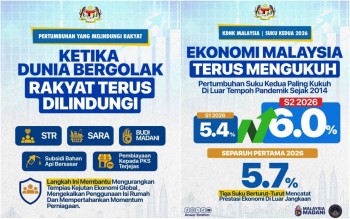
Malaysia's economic engine accelerated sharply in the second quarter of 2026, with gross domestic product expanding at a six per cent rate—a performance that defied expectations and delivered the nation's most robust second-quarter expansion outside pandemic-affected years stretching back to 2014. Prime Minister Datuk Seri Anwar Ibrahim announced the figures on August 14, positioning the result as validation of the government's economic management amid volatile global conditions.
The significance of this achievement lies in its broader context. Global economic momentum has been losing traction as supply chain disruptions persist and regional instability in West Asia continues to weigh on international trade and investor sentiment. That Malaysia managed to post six per cent expansion under such circumstances suggests domestic demand and sectoral resilience are compensating for external headwinds. The second quarter represents the strongest quarterly performance of its type in over a decade, excluding the anomalous growth recorded during pandemic recovery periods when economies were rebounding from crisis-induced contractions.
Anwar attributed the result to the MADANI Government's policy framework, emphasising that safeguarding ordinary Malaysians from inflationary pressures was central to sustaining economic momentum. The administration has deployed multiple support mechanisms, including the BUDI MADANI initiative and direct cash transfers through Sumbangan Tunai Rahmah (STR) and Sumbangan Asas Rahmah (SARA), to cushion households against price volatility. These interventions, he noted, formed part of a broader strategy combining visible aid with behind-the-scenes price controls and supply-chain management to maintain purchasing power and consumer confidence.
For Malaysian readers, the implications are multifaceted. Strong GDP growth typically correlates with improved employment prospects, wage pressures, and business investment—factors that directly influence job availability and income growth across the economy. The six per cent expansion suggests the labour market may tighten further, potentially benefiting job seekers, though wage gains must outpace inflation to deliver real purchasing power improvements. The performance also underscores the success of the government's dual approach: using direct welfare transfers to protect vulnerable populations while implementing supply-side measures to prevent runaway price inflation.
Regionally, Malaysia's outperformance is noteworthy. Several Southeast Asian neighbours are grappling with slower growth trajectories amid the same global challenges. The six per cent figure positions Malaysia ahead of many peers and may attract foreign investors seeking growth exposure in a region where economic momentum varies considerably. This could translate into additional foreign direct investment flows, though geopolitical risks and ongoing regional tensions remain considerations for multinational corporations evaluating expansion or relocation decisions.
Yet Anwar's commentary revealed the government recognises this strong quarterly result must be sustained and translated into tangible improvements in living standards. He acknowledged the need for continued structural reforms and emphasised that growth alone is insufficient if wealth remains concentrated or job quality deteriorates. The emphasis on "more meaningful income" and "quality job opportunities" reflects awareness that headline GDP figures mask distribution challenges—growth that primarily benefits large corporations or wealthy segments while leaving working-class Malaysians behind generates political discontent and threatens social stability.
The MADANI Government's reform agenda thus faces a critical juncture. Converting headline growth into broad-based prosperity requires addressing labour market composition, wage stagnation in certain sectors, and the earnings gap between high-skilled and routine workers. Infrastructure investment, skills development, and sectoral diversification remain essential to ensuring future quarters match Q2's performance while raising median household incomes and job security.
Vulnerable groups require particular attention within this growth narrative. Direct cash assistance schemes like STR and SARA provide immediate relief but are insufficient long-term solutions. The government must simultaneously create pathways to higher-earning employment, support small and medium-sized enterprises that employ lower-wage workers, and ensure social safety nets evolve as the economy transforms. Without these complementary measures, GDP growth will feel distant from the daily economic experiences of many Malaysians.
The external environment remains precarious. Supply chain pressures, geopolitical tensions in West Asia, and potential shifts in global trade patterns could disrupt Malaysia's growth trajectory. The six per cent expansion therefore represents a window for executing longer-term structural reforms—strengthening high-value manufacturing, expanding digital economy capabilities, and building workforce resilience through retraining programs. Delaying such initiatives until growth falters would place the government in a reactive rather than proactive position.
Anwar's invocation of the MADANI framework—grounded in principles of solidarity and shared prosperity—suggests the government understands that legitimacy depends on demonstrating that growth benefits extend across income levels and regions. The second quarter's robust performance has purchased political capital; how that capital is deployed over coming quarters will determine whether 2026 marks a turning point toward inclusive prosperity or merely a cyclical upturn with familiar distributional inequities.

