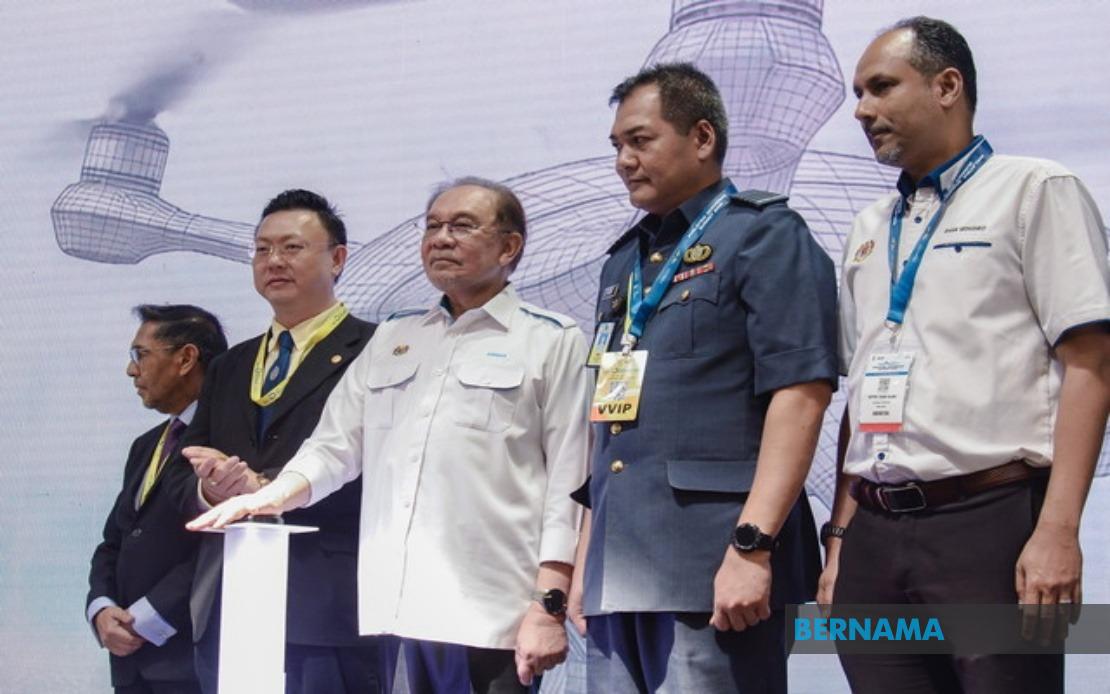
Prime Minister Datuk Seri Anwar Ibrahim has underscored the urgency for Malaysia to rapidly advance its technological capabilities in the unmanned aerial vehicle sector, arguing that swift action in this emerging industry is essential for strengthening the country's standing within the global economy. Speaking at the closing ceremony of MyDrone Expo 2026 in Sepang, Anwar framed drone technology not as a niche specialisation but as a transformative field deeply intertwined with artificial intelligence and broader digital transformation initiatives that will determine competitive advantage in coming decades.
The Prime Minister's remarks came as the three-day MyDrone Expo, jointly organised by the World UAV Federation Malaysia Chapter and the Malaysia UAV Development Association, concluded with substantial results. The event attracted more than 100 exhibition booths and drew thousands of international visitors and industry representatives from 46 countries, demonstrating significant regional and global interest in Malaysia's drone sector potential. The scale of participation suggests growing recognition that Southeast Asia, and Malaysia in particular, could become a hub for UAV innovation and development.
Anwar emphasised that the drone industry represents far more than military or defence applications, though those remain important. The technology extends into civil and commercial domains that directly impact productivity across multiple economic sectors. Agriculture and plantation management stand out as particularly promising applications, where drone technology can optimise crop monitoring, pesticide application, and yield forecasting—sectors where Malaysia's substantial agribusiness interests could benefit significantly from innovation. This broad economic application base positions drones as infrastructure for modernising traditional industries rather than replacing them.
The global market opportunity provides compelling context for Malaysia's push in this direction. Industry projections indicate the worldwide UAV market will surpass USD55 billion by 2030, representing a compound annual growth rate that typically outpaces broader economic expansion. Beyond the direct drone manufacturing and sales sector, the emerging low-altitude economy—encompassing all commercial and industrial activity occurring below traditional aviation corridors—is generating investment flows and economic opportunities at accelerating rates. Early movers in developing regulatory frameworks and industrial ecosystems stand to capture disproportionate value as this sector matures.
Recognising these dynamics, Anwar has directed Cabinet ministers, policymakers, scientific research institutions, and relevant government agencies to provide comprehensive support to the drone industry across regulatory, financial, and operational dimensions. This represents a significant policy commitment, as it requires coordination across multiple government portfolios and necessitates updating regulatory frameworks that often lag technological development. The directive signals that drone sector development is no longer a peripheral innovation interest but a central economic priority within the government's broader digitisation and economic modernisation agenda.
The government's commitment extends to specific areas where intervention can unlock sector growth. Improving the regulatory framework remains foundational—Malaysia must establish clear certification standards, airspace management protocols, and operational guidelines that provide industry participants sufficient certainty to invest in research, manufacturing, and service development. Simultaneously, enhanced research funding directed toward universities and government research establishments creates the intellectual and technical foundation for indigenous innovation rather than reliance on imported solutions. The testing and certification infrastructure Anwar highlighted requires substantial capital investment and technical expertise, yet remains essential for ensuring safety standards and building international confidence in Malaysian UAV products.
The talent pipeline dimension warrants particular attention for Malaysia's long-term competitive positioning. Anwar's reference to developing drone-related expertise similar to existing AI and quantum computing faculties indicates recognition that technological advantage ultimately derives from human capital. Malaysian universities must establish dedicated drone technology programmes spanning engineering, data science, business management, and regulatory affairs. This educational infrastructure takes years to develop effectively, making immediate action essential to avoid falling further behind regional competitors like Singapore and China, which have already established substantial academic and research capabilities in UAV systems.
Private sector involvement emerges as equally critical to government leadership. Anwar explicitly urged deeper collaboration between commercial enterprises, government research facilities, and academic institutions—a tripartite partnership model that has proven effective in other high-technology sectors. Malaysian companies operating in aerospace, electronics, manufacturing, and software development possess transferable capabilities applicable to drone systems. Establishing clear incentive structures and intellectual property protections encourages these firms to redirect innovation efforts toward UAV applications and components, building genuine indigenous industrial capacity rather than merely assembling imported technology.
The regulatory clarity Anwar emphasised addresses a significant barrier to investment and development in many nations, where drone regulations remain fragmented, uncertain, or overly restrictive. Malaysia's opportunity lies in establishing regulatory frameworks sufficiently rigorous to maintain safety and security standards while remaining flexible enough to permit innovation and experimentation. Countries like China and the United States have demonstrated that clear but adaptive regulatory approaches can coexist with rapid technological advancement. Malaysia's decision to signal unambiguous government support removes regulatory uncertainty that otherwise deters private investment and research commitment.
Regional competition in drone technology is intensifying, with neighbouring countries recognising similar opportunities. Singapore has positioned itself as a regulatory and innovation hub for autonomous systems, while Vietnam and Thailand are developing manufacturing capabilities. Indonesia's vast geography creates natural applications for drone technology across agriculture, logistics, and natural resource management. Malaysia's window for establishing leadership in this emerging sector remains open, but decisive action is required immediately to translate policy intent into tangible industrial development and market capture.
The convergence of drone technology with AI and digital transformation initiatives provides strategic opportunities beyond the UAV sector itself. Developing a drone industry ecosystem necessarily requires expertise in sensor systems, data processing, machine learning, cybersecurity, and autonomous decision-making—all competencies with applications across industries. Malaysia's drone sector development thus potentially serves as a catalyst for broader technological capability building, creating spillover benefits for telecommunications, manufacturing, financial services, and other sectors dependent on advanced digital infrastructure.
For Malaysian businesses and investors, the government's clear commitment creates both opportunities and imperatives. Companies in logistics, infrastructure inspection, environmental monitoring, and agricultural services should evaluate how drone technology might enhance their operations or create entirely new business models. Supporting sectors—including software development, sensor manufacturing, and data analytics—should prepare capabilities to serve the emerging drone ecosystem. Educational institutions must accelerate programme development to ensure adequate talent supply as industry demand accelerates.
Anwar's remarks ultimately reflect recognition that Malaysia's economic future depends on technological dynamism and rapid adoption of emerging innovation opportunities. The drone industry, intersecting with AI and digital capabilities, represents precisely the type of transformative sector where strategic investment and supportive policy frameworks can generate substantial economic value. The scale of international participation in the MyDrone Expo validates that Malaysia possesses genuine potential to become a significant player in this market, but realising that potential requires urgent, sustained commitment from government, industry, and academic sectors working in concert.

