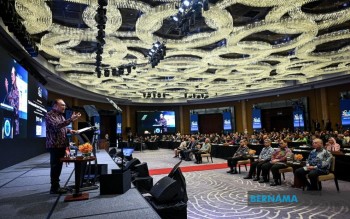
Prime Minister Datuk Seri Anwar Ibrahim has underscored the necessity for Malaysia to establish a sovereign cloud infrastructure capable of safeguarding critical security information and personal data, even as the nation remains receptive to international digital investment. His remarks, delivered during a question-and-answer session at the 39th Asia-Pacific Roundtable in Kuala Lumpur, reflect growing regional concerns about data sovereignty in an era when Southeast Asia's technological dependencies are deepening at an unprecedented pace. The proposal addresses a fundamental tension facing developing economies: the imperative to embrace global digital ecosystems while retaining control over information vital to national interests and individual privacy.
Anwar's advocacy for a sovereign cloud stems partly from his concerns about the implications of the US Cloud Act, which he contends grants American companies the legal authority to access data stored on their servers regardless of where those servers are physically located. He highlighted that while such provisions represent the prerogative of the United States, Malaysia must construct its own protective mechanisms to counter potential vulnerabilities. This distinction—acknowledging American sovereignty while asserting Malaysia's right to independent data protection—reflects the delicate diplomatic balance required when a mid-sized nation navigates relationships with major technological and economic powers.
The sovereign cloud concept, as outlined by Anwar, would function as a firewalled repository specifically designed to house information classified as critical to national security and personal data belonging to Malaysian citizens. By creating a digital space where such information remains under Malaysian jurisdiction and control, the government would theoretically prevent unilateral access by foreign entities, even those operating within Malaysia's own borders. However, Anwar acknowledged the inherent limitations of such an approach within a globalised system, recognising that absolute data protection remains largely illusory when nations maintain open democratic societies and participate actively in international commerce.
This position gains particular relevance for Malaysia and its neighbours as Southeast Asia becomes an increasingly attractive destination for technology sector investment from the United States, China, Germany, and other developed economies. These investors typically require access to consumer data, market intelligence, and operational analytics to justify their capital commitments. A sovereign cloud framework could theoretically allow Malaysia to welcome such investment while maintaining firewalls around genuinely sensitive information—creating distinct zones of protection calibrated to different categories of data.
Yet the proposal also highlights emerging tensions within digital governance across the region. As internet usage, e-commerce adoption, and digital service delivery expand rapidly throughout Southeast Asia, questions of who controls critical information infrastructure have moved from technical concerns into the domain of high geopolitics. Smaller nations increasingly recognise that dependence on foreign cloud providers creates asymmetrical power relationships, where decisions made in distant corporate headquarters can profoundly affect national interests. Anwar's emphasis on sovereignty reflects this awakening to technological interdependence as a form of vulnerability.
Beyond infrastructure questions, Anwar flagged another dimension of digital governance: the need for legitimate government safeguards against the misuse of social media and digital platforms. He identified multiple forms of abuse—political, economic, personal, and sexual—that have proliferated across Southeast Asia alongside the expansion of internet access. Young people, in particular, face exposure to harmful content and predatory behaviour through digital channels. The Prime Minister contended that protecting citizens from such harms represents a legitimate government responsibility, even when such protection necessarily involves some constraint on the open information flows that define liberal democracies.
This framing—simultaneously emphasising openness and protection—reflects the philosophical challenge facing policymakers across the region. Malaysia, like most ASEAN nations, aspires to remain a free, democratic society where information circulates relatively unimpeded. Yet it also confronts genuine harms arising from digital platform misuse that demand governmental response. Balancing these imperatives requires nuance that moves beyond simplistic narratives about surveillance or censorship, focusing instead on targeted interventions protecting vulnerable populations from concrete dangers.
Anwar's broader strategic perspective situates Malaysia's digital sovereignty agenda within the context of regional integration and middle-power positioning. He emphasised that Malaysia's strength derives not from standing alone, but from ASEAN's collective capabilities and coordinated approach to major international challenges. This perspective suggests that a sovereign cloud initiative gains credibility when framed as part of regional digital cooperation rather than nationalist isolation. Indeed, several ASEAN members face similar data sovereignty concerns and might benefit from coordinated infrastructure development or shared digital standards.
The Prime Minister explicitly rejected characterising Malaysia as a great power, instead defining national strategy around maintaining friendly relations with all major powers—whether the United States, China, Germany, or others—while prioritising ASEAN centrality in both foreign policy and investment attraction. This positioning reflects Malaysia's historical experience as a nation whose prosperity depends on remaining open to international capital while exercising sufficient autonomy to protect core interests. A sovereign cloud framework fits logically within this strategy, serving as a tool for demonstrating responsible data stewardship to investors while maintaining the independent control that national dignity requires.
For Malaysian policymakers and regional technology observers, Anwar's remarks signal an emerging consensus that digital infrastructure represents genuine infrastructure—worthy of the same strategic investment and protection that previous generations extended to ports, airports, and power grids. The specific technical architecture of Malaysia's sovereign cloud remains undefined, as does its governance structure and interoperability with regional neighbours' systems. Yet the conceptual commitment appears settled: Malaysia intends to build systems ensuring that critical information remains subject to Malaysian law and Malaysian oversight, even in an increasingly interconnected digital world.

