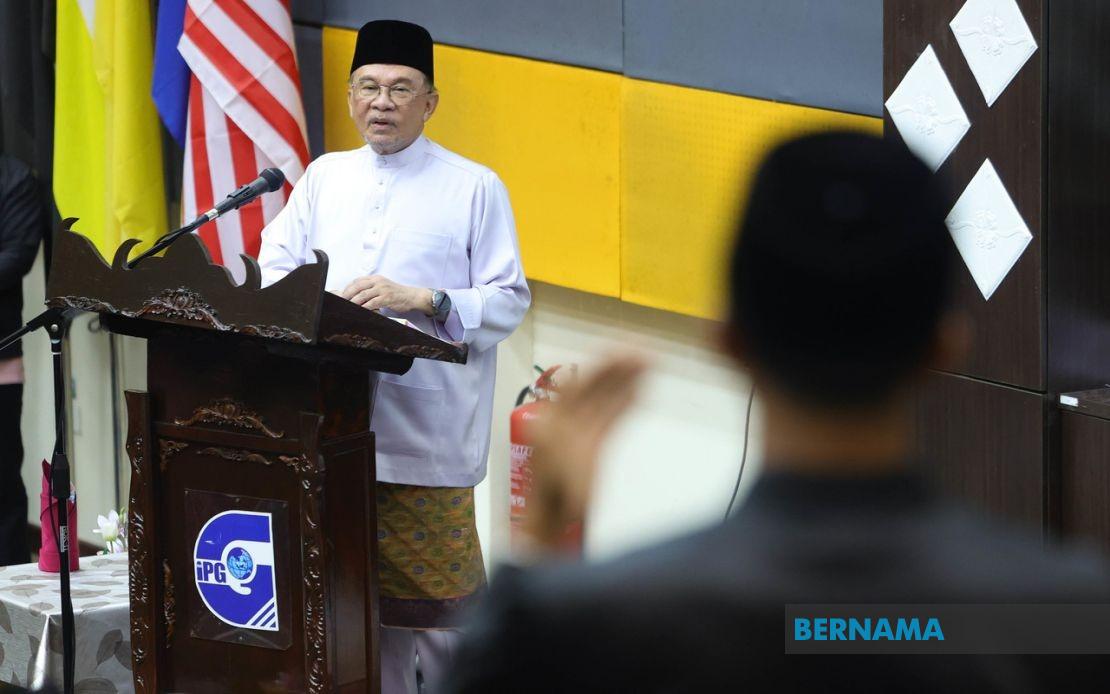
Prime Minister Datuk Seri Anwar Ibrahim has called for a fundamental shift in how Malaysia develops its teaching workforce, insisting that educators must possess dual competencies spanning cutting-edge technological domains and deep-rooted moral frameworks. Speaking at an event in Nilai attended by Education Minister Fadhlina Sidek and Institut Pendidikan Guru Kampus Pendidikan Tinggi director Dr Kartini Abdul Mutalib, the Prime Minister outlined a vision for Malaysian education that bridges the gap between digital innovation and traditional values.
The rapid pace of global technological transformation, particularly in artificial intelligence, data science, and digital systems, has created an urgent imperative for educational institutions to evolve beyond conventional approaches. Anwar highlighted that Malaysia cannot maintain its competitive position if schools and universities continue relying on outdated curricula and pedagogical methods. The emerging fields encompassed within Science, Technology, Engineering and Mathematics represent not merely optional enhancements but essential components of contemporary educational frameworks. Yet this technological competency, he emphasised, remains incomplete without corresponding developments in character formation and ethical reasoning among both educators and students.
The Prime Minister articulated his educational philosophy through a memorable formulation: the nation must "reach for the skies while keeping our roots on the ground." This metaphorical construct captures a central tension in Malaysian policymaking—the desire to adopt advanced technologies without surrendering cultural, religious, and moral anchors that have traditionally defined the nation's identity. For Malaysia specifically, where religious and cultural diversity characterises the population, this balance assumes particular significance. The challenge involves preparing students and teachers to operate competently within globalised, technology-driven environments whilst remaining grounded in principles that reflect Malaysia's multicultural fabric.
Anwar positioned education as the foundational pillar upon which broader national development rests. His assertion that education represents the "first priority" followed by institutional agility in responding to international change reflects a recognition that human capital formation ultimately determines whether nations prosper or stagnate. In Southeast Asian contexts where several neighbours are similarly investing heavily in STEM education and digital transformation, Malaysia's ability to develop teachers combining technical mastery with ethical sophistication may prove decisive in attracting investment and talent. The regional competition for skilled educators and students increasingly hinges on whether educational systems can offer coherent frameworks that synthesise technological advancement with humanistic values.
The Prime Minister directed particular concern toward the corrosive effects of communal animosity on educational quality and social cohesion. His warning that education fails fundamentally if it becomes infected with racial or religious hatred identifies a specific vulnerability within plural societies. When teachers or students internalise prejudicial sentiments toward other communities, the formal curriculum becomes undermined by informal messages that contradict stated commitments to knowledge advancement and social cooperation. This dynamic proves especially problematic in technology and innovation sectors, where collaborative international networks and diverse teams increasingly drive breakthroughs. Individuals trained in environments of intolerance risk becoming isolated from global professional communities and unable to contribute effectively to knowledge economies requiring cross-cultural exchange.
The articulation of Malaysia's multiracial character as an asset rather than a liability represents a strategic reframing of national identity. Anwar's contention that diversity constitutes strength rather than vulnerability directly challenges narratives emphasising communal separation or competition between ethnic or religious groups. This framing proves consequential for educational policy because curriculum decisions, school composition policies, and teacher recruitment practices fundamentally shape whether students develop capacities for intercommunal understanding. The Prime Minister's assertion that no nation, regardless of power or resources, can maintain security whilst sowing seeds of intergroup hatred carries particular resonance in a regional context where several neighbours have experienced serious communal violence or face ongoing ethnic tensions.
Tolerance and mutual respect, as Anwar identified them, constitute not merely virtuous sentiments but functional prerequisites for progressive societies. When teachers understand and practise genuine respect across religious and cultural lines, they model behaviours that students internalise. When schools deliberately cultivate environments of intellectual exchange across difference, students develop capabilities for the collaborative problem-solving that modern technological work demands. For Malaysia, where institutions from primary schools through universities serve ethnically and religiously mixed populations, educational spaces represent critical venues for either reinforcing or ameliorating communal stereotypes. The decision to emphasise these values at the highest governmental levels suggests recognition that technological advancement disconnected from social cohesion yields stunted development.
The timing of these pronouncements aligns with global trends toward ethics-focused technology education. Universities worldwide have begun establishing dedicated institutes examining artificial intelligence ethics, algorithmic fairness, and responsible technology development. Anwar's emphasis on grounding technological competency in human values reflects this international movement toward recognising that technical expertise alone produces incomplete professionals. Malaysian institutions positioned at the forefront of integrating ethical frameworks with STEM training could potentially develop comparative advantages in training teachers and technologists committed to socially responsible innovation.
Implementing this dual vision of technological competency combined with ethical grounding will require substantive investment in teacher training infrastructure and curriculum redesign. Institutions responsible for educator preparation must themselves employ faculty capable of bridging technical and humanistic domains. This represents a departure from traditional models where STEM and humanities education remained largely compartmentalised. Malaysia's teacher training institutions will need resources to upgrade facilities, recruit scholars versed in both technology and philosophy or religious studies, and develop integrated programmes where technological learning occurs explicitly within frameworks examining values, culture and social responsibility.
The Prime Minister's remarks also carry implications for Malaysia's positioning within regional and global educational networks. Countries increasingly compete to attract talented educators and to export educational models and expertise. Malaysian institutions that successfully synthesise technological innovation with ethical foundations rooted in the nation's multicultural heritage could develop distinctive pedagogical approaches with appeal across Southeast Asia and beyond. This represents an opportunity to contribute original thinking to global conversations about education in technological societies, rather than merely importing frameworks developed in culturally different contexts.

