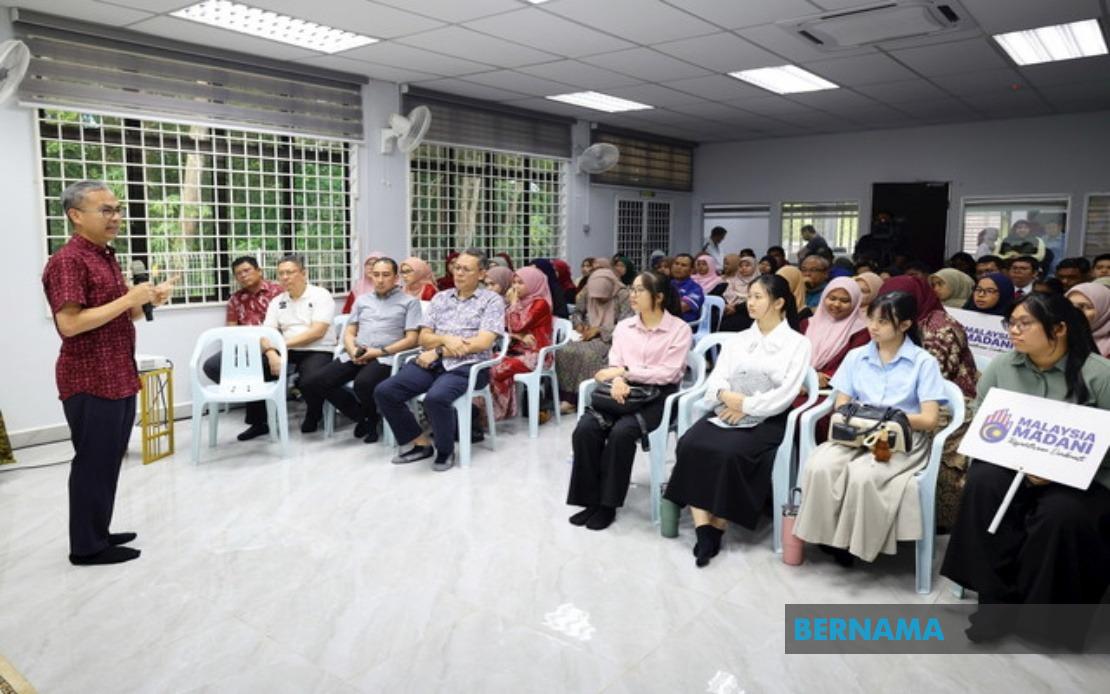
Communications Minister Datuk Seri Fahmi Fadzil has underscored the critical importance of instilling a robust sense of patriotism in Malaysia's younger generation while simultaneously equipping them with competent digital skills and responsible social media habits. Speaking after engaging with secondary school students in Jempol, Fahmi stressed that fostering national consciousness and historical awareness represents a cornerstone of citizenship development in an increasingly complex digital landscape.
The minister's intervention reflects growing official concern about the information environment young Malaysians inhabit. During his dialogue with 60 Form Six students from three schools in the Jempol parliamentary constituency, Fahmi noted that participants raised substantive questions concerning misinformation, psychological wellbeing in the digital age, platform dynamics, and the implications of accelerating technological advancement including artificial intelligence. These concerns underscore a generation grappling with novel societal challenges absent from previous cohorts' experiences.
Fahmi emphasized that every Malaysian, irrespective of background, carries a civic obligation to understand the nation's historical trajectory and to comprehend their personal role in advancing collective national interests. This framing positions historical literacy not as academic exercise but as foundational knowledge enabling informed citizenship. By connecting historical understanding to contemporary responsibility, the minister articulated a framework where knowledge of Malaysia's independence struggle, nation-building journey, and constitutional foundations directly informs how citizens navigate present-day challenges and contribute to future development.
The programme bringing together students from Sekolah Menengah Kebangsaan Batu Kikir, SMK Seri Perpatih, and SMK Datuk Mansor employed an "edutainment" methodology designed to render civic education more engaging and accessible than conventional classroom instruction. This pedagogical approach acknowledges that traditional lecturing often fails to resonate with digitally native populations accustomed to interactive, multimedia-rich content. By integrating entertainment elements with substantive information delivery, organisers attempted to create conditions where patriotic messaging and digital literacy education achieve genuine uptake rather than passive compliance.
The dialogue session constituted part of the broader Pentarama X Kelab Malaysiaku initiative, a collaborative effort coordinated by the Department of Information Malaysia that synergizes with National Month observances and forthcoming independence commemorations. Pentarama, functioning as a performance and communications unit under the information department, disseminates government messaging and patriotic values through theatrical and musical formats—an approach premised on the assumption that emotional and aesthetic engagement proves more persuasive than didactic exposition alone.
Erwin Khairul Ahmad, director-general of the Department of Information Malaysia, revealed that the Kelab Malaysiaku network has expanded to encompass 850 clubs nationwide, suggesting substantial institutional investment in grassroots patriotic mobilization at the school level. This proliferation indicates governmental recognition that cultivating nationalist sentiment requires sustained, geographically dispersed programming rather than episodic national campaigns. The expansion particularly targets the period surrounding National Day and Malaysia Day celebrations, strategically aligning patriotic reinforcement with historically symbolic moments in the national calendar.
The emphasis on digital literacy within this patriotic framework reflects concern that young Malaysians require not merely nationalist conviction but sophisticated competence in navigating information ecosystems characterized by misinformation, polarization, and manipulation. Fahmi's observation that students raised questions about fake news suggests awareness among this cohort that digital platforms present both opportunity and peril. By pairing patriotic education with digital literacy instruction, policymakers implicitly acknowledge that future national cohesion depends upon citizens capable of discerning credible information while resisting algorithmic amplification of divisive narratives.
For Malaysian educators and administrators, this intervention signals official prioritization of what might be termed "critical digital citizenship"—a framework encompassing not merely technical skills or platform literacy but ethical reasoning about online conduct and its social implications. The minister's highlighting of mental health concerns in digital contexts further broadens the scope beyond traditional cybersecurity or media literacy, acknowledging that psychological wellbeing intersects with technology use in ways requiring integrated policy responses.
The regional significance of this initiative extends beyond Malaysia's borders, as Southeast Asian governments generally confront analogous challenges regarding youth engagement with digital platforms, susceptibility to misinformation, and the preservation of national cohesion amid rapid technological change. Malaysia's attempt to blend patriotic cultivation with digital citizenship education offers a model potentially instructive for neighboring states similarly grappling with these tensions.
Moreover, the deliberate inclusion of voices and concerns from the student cohort—rather than unidirectional transmission of state messaging—suggests evolving understanding that patriotism among younger generations requires responsiveness to their actual preoccupations rather than invocation of historical narratives divorced from contemporary relevance. When government officials listen substantively to youth anxieties regarding artificial intelligence, mental health, and information authenticity, they implicitly validate these concerns as legitimate elements of national discourse rather than peripheral distractions from "proper" civic education.
The programme's design, incorporating representation from the Malaysian Communications and Multimedia Commission alongside the information department, reflects institutional recognition that safeguarding the information environment requires coordination across communications, digital governance, and educational domains. This multi-agency approach acknowledges that digital literacy cannot be siloed within schools but demands coherent policy integration encompassing platform regulation, content standards, educational curricula, and public communication strategies.
As Malaysia continues navigating demographic and technological transitions, the cultivation of patriotic commitment among youth increasingly hinges upon demonstrating that national identity remains relevant to their lived experiences and future aspirations. Officials like Fahmi appear to recognize that hollow nationalism divorced from addressing tangible concerns—mental health impacts of social media, employment prospects in an AI-transformed economy, access to reliable information—cannot sustain genuine attachment to nation. By explicitly acknowledging and engaging with student preoccupations, policymakers signal that patriotism constitutes not nostalgia for historical achievements but active commitment to building equitable, inclusive futures where all Malaysians possess agency.

