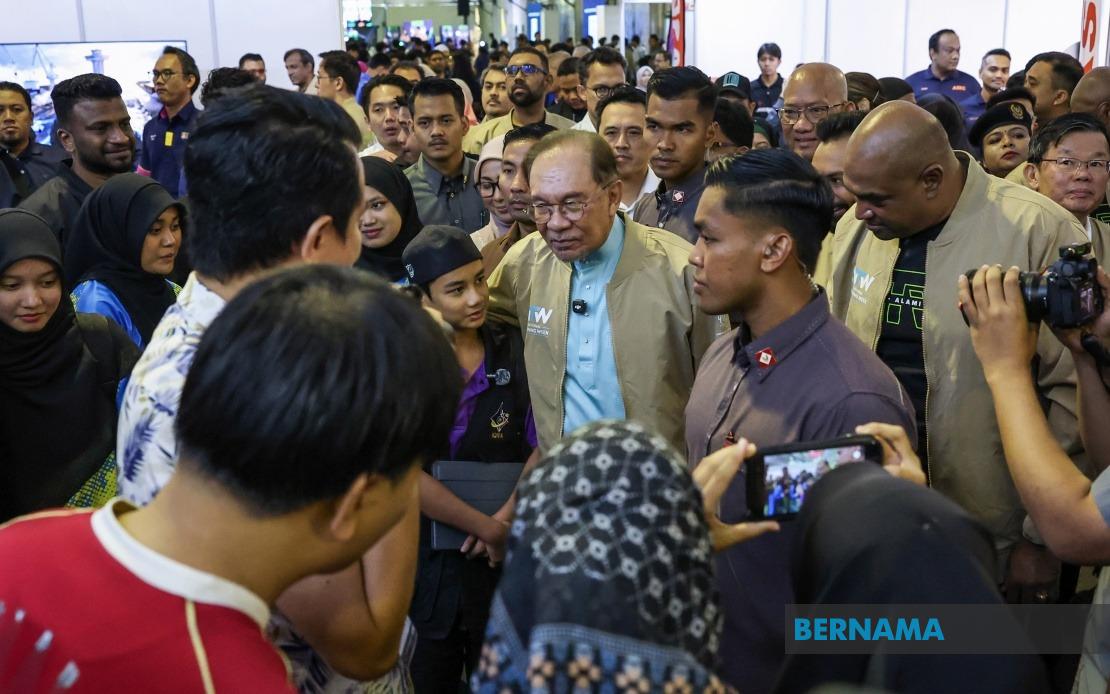
Prime Minister Datuk Seri Anwar Ibrahim has delivered a stark message to Malaysians: the country's aspirations for greatness cannot be realised if its population continues to be ensnared by outdated worldviews and the poisonous divisions they create. Speaking at the closing ceremony of National Training Week 2026 at Universiti Teknologi MARA Permatang Pauh in Bukit Mertajam, Penang, Anwar positioned the rejection of divisive and racial politics as essential to the nation's developmental trajectory and regional standing.
The Prime Minister's remarks reflect a broader governance philosophy centred on steering Malaysia away from the fractious identity-based competitions that have historically dominated its political landscape. By framing the question as one of national capability rather than moral principle alone, Anwar signals that political fragmentation carries concrete economic and social consequences that reach far beyond rhetoric. His intervention underscores the tension between Malaysia's constitutional diversity and the challenge of building consensus around shared national interests—a perpetual tension in a multicultural state where electoral incentives sometimes reward division.
Anwar placed particular emphasis on the younger generation as agents of transformation, positioning them as the primary audience for his call to unity. This strategic focus on youth reflects recognition that generational attitudes toward identity politics may differ from those of their parents and grandparents, and that early intervention in shaping values could prove decisive in altering Malaysia's political culture. The National Training Week platform itself—a government initiative focused on skills development and workforce readiness—provided a symbolic venue for connecting economic advancement with social cohesion, suggesting that prosperity and social harmony are inseparable objectives.
The MADANI Government's approach, as articulated by Anwar, prioritises dialogue and inclusive policymaking as alternatives to inflammatory rhetoric that sets groups against one another. This represents a deliberate pivot from governance styles that, whether intentionally or through institutional inertia, have sometimes leveraged communal anxieties to consolidate political support. By publicly committing to an inclusive framework, Anwar establishes a benchmark against which his administration's actual policies will be measured—a potentially constraining move that reflects either genuine conviction or astute political positioning.
Central to Anwar's message is the conviction that Malaysia's future success, both domestically and in regional and global contexts, hinges on the younger generation's willingness to invest in self-improvement while simultaneously committing to collective progress. The emphasis on continuous knowledge enhancement, skill development, and disciplined self-application frames individual advancement not as competitive self-interest but as contribution to national capacity. This framing attempts to reconcile personal ambition with communal obligation, a balance that multicultural societies must negotiate carefully.
The government's commitment to expanding training and reskilling opportunities through the Ministry of Human Resources and the Human Resource Development Corporation signals recognition that economic insecurity and limited opportunity can themselves fuel social fragmentation. By offering pathways to better employment and higher incomes, the administration positions economic inclusion as foundational to social stability. Malaysia's competitive position in Southeast Asia depends partly on workforce quality, making skills development simultaneously an economic imperative and a social one.
Anwar's simultaneous role as Finance Minister allowed him to situate his political message within an economic context. He cited the ringgit's emergence as Asia's best-performing currency, record-high investment levels, and robust economic growth as evidence that the MADANI Government's approach is delivering tangible results. These achievements, presented as flowing from reform measures and targeted support for citizens facing rising living costs, construct a narrative in which inclusive governance and economic resilience reinforce one another. For Malaysian readers, particularly those concerned about purchasing power and employment prospects, such signals carry particular weight.
The presence of Penang Chief Minister Chow Kon Yeow and Human Resources Minister Datuk Seri R. Ramanan at the ceremony underscored the multi-level commitment to the skills development agenda. State-level participation signals that the emphasis on youth training and workforce readiness transcends federal initiatives, potentially indicating broader consensus among political actors on this dimension of governance. However, the distinction between rhetorical commitment and resource allocation remains significant, particularly given Malaysia's ongoing fiscal constraints.
Anwar's call for youth to make full use of National Training Week and provide feedback to strengthen skills programmes suggests openness to input and iterative improvement. This invitation, if acted upon substantively, could create feedback loops that enhance programme effectiveness and signal to young Malaysians that their voices matter in shaping government initiatives. The credibility of such engagement mechanisms determines whether they represent genuine consultation or performative inclusion.
The broader context for Anwar's remarks involves Malaysia's navigation of deepening global economic uncertainties, regional competition for investment and talent, and persistent domestic anxieties about economic opportunity and social cohesion. Against this backdrop, his insistence that outdated thinking and hatred must be overcome reads as both diagnosis and prescription: acknowledging that divisions persist while asserting that transcending them remains possible and necessary. Whether such aspirational messaging can shift ingrained patterns of political behaviour, however, depends on sustained commitment to institutional change and equitable resource distribution across communities.
For Southeast Asian observers, Anwar's intervention reflects broader regional struggles with balancing national unity and identity politics in diverse societies. Malaysia's experience—both the challenges it illustrates and any solutions it develops—carries lessons for neighbouring countries grappling with similar tensions. The test of Anwar's government will ultimately lie not in the eloquence of such appeals but in whether concrete policies and resource allocation match the rhetoric of inclusivity and shared progress that he articulated at Universiti Teknologi MARA Permatang Pauh.

