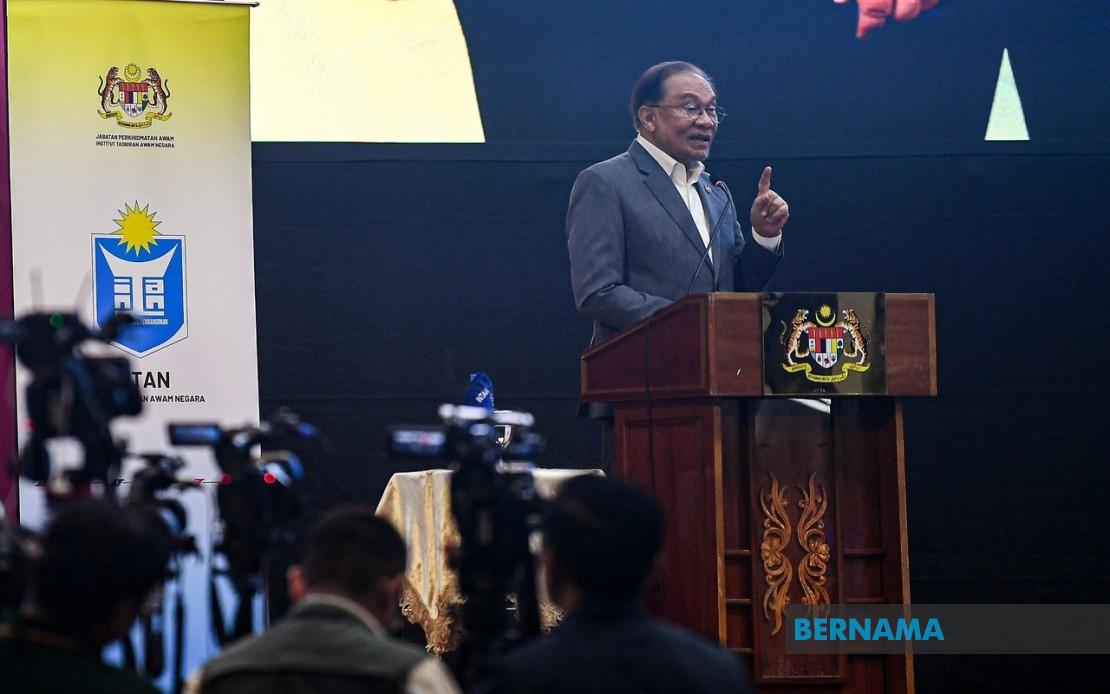
Prime Minister Datuk Seri Anwar Ibrahim has issued a direct challenge to Malaysians to move beyond the lingering mental patterns of colonialism that continue to shape how the nation approaches governance, education, economics and culture. Speaking at Universiti Islam Selangor during an engagement with civil servants from the Central Zone, Anwar stressed that true independence means more than simply gaining political sovereignty—it requires a fundamental shift in how citizens perceive themselves and their nation's capabilities relative to Western powers.
The Prime Minister articulated a concern that resonates across Southeast Asia: the tendency of post-colonial societies to measure their own institutions and approaches against Western benchmarks and find them wanting. He pointed out that even among Malaysians born after independence in 1957, a substantial portion still unconsciously accepts the hierarchy that places Western models at the apex of development, progress and modernity. This mindset, he suggested, represents an unfinished decolonisation—a failure to truly reclaim intellectual and cultural agency even decades after formal independence was achieved.
Anwar's criticism extended specifically to how this colonial echo manifests in educational policy and language choices. He described the contradiction of citizens with "brown skin" who nonetheless insist that education must be conducted in English, that cultural sophistication is measured by alignment with Western standards, and that economic and political systems must necessarily follow Western templates. The implication is that these individuals have accepted a framework in which anything associated with Malaysia's own heritage, languages and indigenous approaches is inherently less worthy of emulation or development.
The gathering where these remarks were made included Chief Secretary to the Government Tan Sri Shamsul Azri Abu Bakar and Director-General of the Public Service Tan Sri Wan Ahmad Dahlan Abdul Aziz, suggesting that the message was deliberately directed at the civil service apparatus that administers national policy. This audience selection indicates the Prime Minister views the bureaucracy as a critical lever for shifting the nation's ideological orientation away from Western dependency toward what he frames as authentic Malaysian development.
For Malaysia specifically, this argument carries particular weight. As a multiethnic, multicultural democracy that has navigated complex post-colonial challenges, the nation has often borrowed extensively from various models—Westminster parliamentary systems, Western corporate governance frameworks, and English-medium education in elite institutions. While these choices were pragmatic responses to particular historical circumstances, Anwar's intervention suggests they should now be re-examined through a lens of national self-determination rather than assumed superiority of foreign approaches.
The timing of this appeal also reflects broader regional and global currents. Southeast Asia as a whole has become increasingly assertive about charting its own developmental path, resisting pressure to conform to externally prescribed models of democracy, human rights advocacy, or economic organisation. Malaysia, as one of the region's larger and more influential economies, has particular responsibility to model an alternative to blanket Westernisation while maintaining international competitiveness and engagement.
Anwar's framing positions the challenge not as xenophobia or isolationism but as intellectual maturity and genuine independence. He argues that a truly confident nation draws from multiple sources—learning from global best practices without surrendering the right to adapt, reject, or innovate based on its own circumstances, values and priorities. This distinction matters because it allows for continued international engagement and cooperation while rejecting the premise that Western approaches are universally optimal or morally superior.
The practical implications of this philosophical stance extend across multiple policy domains. In education, it suggests reconsidering the balance between English and Malay medium instruction, and the relative emphasis placed on Western versus Asian intellectual traditions. In governance, it invites fresh evaluation of whether Westminster parliamentary conventions truly serve Malaysian needs or whether hybrid approaches might be more effective. In economics, it opens space for reconsideration of development models that may prioritise community welfare and environmental sustainability over pure market efficiency.
Yet implementing such a reorientation faces substantial obstacles. International business operates predominantly in English, many of Malaysia's trading partners and investors come from Western nations, and the nation's educational infrastructure has been built over decades with English proficiency as a key output. Simply reversing course without careful planning could undermine competitiveness. The challenge, therefore, is not wholesale rejection of Western influence but rather achieving a more balanced, intentional and self-directed relationship with it.
Anwar's intervention also speaks to anxiety about Malaysia's identity amid rapid globalisation and the influence of international capital, technology and culture. By framing the issue as a choice about national agency rather than as backwards-looking nostalgia, he attempts to reposition the conversation. This allows younger Malaysians, in particular, to consider their nation's trajectory without the false choice between modernisation (equated with Westernisation) and preservation (dismissed as stagnation).
The statement represents a sustained ideological effort by the Prime Minister to reshape national discourse around development, sovereignty and cultural pride. Whether this rhetorical reorientation translates into concrete policy shifts—in curriculum design, language policy, or governance structures—will determine whether this represents a meaningful turning point or primarily symbolic repositioning. What is clear is that Anwar sees breaking free from colonial psychological patterns as central to Malaysia's maturation as an independent nation.

