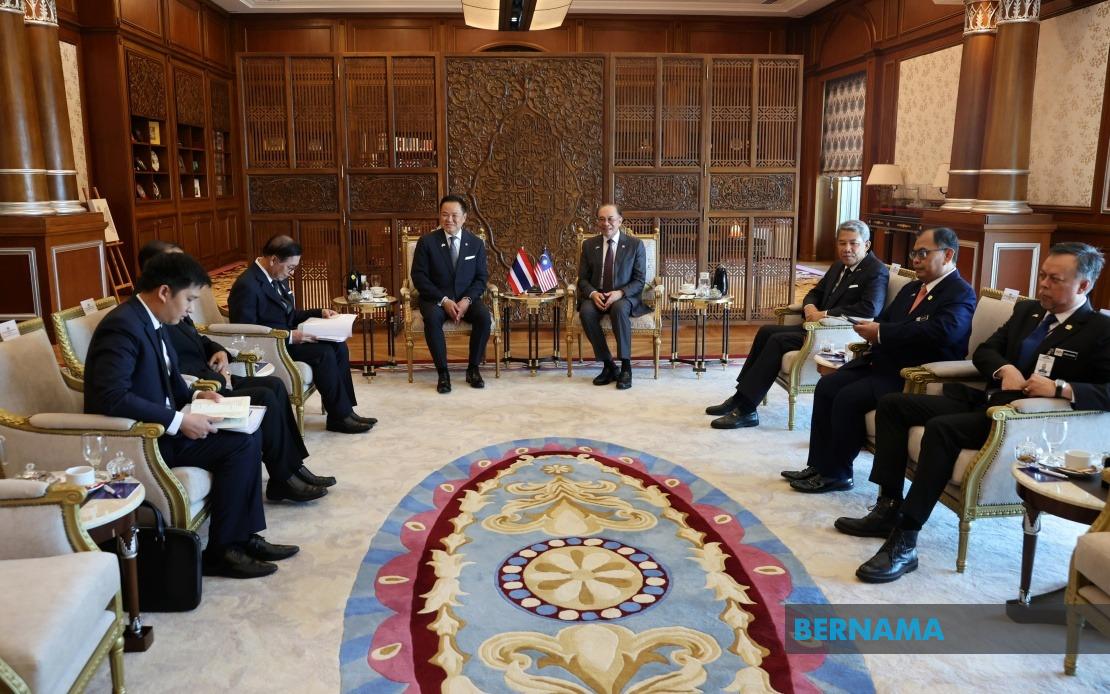
Malaysia's commitment to resolving the Myanmar conflict through dialogue rather than isolation received fresh emphasis this week as Prime Minister Datuk Seri Anwar Ibrahim hosted his Thai counterpart for bilateral talks in Putrajaya. The discussions, held during Thai Prime Minister Anutin Charnvirakul's first official visit to Malaysia since his reappointment in March 2026, underscored the regional consensus that military coups and political deadlock demand patient diplomatic engagement rather than confrontational stances.
Anwar articulated a philosophy that has become increasingly central to Malaysia's foreign policy approach: grounding solutions to intractable regional problems in respect for national sovereignty and self-determination. By emphasizing that Myanmar's people should be permitted to chart their own course, the Malaysian premier signalled support for processes that prioritize inclusive dialogue over externally imposed timelines or conditions. This approach reflects a broader Southeast Asian understanding that prescriptive international intervention often hardens positions rather than facilitating breakthrough moments.
What distinguishes Malaysia's framing is the strategic assignment of Thailand as a linchpin in these efforts. This positioning carries substantial weight given Bangkok's geography, historical ties to Naypyidaw, and economic interdependence with Myanmar. Thailand shares a long land border with Myanmar and hosts significant refugee and migrant populations displaced by the conflict, making the kingdom's stabilization interests genuine rather than rhetorical. By explicitly recognizing Thailand's potential as a neighbour with unique leverage and credibility, Anwar has effectively endorsed a differentiated diplomatic architecture where each ASEAN member contributes according to its capacities and relationships.
The Myanmar situation has presented ASEAN with perhaps its most significant test since the bloc's founding principles were established. Since the military takeover in February 2021, the ten-member association has struggled to maintain cohesion while advancing the Five-Point Consensus—a framework calling for dialogue, cessation of violence, humanitarian assistance, and mediation by an ASEAN envoy. Progress has been halting, with some member states pursuing bilateral channels while others maintain official distance from the junta. Malaysia's reaffirmation of the engagement pathway suggests continuing faith in ASEAN mechanisms, even as their effectiveness remains limited.
The bilateral meeting also touched upon Thailand's southern border tensions with Cambodia, an issue that intersects with broader regional stability concerns. Anwar's acknowledgment of Anutin's commitment to peaceful resolution demonstrated Malaysia's careful navigation of competing ASEAN interests. By publicly endorsing diplomatic solutions to disputes between member states, Malaysia reinforces the principle that intra-ASEAN conflicts must not undermine collective responses to larger threats. This balancing act requires diplomatic finesse, as member states must simultaneously support each other's sovereignty claims while preventing bilateral disputes from fragmenting the bloc.
The timing of Anutin's visit carries additional significance in the context of infrastructure development and cross-border cooperation. The two leaders are scheduled to jointly inaugurate a road connection between Malaysia's Immigration, Customs, Quarantine and Security (ICQS) Complex in Bukit Kayu Hitam, Kedah, and Thailand's corresponding Customs, Immigration and Quarantine (CIQ) Complex in Sadao. This infrastructure project represents tangible progress on facilitating legitimate trade and movement while strengthening security protocols—precisely the kind of practical cooperation that underpins deeper political relationships.
Such connectivity initiatives acquire heightened importance in the context of regional geopolitical shifts. As Southeast Asian nations navigate competing pressures from major powers and internal instability, cross-border infrastructure becomes both a symbol of commitment to intra-regional partnership and a practical mechanism for addressing shared challenges. The Bukit Kayu Hitam-Sadao link will streamline commerce between Malaysia and Thailand while potentially enhancing coordination on security and customs matters that bear indirectly on stability across Myanmar's borders.
Malaysia's diplomatic positioning on Myanmar reflects broader strategic calculations about ASEAN's future relevance and cohesion. By emphasizing dialogue and respecting self-determination, Kuala Lumpur avoids the appearance of imposing solutions while maintaining its credentials as a reasonable actor committed to regional rules. This approach proves particularly valuable as ASEAN faces skepticism from observers who question whether the bloc can meaningfully influence member state behaviour or coordinate responses to existential challenges. Malaysia's consistent advocacy for engagement-based approaches, backed by respected leadership, lends weight to ASEAN's claims that patient diplomacy remains viable.
The Myanmar crisis will likely remain contested terrain within ASEAN, with member states disagreeing on optimal strategies and timelines. However, the visible alignment between Malaysia and Thailand on fundamental principles—rejecting isolation, valuing dialogue, respecting Burmese agency—suggests that the bloc's core membership continues supporting gradualist approaches. This consensus, while offering no guarantees of breakthrough, provides the essential foundation for any future progress toward political settlement in Myanmar.
Looking forward, Anwar's emphasis on Thailand's pivotal role should be understood as both recognition of Bangkok's structural position and implicit encouragement for the Thai government to deepen its mediation efforts. Whether through formal ASEAN channels or quieter bilateral diplomacy, Thailand possesses advantages that neither Malaysia nor other bloc members can replicate. For Malaysian readers, this development suggests that Putrajaya remains committed to engaging Myanmar through patient regional mechanisms rather than pursuing confrontational stances that could further splinter ASEAN consensus.

