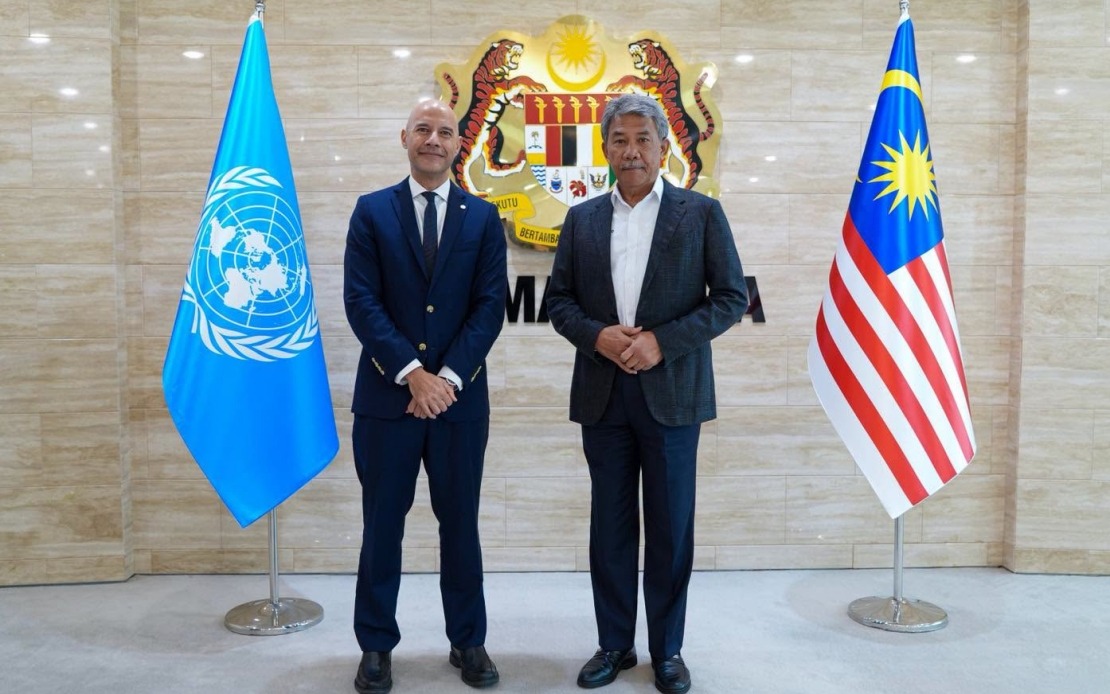
The Malaysian government is signalling its commitment to deepening engagement with the United Nations through a meeting between Foreign Minister Datuk Seri Mohamad Hasan and the regional representative of the world body. Nikolas Myint, who was recently appointed as United Nations Resident Coordinator for Malaysia, Singapore and Brunei, paid a courtesy visit to Wisma Putra on Wednesday to begin what is expected to be a substantive working relationship with Malaysian officials.
The appointment of Myint to oversee UN operations across three Southeast Asian nations underscores the organization's strategic focus on the region. His elevation to coordinate UN activities in Malaysia, Singapore and Brunei came through a decision by United Nations Secretary-General on May 31, 2026, reflecting the importance the international body places on engagement with these three economies. The timing of Myint's initial meeting with Malaysia's foreign minister signals that Kuala Lumpur intends to position itself as a key partner in the UN's regional agenda.
According to remarks shared by Mohamad following the meeting, both sides explored areas of mutual interest and cooperation. The discussion centred on how Malaysia and the UN system can work together more effectively to address the complex challenges confronting the global community. These range from climate change and sustainable development to humanitarian assistance and conflict resolution—issues that directly affect Southeast Asia's stability and prosperity.
Malaysia's foreign ministry emphasized that the nation values the UN's multilateral framework for addressing transnational problems that cannot be solved by individual countries acting alone. In a statement, Mohamad highlighted that Malaysia remains committed to supporting the United Nations' mission while ensuring that international cooperation aligns with the country's own development priorities. This framing reflects a deliberate effort to position Malaysia not merely as a participant in the UN system, but as an active contributor shaping its direction.
The courtesy call also represents an opportunity to brief Malaysia's government on the UN's current portfolio of activities within the country. UN agencies operating in Malaysia work on issues spanning health, education, environment, and social welfare. Regular engagement between senior Malaysian officials and UN representatives helps ensure that international development assistance and programmes complement national strategies rather than operating in parallel.
For Southeast Asia more broadly, the presence of a regional UN coordinator with responsibility for three major economies signals the organization's recognition of the area's geopolitical and economic significance. Malaysia, as an upper-middle-income country and founding member of ASEAN, often serves as a diplomatic hub and voice for the region. The Foreign Minister's receptiveness to Myint's visit reflects Kuala Lumpur's intention to leverage this position to influence UN priorities affecting Southeast Asia.
The meeting carries particular relevance given Malaysia's ongoing focus on sustainable development and climate action. The country has committed to net-zero emissions by 2050 and maintains active programmes addressing biodiversity loss and environmental degradation. UN agencies provide technical expertise and financial mechanisms that help Malaysia advance these goals. Regular high-level contact between the Foreign Minister and the UN Resident Coordinator helps ensure these initiatives receive political attention at the highest levels of government.
Moreover, the dialogue reflects Malaysia's broader strategic orientation toward multilateralism. Despite navigating complex regional geopolitical dynamics, Malaysia has consistently invested in international institutions and cooperative frameworks. The UN remains central to this strategy, offering a neutral platform for Malaysia to address security concerns, pursue economic cooperation, and amplify its voice on global issues affecting developing nations.
The appointment of Myint also introduces an institutional dimension to Malaysia-UN relations that extends beyond bilateral exchanges. As coordinator for three countries, Myint will likely facilitate greater coordination among UN agencies operating across Malaysia, Singapore and Brunei, potentially enabling more efficient resource deployment and better integrated programming. This structural advantage presents opportunities for Malaysia to shape regional UN strategy in ways that benefit all three countries while addressing country-specific needs.
Looking ahead, the relationship between Mohamad and Myint will likely set the tone for Malaysia's engagement with the UN system during a critical period. Global challenges are intensifying—from climate impacts to pandemic preparedness—while resources for international development remain constrained. Malaysia's willingness to engage proactively with UN leadership suggests the government recognizes that success in addressing these challenges requires sustained partnership between national governments and international institutions.
The Foreign Ministry's public acknowledgment of the meeting also serves a domestic political function. It demonstrates to Malaysian stakeholders—civil society, businesses, academia—that government is actively engaging with international partners on matters affecting the country's future. This transparency reinforces Malaysia's credentials as a responsible actor in the global system while maintaining pressure on domestic agencies to align with international commitments on development and sustainability.
Looking at the broader context, Malaysia's approach to UN engagement reflects a sophisticated understanding that traditional notions of sovereignty need not conflict with participation in global institutions. Rather, effective multilateralism requires countries to invest time and political capital in relationships with international organizations. The meeting between Mohamad and Myint represents precisely this investment, establishing the foundation for cooperation that could yield tangible benefits for Malaysia's development agenda and regional stability throughout Myint's tenure.

