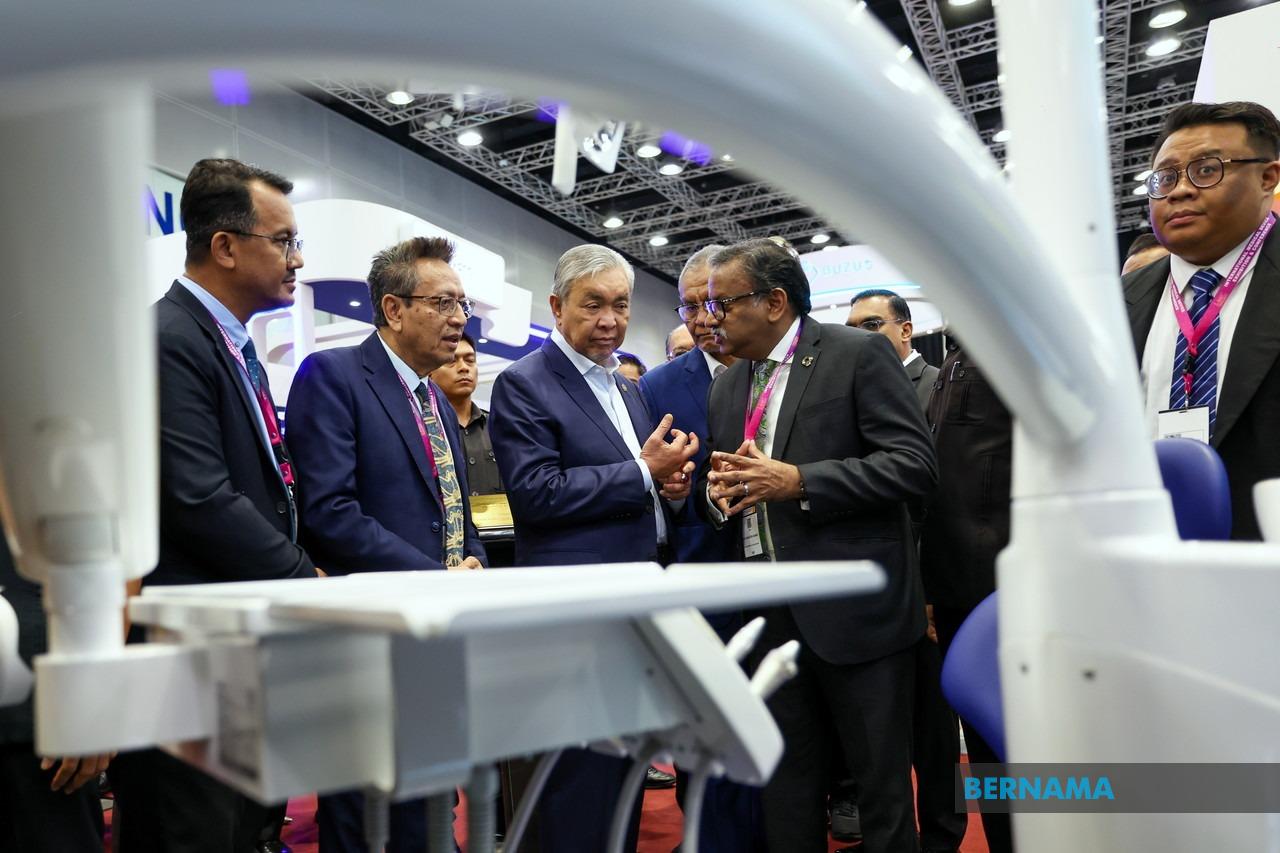
Malaysia is setting its sights on becoming a significantly larger player in the global medical device market, with Deputy Prime Minister Datuk Seri Dr Ahmad Zahid Hamidi calling for the nation to surpass RM50 billion in exports by 2030—a substantial jump from the RM34.54 billion achieved last year. The ambitious growth target, unveiled at the closing ceremony of the International Medical Device Exhibition and Conference (IMDEC) 2026 in Kuala Lumpur, reflects the government's determination to transform the country's medical technology sector into a major regional powerhouse over the remainder of this decade.
The RM50 billion export milestone represents just one component of a three-pronged strategy designed to reshape Malaysia's position within the medical device industry. Ahmad Zahid framed the objectives as concrete measures by which the nation can evaluate its progress in building a robust and competitive MedTech ecosystem. The government's confidence in achieving this expansion rests on Malaysia's existing strengths: an established manufacturing infrastructure, preferential market access through regional trade agreements, and a well-earned global reputation for quality and reliability. Yet officials acknowledge that simply increasing export volumes will not suffice for long-term success.
The second pillar of Malaysia's strategy involves nurturing and developing at least ten homegrown Malaysian medical technology champions capable of competing on regional and global stages. This objective signals an important shift in thinking about how the country should participate in the medical device supply chain. Rather than remaining primarily a contract manufacturer or assembly hub for multinational corporations, Malaysia aims to cultivate locally-owned enterprises that develop proprietary technologies, hold valuable intellectual property rights, and establish themselves as independent market competitors. The government has signalled its willingness to continue attracting leading international MedTech firms, but this invitation now comes with an expectation that technology transfer and knowledge retention will play increasingly important roles in investment negotiations.
The third ambition addresses what economists and policy makers view as a critical vulnerability in Malaysia's industrialisation trajectory: the quality of jobs generated by investment inflows. Ahmad Zahid emphasized that at least half of all employment opportunities created by new MedTech investments by 2030 should comprise managerial, technical, and supervisory positions—the higher-value roles that provide superior compensation, career progression, and skills development. This target carries particular urgency given that the medical device sector's proportion of such positions currently stands at only 33.1 percent as of 2025. The deputy prime minister articulated a fundamental principle underpinning this push: capital may flow into Malaysia, but the nation must ensure that advanced capability and sophisticated skill sets remain anchored within Malaysian borders.
Ahmad Zahid, speaking in his capacity as National Technical and Vocational Education and Training Council chairman, articulated a significant departure from past practice in how Malaysia has approached workforce development. Traditionally, companies arriving with investment have identified skills gaps after establishing operations, prompting reactive government responses and talent recruitment programmes. The new approach reverses this sequence, insisting that capability building must precede major capital inflows rather than following them. This proactive stance requires multinational firms contemplating expansion in Malaysia to engage earlier in dialogue with government, educational institutions, and workforce development agencies. Companies are being encouraged to collaborate in shaping training programmes, anticipating future skill requirements, offering industrial exposure opportunities, and expanding apprenticeship pathways well before they formally commit to operational presence.
The sector has already demonstrated momentum in the near term. During 2025, Malaysia approved RM4 billion in fresh medical device investments across forty-six separate projects, which collectively generated approximately 3,400 employment opportunities. These figures suggest that investor interest remains strong, and the mechanisms for attracting capital-intensive manufacturing are functioning effectively. However, the challenge ahead involves ensuring that these investments increasingly translate into high-value activity and locally-developed intellectual property rather than simply replicating assembly operations that could easily relocate to lower-cost jurisdictions.
International market dynamics underscore the urgency of Malaysia's ambitions. The global medical device industry reached a valuation exceeding USD572 billion in the previous year, with projections indicating the sector will nearly double in size to surpass USD1 trillion by 2034. This expansion reflects aging populations across developed and emerging economies, rising healthcare expenditure in Asia-Pacific regions, and accelerating technological innovation in diagnostic and therapeutic devices. Nations that successfully position themselves as hubs for high-value medical technology production will capture disproportionate benefits from this expansion. Malaysia's current export trajectory, while respectable, risks marginalisation if the country cannot transition toward premium products and proprietary solutions that command superior margins.
The IMDEC 2026 conference itself, held from August 26 to 28, provided a platform for advancing these objectives through direct engagement among stakeholders. The event assembled more than one hundred sixty exhibitors and hosted over fifty speakers from regional and international backgrounds, who addressed topics spanning regulatory frameworks, technological innovation, and healthcare system transformation. Such gatherings create networking opportunities that can catalyse partnerships between multinational firms seeking to expand operations, local companies seeking technology transfer and market access, and government agencies tasked with policy implementation and workforce development.
Malaysia's medical device sector strategy must also be understood within the broader Southeast Asian economic context. Regional competitors including Thailand, Vietnam, and Indonesia are simultaneously pursuing medical technology diversification and industrial upgrading. Thailand has positioned itself as a regional hub for orthopedic devices, while Vietnam has attracted investment in electronics manufacturing that increasingly encompasses medical applications. Malaysia's established manufacturing ecosystem and strategic location position it advantageously, yet complacency risks surrendering first-mover advantages. The government's emphasis on developing local champions and capturing higher-value activities reflects awareness that commodity-style medical device manufacturing cannot indefinitely sustain employment growth or wage improvements that Malaysia's workforce has come to expect.
The transition Ahmad Zahid envisions—from contract manufacturer to technology originator—requires sustained commitment from multiple constituencies. Educational institutions must align curricula with emerging industry requirements and cultivate entrepreneurial mindsets among graduates capable of founding and scaling technology enterprises. Research institutions require adequate funding to develop innovations that private sector firms can eventually commercialise. Financial institutions must become more comfortable providing capital to early-stage MedTech ventures, which typically involve higher risk than established contract manufacturing operations. Regulatory agencies need sufficient expertise to evaluate novel medical devices and approve them expeditiously without compromising safety or efficacy standards. Finally, companies must internalize the understanding that investing in Malaysian talent development and local research capabilities represents strategic long-term positioning rather than merely paying compliance costs.
The RM50 billion export target by 2030, while ambitious, becomes more credible when evaluated against Malaysia's demonstrated capacity for rapid sectoral expansion in previous decades. The semiconductor industry, initially characterised by assembly operations, evolved into a more sophisticated ecosystem including design and fabrication capabilities. The electrical and electronics manufacturing sector underwent similar transformation. Yet Malaysia cannot assume automatic progression along this trajectory; deliberate policy intervention, strategic investment in human capital, and sustained commitment from both public and private sectors will prove essential. Ahmad Zahid's pronouncements indicate that the government considers this not merely a commercial objective but a development priority central to Malaysia's evolution toward a high-income economy.

