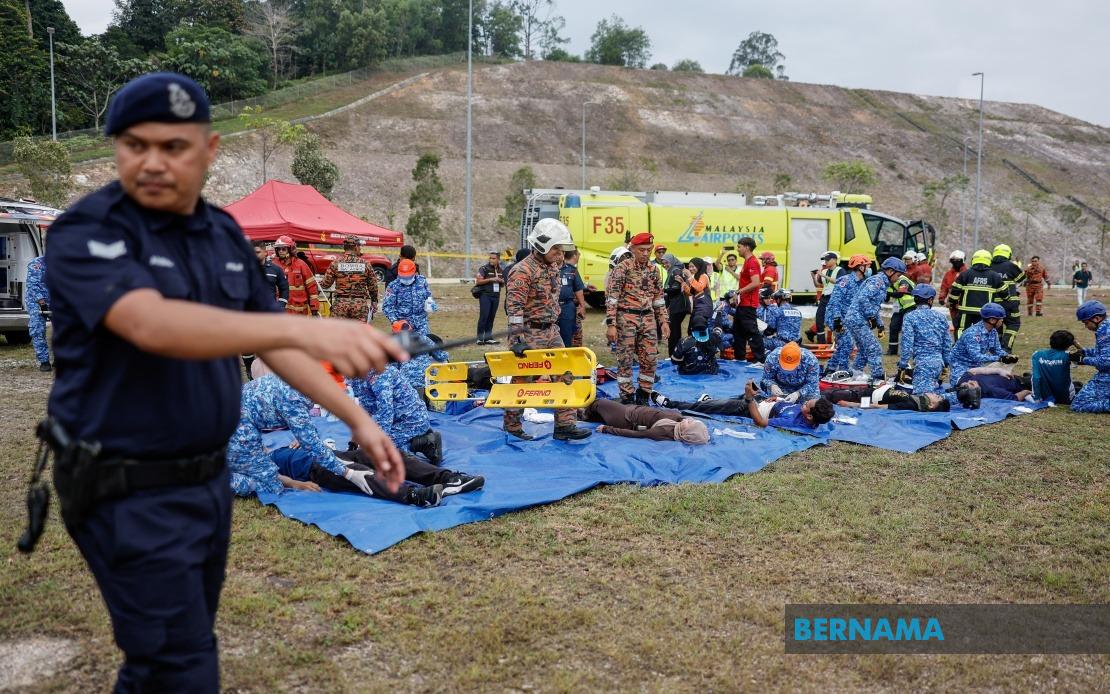
Malaysia's emergency response system faced a crucial test on July 16 when authorities staged Ex Urban Falcon 2026, a comprehensive crisis simulation at the Denai Alam Rest and Service Area along the Damansara-Shah Alam Elevated Expressway. The exercise, involving over 20 enforcement and emergency agencies with 450 participants, represented a significant evolution in the nation's aviation disaster preparedness by focusing on aircraft accidents occurring well beyond airport boundaries—an operational challenge that has received minimal attention in previous training scenarios.
The simulated incident depicted an ATR72 aircraft impact approximately six kilometres from Sultan Abdul Aziz Shah Airport in Subang. According to Airport Fire and Rescue Services (AFRS) general manager Muhammad Hidayat Ismail, the scenario was deliberately positioned beyond the conventional response zone to test coordination mechanisms under real-world conditions that deviate from standard aerodrome emergency protocols. Under Malaysia's National Aeronautical Search and Rescue Manual (NAMSA), AFRS maintains direct responsibility across a radius extending eight kilometres from the airport's centre point, yet previous exercises had concentrated mainly on incidents occurring within or immediately adjacent to airport grounds.
The decision to simulate an off-airport scenario addresses a critical gap in Malaysia's emergency management framework. Muhammad Hidayat emphasised that this represented the first exercise of its scale and scope to comprehensively test response capabilities when an aircraft accident occurs substantially beyond typical response zones. This departure from historical practice reflects growing recognition that commercial aviation routes and flight patterns can result in emergency landings or catastrophic incidents in populated areas far removed from airport infrastructure. The exercise therefore aimed to validate whether Malaysia's multi-agency systems can function effectively when traditional coordination networks must be stretched across urban and suburban terrain.
A primary challenge highlighted throughout the drill involved response time and accessibility. Teams confronted significant obstacles navigating the narrow secondary roads connecting the expressway to the simulated crash site, with additional complications arising from traversing multiple toll plazas. These logistical constraints mirror real-world complexities that responders would face during an actual off-airport incident, particularly given the concentration of Malaysian aviation activity around major urban corridors where congestion and infrastructure bottlenecks routinely impede emergency vehicle movement.
Despite these difficulties, Muhammad Hidayat observed that participating agencies executed their designated functions according to established protocols with particular competence in firefighting and rescue operations. The exercise demonstrated that technical capabilities—advanced aircraft firefighting vehicles meeting International Civil Aviation Organisation (ICAO) and Civil Aviation Authority of Malaysia (CAAM) specifications—remain properly maintained and operationally ready. However, the successful execution of firefighting protocols represented only one dimension of a far more complex response architecture required for major aviation disasters.
A critical distinction emerged between airport-based and off-airport incidents: survival prospects diminish significantly when aircraft impact uneven terrain removed from airport grounds. Off-airport locations typically present more severe structural damage, greater environmental hazards, and reduced accessibility for rescue teams, collectively resulting in casualty profiles where fatalities substantially outnumber survivors. This sobering reality underscores why inter-agency coordination during Disaster Victim Identification (DVI) operations—led by the Royal Malaysia Police—becomes exponentially more demanding in off-airport scenarios compared to controlled airport environments.
The exercise engaged critical institutions across aviation, emergency management, and local governance, including Malaysia Airports Holdings Berhad (MAHB), the National Disaster Management Agency (NADMA), the Selangor state government, and PROLINTAS-DASH operating the elevated expressway. This broad institutional representation reflected the genuine complexity of coordinating response across multiple jurisdictional boundaries when aviation disasters occur outside airport environs. Each organisation brings distinct capabilities and operational mandates that must function cohesively, yet off-airport incidents necessarily involve civil authorities, infrastructure managers, and local emergency services whose roles differ fundamentally from airport-based response structures.
Muhammad Hidayat acknowledged that observations from the exercise would inform systematic improvements. A dedicated workshop scheduled for July 26 and 27 would analyse findings and identify refinement opportunities within Malaysia's coordinated disaster response framework. This follow-up process represents important practice in emergency management, converting field observations into actionable improvements rather than treating exercises as standalone validation events. The analytical phase following Ex Urban Falcon 2026 would likely address communication protocols, resource staging, inter-agency command structures, and resource allocation mechanisms specific to off-airport environments.
The sustained participation by all involved agencies conveyed a broader message regarding Malaysia's aviation safety commitment. Muhammad Hidayat framed the exercise as evidence of systemic preparedness that ultimately reinforces public confidence in aviation safety frameworks. This confidence dimension proves particularly significant in Malaysia's context, where aviation supports both domestic connectivity and international business operations. Demonstrating that authorities comprehensively prepare for worst-case scenarios—including uncommon off-airport incidents—subtly but meaningfully influences passenger perception and national reputation within aviation sectors.
The distinction between theoretical preparedness and operational readiness became apparent through Ex Urban Falcon 2026. While Malaysia maintains sophisticated technological capabilities and formal emergency protocols, translating these elements into coordinated action across multiple agencies facing logistical constraints and unfamiliar operational environments revealed both strengths and development areas. The exercise reflected international best practices emphasising recurring, increasingly challenging scenario-based training rather than reliance on static procedures. As Southeast Asian aviation continues expanding and flight frequencies increase across regional airspace, maintaining this commitment to realistic, demanding training becomes essential for protecting both passengers and communities beneath busy air corridors.

