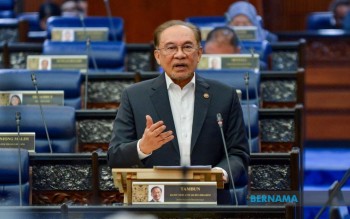
The Malaysia-Thailand Border Economic Zone represents a strategic pivot to unlock greater commercial connectivity across mainland Southeast Asia, Prime Minister Datuk Seri Anwar Ibrahim indicated in Parliament on July 14. Speaking during Minister's Question Time in the Dewan Rakyat, Anwar outlined how the joint initiative—already formally inaugurated at Sadao and Bukit Kayu Hitam with his Thai counterpart Anutin Charnvirakul—will fundamentally reshape trade dynamics between Malaysia and the broader Indochinese region comprising Laos, Cambodia and Vietnam.
The core economic benefit centres on removing longstanding customs friction that has constrained Malaysian exporters. Anwar noted that Malaysian fisheries and agricultural products have historically encountered restrictive Thai customs procedures when transiting through Thai territory toward downstream Indochina markets. Bangkok's agreement to streamline these requirements signals a significant shift in bilateral trade facilitation. By harmonising or relaxing customs protocols at border crossing points, Malaysian goods can now move with considerably greater efficiency, reducing transit times and associated costs that previously compressed margins for exporters, particularly smaller operators lacking sophisticated logistics networks.
This development carries particular significance for Malaysia's primary export sectors. Fisheries and agricultural commodities form backbone industries for rural communities, especially in Peninsular Malaysia's border regions and the east coast. The Indochina region, with its expanding middle class and growing food consumption, represents substantial untapped demand for Malaysian products. However, geographic constraints mean Thai territory effectively functions as a gateway. Previous tariff schedules and bureaucratic procedures created artificial barriers that benefited Thai producers and limited Malaysian market penetration. The BEZ framework repositions Malaysia as a preferred supply source rather than a disadvantaged competitor.
Beyond the two initial border towns, the initiative encompasses Rantau Panjang in Kelantan, where Anwar indicated the federal government would work with the state administration to accelerate implementation. This expansion signals ambition to transform the entire Malaysia-Thailand border corridor into a genuinely integrated economic space rather than treating development as isolated projects. Rantau Panjang's inclusion is strategically significant, as the town serves as a natural gateway to Thailand's northeastern provinces and onward connectivity to Laos and Cambodia via established transportation networks.
Critically, Anwar emphasised that the BEZ framework prioritises inclusion of small and medium-sized enterprises alongside job creation and skills development. Border communities have historically remained economically peripheral despite geographic proximity to trade routes. By designing the zone with SME participation in mind, the government aims to distribute prosperity among local entrepreneurs rather than concentrating benefits among large corporations. This approach acknowledges that unmanaged trade liberalisation can marginalise smaller players unable to exploit new market access independently. Targeted support mechanisms should enable local businesses to leverage the zone's infrastructure and reduced trade barriers.
Transportation infrastructure represents the essential physical backbone for realising the BEZ's commercial potential. Anwar revealed that the federal government has committed to extending the East Coast Rail Link southward to reach Rantau Panjang. This decision transforms the ECRL from a primarily domestic connectivity project into a potential gateway for Malaysia-Thailand trade integration. During discussions with Anutin, Malaysia proposed that the rail corridor be extended into Thai territory along the same alignment, potentially creating an unprecedented land-based transport corridor linking Malaysia's interior directly to Thailand's northeastern provinces and beyond toward Vietnam.
Rail-based border connectivity offers advantages over existing road routes. Bulk commodities like agricultural products and seafood benefit considerably from rail transport's lower per-unit costs, reduced spoilage for perishables through climate control, and predictable scheduling. A functioning Malaysia-Thailand rail link would directly reduce the operational friction that currently limits agricultural export competitiveness. Infrastructure development of this calibre typically requires multi-year implementation timelines, but its completion would materially alter regional trade patterns by making Malaysian exports substantially more cost-competitive across Indochina.
The broader strategic context reflects Malaysia's calculated positioning within Southeast Asia's evolving economic architecture. While ASEAN provides the overarching framework, bilateral arrangements increasingly drive trade expansion. Thailand functions simultaneously as competitor and necessary partner for Malaysian exporters seeking Indochina market access. The BEZ framework essentially formalises what geographical reality demands: Thai cooperation is prerequisite for Malaysian commercial success in Cambodia, Laos and Vietnam. By securing Bangkok's commitment to customs relaxation and jointly investing in border infrastructure, Anwar's administration has converted a potential competitive disadvantage into a collaborative advantage.
The trade potential represents the opportunity cost of inaction. Malaysia-Thailand bilateral commerce has historically underperformed relative to the two nations' combined economic capacity. Anwar characterised existing trade volumes as falling short of realistic potential, reflecting how customs barriers, infrastructure gaps and lack of coordination have constrained natural complementarities. The BEZ initiative directly addresses these structural limitations through institutional reform and physical infrastructure investment.
Implementation success will depend on several factors extending beyond immediate government announcements. Thai bureaucratic acceptance of streamlined customs procedures requires coordinating multiple agencies and potentially revising longstanding regulations. Infrastructure projects like the ECRL extension and potential Thai rail continuation involve substantial capital investment and complex cross-border coordination. Border communities and SMEs require practical support mechanisms—training programmes, financing facilities, market information systems—rather than merely rhetorical inclusion.
For Malaysian businesses and policymakers, the BEZ framework signals a measured but meaningful opening of regional trade possibilities. Rather than pursuing dramatic protectionist reversals, the government has chosen to negotiate bilateral competitive advantages while investing in enabling infrastructure. Success would position Malaysia as an efficient transit point and export source for Indochina markets, generating employment and prosperity across border regions that have historically lagged national development metrics.
The initiative ultimately reflects pragmatic recognition that Malaysia's economic future depends on deepening integration within Southeast Asia rather than pursuing isolation. The BEZ represents incremental but substantive progress toward that objective, provided implementation matches ambition.

