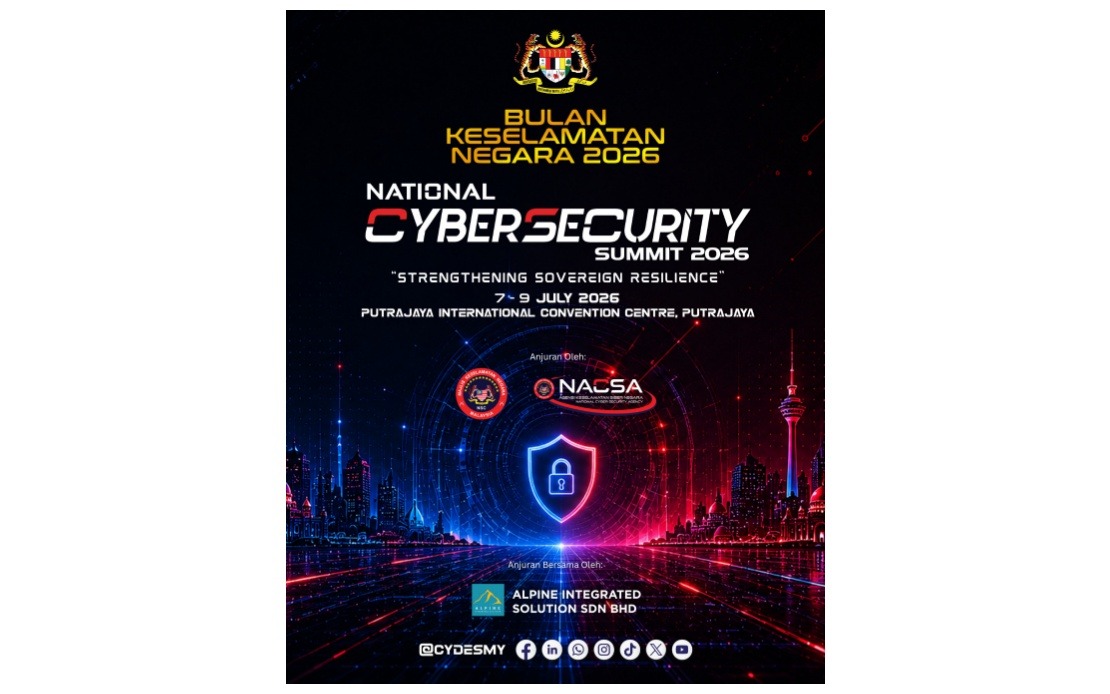
Malaysia's cyber security sector will converge in Putrajaya next month for a three-day summit aimed at fortifying the nation's digital defences against mounting threats. The National Cyber Security Agency, operating under the Prime Minister's National Security Council, will facilitate the National Cyber Security Summit 2026 from July 7 to 9 at the Putrajaya International Convention Centre. The gathering represents a critical juncture for aligning Malaysia's cyber strategy with emerging digital risks that increasingly impact government, business and citizens across the region.
The timing of the summit is particularly significant given the Cybercrimes Bill 2026's passage through the Dewan Rakyat on July 1, a legislative milestone that establishes the legal framework for combating digital offences. This new law operationalises the broader Malaysian Cyber Security Strategy 2025-2030, which functions as the nation's overarching roadmap for addressing cyber vulnerabilities and building institutional capacity. The alignment between legislative action and the summit creates a comprehensive policy environment that reflects Malaysia's strategic approach to cyber governance—one increasingly necessary as the country deepens its digital economy integration across ASEAN.
Organised around the theme Strengthening Sovereign Resilience, the summit will convene policymakers, corporate executives, technology practitioners and security specialists to examine multi-sector cyber challenges. This cross-functional approach acknowledges that cyber threats transcend institutional boundaries; they demand coordinated responses involving government agencies, private enterprises, educational institutions and international partners. By bringing these stakeholders under one roof, Malaysia signals its understanding that resilience emerges through shared intelligence, standardised practices and collective problem-solving rather than siloed institutional efforts.
The National Security Council will simultaneously use the platform to introduce three transformative initiatives. Prime Minister Datuk Seri Anwar Ibrahim will formally launch the National Security Policy 2026-2030, setting strategic direction for Malaysia's defence posture in an era of hybrid threats. Accompanying this will be Malaysia's National Cryptography Policy, known as MyKriptografi, along with its associated action plan spanning 2026-2030. The third initiative—the Artificial Intelligence Systems Cybersecurity Framework—addresses a frontier concern as Malaysian enterprises and government agencies accelerate AI deployment without always maintaining security-first implementation practices.
The conference agenda demonstrates ambition in scope and depth. Organisers have scheduled 41 substantive sessions encompassing forums dedicated to implementing the Malaysian Cyber Security Strategy, dedicated cyber crime discussions, an Information and Communications Technology Security Officers convention, programming focused on women's participation in cyber careers, technical workshops and closed-door strategy sessions. This structured format allows participants to engage at multiple levels simultaneously, from high-level policy discourse to granular technical problem-solving. The inclusion of female-focused programming reflects recognition that cyber security's gender imbalance hampers sector growth; Malaysia's tech talent shortage intensifies when half the population remains underrepresented in these high-value career paths.
Participation spans geographic and sectoral boundaries in ways uncommon for regional cyber conferences. The summit will attract 96 speakers and panellists drawn from Malaysian government ministries, law enforcement bodies, private sector technology firms, academic researchers and international cyber security practitioners. Commercial representation includes 122 companies—78 domestically registered businesses and 44 international firms headquartered across seven countries—indicating Malaysia's positioning as a cyber security hub within Southeast Asia. This corporate presence transforms the summit from a purely policy discussion forum into a marketplace for solutions, talent recruitment and international partnership formation.
Expected attendance reflects the summit's significance within Malaysia's national security calendar. Beyond the 96 formal speakers, the event anticipates 3,000 total participants comprising registered delegates, trade visitors and industry representatives. Additionally, 250 specially invited domestic guests—likely senior government officials, business leaders and security establishment figures—will attend, suggesting the Prime Minister's office views the summit as essential to national leadership. This scale positions NCSS 2026 among Southeast Asia's premier cyber security convenings, competing with regional events in Singapore and Thailand for thought leadership and influence.
The summit occurs amid accelerating digital transformation across Malaysia's economy and government services. The financial sector's reliance on digital infrastructure, the healthcare system's expansion of telemedicine, and government agencies' ongoing digitisation efforts create expanding attack surfaces that threat actors actively exploit. Ransomware attacks targeting Malaysian institutions have intensified in recent years, while state-sponsored cyber espionage concerns grow as geopolitical tensions influence digital operations. Regional instability in areas like the South China Sea creates additional layers of cyber threat complexity, with potential for digital conflict emerging alongside traditional security concerns.
Malaysia's cyber security posture directly influences ASEAN's collective digital resilience. As one of the region's more economically advanced and digitally integrated nations, Malaysian developments in cyber policy and capability set precedents that neighbours monitor and potentially adopt. The summit's convening power creates space for bilateral and multilateral cyber security cooperation discussions that advance ASEAN's stated commitment to digital security. Formal participation by international companies from seven nations suggests the summit will include substantive exchanges on cross-border threat intelligence sharing, incident response coordination and harmonisation of cyber security standards—capabilities essential for regional stability.
The National Security Month framing emphasizes that cyber security is not merely a technical challenge but a national security imperative requiring whole-of-society engagement. By coupling the summit with National Security Month programming, Malaysia's security establishment signals that cyber threats rank alongside conventional military and law enforcement concerns in the hierarchy of national priorities. This framing helps educate the broader public about cyber risks while legitimizing investments in cyber infrastructure, personnel training and international cooperation. For Malaysian businesses and citizens increasingly conducting activities through digital channels, this institutional commitment provides assurance that government takes seriously the protection of economic and personal data.
The Artificial Intelligence Systems Cybersecurity Framework's launch carries particular importance given AI's disruptive trajectory. Malaysian enterprises and government agencies are adopting AI applications at accelerating rates, often without adequate security protocols. An AI system compromised by malicious actors or adversarial inputs creates cascading failures that traditional cyber defences fail to address. The AISCF provides technical and policy guidance for Malaysian organisations implementing AI securely, potentially positioning Malaysia as a regional leader in responsible AI deployment. This framework becomes increasingly valuable as smaller Southeast Asian nations lack the institutional resources to develop indigenous AI security standards and must adapt frameworks from developed countries to local contexts.
Looking forward, the summit's outcomes will likely influence Malaysia's cyber security trajectory through the remainder of the 2025-2030 strategic period. Network connections formed among participants will create ongoing collaboration channels, expected to accelerate information sharing and capability development. Policy recommendations emerging from closed workshops may inform refinements to the Cybercrimes Bill 2026 as enforcement agencies and prosecutors implement its provisions. International partnerships initiated at the summit could facilitate Malaysian participation in global cyber threat intelligence networks and incident response coordination bodies, positioning the country advantageously within the evolving international cyber governance architecture.

