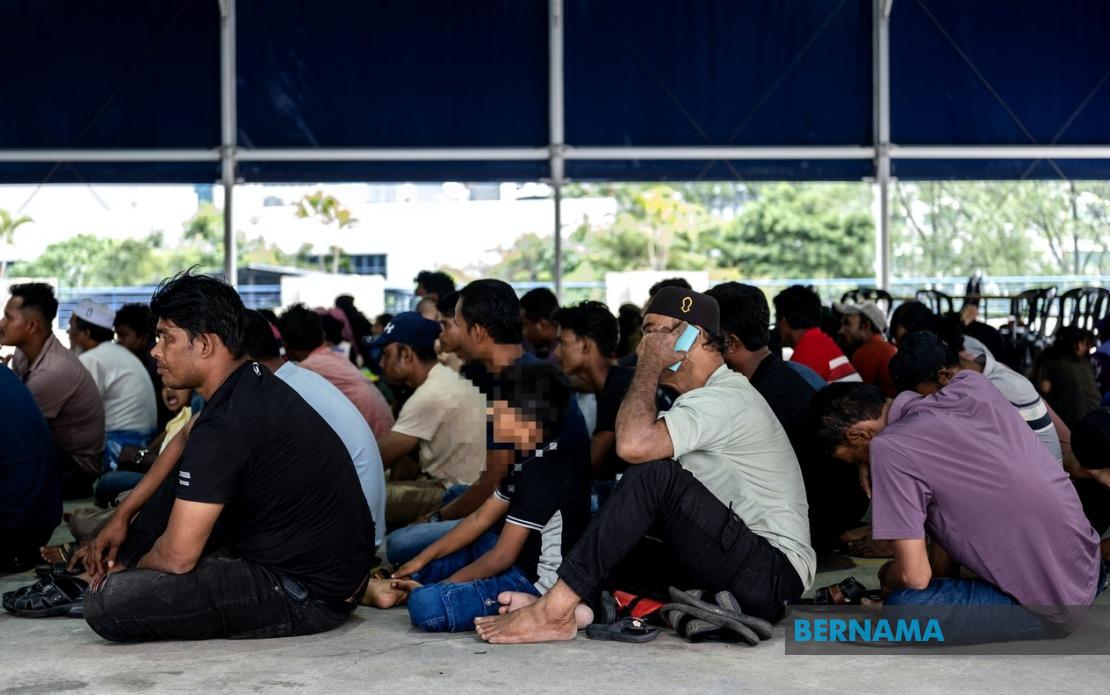
Malaysia's government expects to compile preliminary figures on Myanmar refugees registered through its official identification scheme by the final quarter of 2024, according to Home Minister Datuk Seri Saifuddin Nasution Ismail. Speaking after a public event in Putrajaya on Friday, the minister outlined the timeline for a systematic census being carried out by the Immigration Department in coordination with other government bodies. The stocktaking of refugee populations represents a significant administrative undertaking for Southeast Asia's second-largest economy, which hosts one of the region's substantial displaced communities amid Myanmar's ongoing political turbulence.
The refugee registration drive operates under the Refugee Registration Document, or DPP, framework—a government scheme designed to establish verifiable identity records and biometric information for individuals seeking recognition as refugees. This initiative aligns with Malaysia's updated National Security Council Directive, implemented in 2023 to provide a structured approach to managing irregular populations and humanitarian concerns simultaneously. By establishing a credible database, authorities aim to distinguish between genuine refugees fleeing persecution and other migrant groups, a distinction that carries profound policy implications for resource allocation, security vetting, and international obligations.
The Home Minister confirmed that the Immigration Department is actively engaging with relevant agencies to conduct the data collection exercise, though the specific mechanisms for reaching and registering refugees remain logistically complex. Malaysia must balance humanitarian principles with security considerations while managing the practical challenge of identifying and documenting individuals who may lack official documentation or trust in government processes. The minister stated that officials plan to publicise the programme widely to encourage eligible persons to come forward voluntarily, acknowledging that effective registration requires both institutional capacity and community cooperation.
Saifuddin Nasution indicated that individuals verified as legitimate refugees would receive priority consideration for repatriation through Malaysia's Ministry of Foreign Affairs, Wisma Putra. This signals a policy commitment to facilitating onward movement rather than indefinite settlement, addressing concerns about burden-sharing and the humanitarian principle of finding durable solutions. Repatriation efforts depend not only on Malaysia's goodwill but also on cooperation from the United Nations High Commissioner for Refugees, third-country resettlement programmes, and political developments in Myanmar itself. The minister's emphasis on repatriation reflects growing pressure across Southeast Asia to manage refugee populations within existing capacities.
Crucially, the Home Minister clarified that the refugee registration exercise extends beyond Myanmar nationals to encompass all individuals in Malaysia's territory who potentially qualify for refugee status. This broader scope reflects the country's experience with displaced populations from Afghanistan, Syria, Palestine, and other conflict zones. By treating all refugee cases through a unified mechanism rather than ad-hoc arrangements, Malaysia aims to establish consistency in documentation and eligibility assessment, though this approach also raises questions about comparative prioritisation and resource distribution among different refugee populations.
The announcement comes amid broader Southeast Asian challenges surrounding Myanmar's post-coup instability. Since the February 2021 military coup, over one million people have been internally displaced within Myanmar, while hundreds of thousands have fled to neighbouring countries. Malaysia, with its established Rohingya camps and existing migrant infrastructure, remains a primary transit and settlement location for those escaping violence. The DPP programme represents an attempt to impose administrative order on what has become a sprawling humanitarian situation with significant security, economic, and social dimensions.
The timing of the data collection—with results expected by October, November, or December 2024—provides government agencies several months to establish registration points, train staff, and conduct outreach. However, observers note that refugee populations often remain geographically dispersed and socially marginalised, making comprehensive registration exceptionally challenging. Informal settlements, urban dispersal, and limited access to administrative services mean that final figures may substantially undercount the actual refugee population, particularly among undocumented arrivals who fear detection.
For Malaysian policymakers, refugee registration serves multiple objectives simultaneously. Transparent demographic data strengthens advocacy for international burden-sharing and donor support, allowing Malaysia to present evidence-based appeals to developed nations and multilateral institutions. Simultaneously, documented refugee populations facilitate security screening and integration support where applicable. The process also provides humanitarian agencies with verified beneficiary lists for targeted assistance programmes addressing food security, healthcare, and education.
The foreign policy dimensions of Malaysia's refugee approach cannot be overlooked. As ASEAN grapples with Myanmar's political crisis and the resulting humanitarian externalities, Malaysia's willingness to implement systematic registration contrasts with some regional partners' more restrictive postures. This stance positions Malaysia as a pragmatic actor balancing security and humanitarian imperatives, though it also exposes the country to criticism regarding integration burdens and strain on public services in affected areas.

