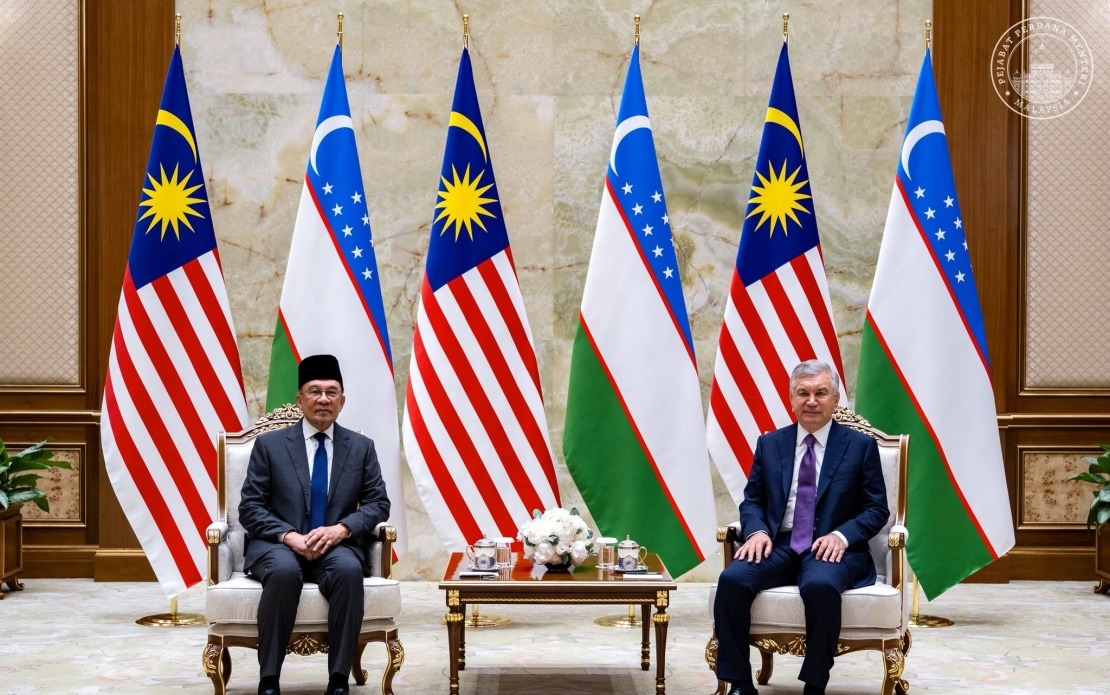
Prime Minister Datuk Seri Anwar Ibrahim has identified significant opportunities for Malaysia and Uzbekistan to broaden their strategic partnership, with discussions covering energy, trade, investment, education, the halal sector and tourism. The initiative emerged from a substantive meeting between Anwar and Uzbekistan President Shavkat Mirziyoyev during a transit stop in Tashkent on June 17, as the Malaysian leader travelled to Kazan to attend the ASEAN-Russia Commemorative Summit.
The brief but consequential encounter provided an important platform for both nations to reassess their bilateral trajectory and identify areas where cooperation could yield mutual benefit. Anwar used the occasion to exchange perspectives on strengthening ties that, while still developing, show promising signs of growth across multiple strategic domains. The meeting represented more than diplomatic courtesy—it signalled a concerted effort to move beyond nominal relations toward substantive economic and cultural engagement.
Energy cooperation emerged as a cornerstone of the bilateral agenda, with particular emphasis on gas and petroleum industries. For Malaysia, this holds considerable significance given the country's evolving energy security strategy and the need to diversify energy partnerships across Asia. Uzbekistan, as a major gas producer and a country with substantial hydrocarbon reserves, offers complementary interests. The potential collaboration in these sectors extends beyond immediate commercial transactions; it could contribute to regional energy stability and create pathways for long-term infrastructure development that benefits both economies.
Beyond energy, the leaders recognised untapped potential in traditional trade and investment frameworks. Malaysia's established expertise in financial services, manufacturing and digital technology could find ready markets in Central Asia, while Uzbekistan's position as a gateway between East and West presents opportunities for Malaysian businesses seeking to expand their footprint in the broader Eurasian marketplace. Such economic ties would naturally reinforce political relationships and create constituencies within both nations with vested interests in maintaining stable, prosperous bilateral relations.
Education emerged as another priority area where genuine synergies exist. Malaysia hosts substantial numbers of Central Asian students and has developed substantial educational infrastructure in Islamic studies and modern professional disciplines. Expanding educational exchanges with Uzbekistan would benefit both nations, fostering people-to-people connections that extend beyond government-to-government relations and create future generations of mutual understanding and cooperation.
The halal industry represents a particularly intriguing avenue for collaboration, one that speaks to shared values and economic opportunity. Uzbekistan, a Muslim-majority nation with growing interest in halal certification and standards, could benefit from Malaysia's position as a global halal hub. The country has developed sophisticated regulatory frameworks, certification mechanisms and industry expertise that could be adapted for Central Asian markets. This sector offers an ideal intersection of commercial viability and shared cultural heritage.
Anwar placed significant emphasis on what he termed the preservation and advancement of Islamic civilisation's intellectual treasures, highlighting both leaders' recognition that bilateral relations should reflect shared heritage and scholarly traditions. This dimension extends the partnership beyond transactional economics into cultural and intellectual domains. Both nations can benefit from exchanging academic expertise, supporting heritage preservation initiatives and promoting scholarly discourse that advances human knowledge. For Malaysia, such engagement strengthens its position as a bridge between Southeast Asia and Central Asia, leveraging Islamic civilisation as a connective tissue.
Tourism cooperation offers another practical dimension to the expanding relationship. Malaysia's mature tourism infrastructure and Uzbekistan's significant cultural attractions—particularly along the historic Silk Road—create natural complementarities. Enhanced tourism flows between the nations would generate economic benefits while promoting cross-cultural understanding. The sector also provides opportunities for Malaysian hospitality and tourism expertise to contribute to Uzbekistan's development agenda.
Anwar's characterisation of the partnership as contributing to "human dignity, empowerment of knowledge and more equitable development" suggests a framework extending beyond narrow commercial interests. This language reflects a conscious positioning of bilateral relations within broader regional development narratives, particularly relevant given Malaysia's engagement with ASEAN's development agenda and Central Asia's own aspirations for inclusive growth.
The Prime Minister's acknowledgment of Uzbekistan's strengthening role in Central Asia and its commitment to closer ASEAN ties provides important context. Uzbekistan's geographic position, economic weight and diplomatic initiatives make it an increasingly significant actor in regional geopolitics. For Malaysia, engaging meaningfully with Uzbekistan enhances ASEAN's broader outreach to Central Asian nations and contributes to the organisation's strategy of maintaining balanced relationships across Asia.
Anwar's well-wishes to Uzbekistan's national football team competing in the 2026 FIFA World Cup qualifiers, while seemingly peripheral, reflects efforts to humanise diplomatic relations and build rapport at personal and cultural levels. Such gestures, while informal, contribute to the broader climate within which formal negotiations occur and suggest leaders viewing each other as partners in shared aspirations rather than competitors.
The significance of this initiative lies not merely in the sectors identified but in the recognition that Malaysia-Uzbekistan relations possess untapped potential warranting serious strategic attention. As Southeast Asia looks toward deeper Central Asian engagement and Central Asia seeks broader Asian partnerships, Malaysia's position as a developed Muslim-majority economy with sophisticated institutions makes it a natural partner. The framework outlined during this meeting could serve as foundation for more ambitious cooperation in subsequent years, potentially creating models for broader ASEAN-Central Asia engagement.