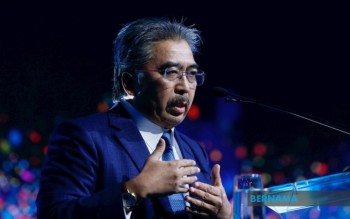
The Malaysian government is carefully navigating the complex challenge of funding a comprehensive electric vehicle charging network while managing public concerns and fiscal limitations. During a Dewan Negara session, Investment, Trade and Industry Minister Datuk Seri Johari Abdul Ghani indicated that any proposed EV levy remains under active consideration rather than a settled policy decision, reflecting the delicate balancing act authorities face in transitioning the nation's automotive sector toward electrification.
Johari's comments underscore a fundamental tension in Malaysia's EV strategy: the government recognises the urgent need for charging infrastructure yet grapples with how to finance it fairly across stakeholders. Rather than imposing obligations unilaterally, policymakers are evaluating different structural approaches that distribute costs appropriately. The minister acknowledged that whether charges fall on manufacturers or consumers ultimately determines the practical impact on the purchasing public, a consideration that has shaped deliberations within government circles.
The fiscal reality confronting Malaysia's leadership cannot be ignored when examining infrastructure funding options. Operating under a deficit constraint, the government must identify sustainable revenue streams for large-scale public investments that cannot be absorbed entirely through existing budget allocations. A dedicated levy on EV sales represents one mechanism to create a ringfenced fund specifically designed for charging station expansion, bypassing the need for competing priorities within the general treasury.
Johari articulated the broader economic context driving these discussions, pointing out that Malaysia's electricity generation infrastructure remains heavily dependent on gas and coal-fired power stations. This reality affects the calculations around EV adoption, as the environmental benefits of shifting from petrol vehicles depend partly on how cleanly that electricity is generated. The government must therefore consider investments in both charging infrastructure and energy generation capacity simultaneously, multiplying the financial demands.
The minister's emphasis on not yet deciding to impose the levy reflects sensitivity to public sentiment and affordability concerns. Malaysians purchasing their first or second electric vehicle already navigate higher upfront costs compared to conventional cars, even with current incentive schemes. An additional levy could alter purchasing decisions, particularly among middle-income buyers whom the government hopes to attract to accelerate EV market penetration. By signalling continued assessment rather than predetermined policy, authorities are signalling openness to stakeholder input before finalising their approach.
Manufacturer perspectives have not been overlooked in these considerations. If the levy were imposed on vehicle makers, they would most likely recoup costs through higher retail prices, effectively shifting the burden to consumers anyway. This passthrough effect complicates the political calculus, as consumers face price increases regardless of the formal mechanism chosen. The government must therefore decide whether transparency in pricing favours a direct consumer levy, or whether manufacturer-level levies are preferable despite their indirect nature.
The infrastructure gap driving these discussions is substantial. China's charging network demonstrates what comprehensive electrification requires at scale, yet the financial capacity and density of vehicle ownership differ significantly between that nation and Malaysia. Building even a fraction of China's infrastructure capacity would strain Malaysia's resources, making creative financing mechanisms essential. A dedicated EV levy fund would create a sustainable, long-term revenue stream tied directly to vehicle numbers on the road.
Johari's reference to the broader picture reflects frustration within the government that public discourse sometimes ignores interconnected policy challenges. Subsidising EVs while maintaining petrol and diesel pricing support, financing infrastructure expansion, and managing electricity supply costs simultaneously creates compounding fiscal pressures. When the minister noted that observers often see only one dimension of this complex problem, he was pointing toward the need for greater public understanding of tradeoffs inherent in automotive sector transformation.
The timing of these discussions matters for Malaysian industry and consumers. Regional competitors are advancing their charging networks at pace, and Malaysia cannot afford prolonged delays in establishing competitive infrastructure. However, rushing into an unpopular levy without sufficient explanation risks creating political backlash that could undermine broader EV adoption goals. The government's measured approach signals recognition that sustainable policy requires both sound financial architecture and public buy-in.
For Southeast Asian observers, Malaysia's deliberations offer instructive lessons in the challenges even middle-income nations face when transitioning transportation systems. Unlike wealthy developed markets with deep treasury resources, or rapidly expanding markets with manufacturing scale, Malaysia must balance ambitions against genuine resource constraints while maintaining political viability. The outcomes of these policy discussions will likely influence how neighbouring countries approach similar infrastructure financing questions.
The decision ultimately rests on identifying the mechanism that generates reliable funding, distributes costs equitably, and maintains support across manufacturers, consumers, and the broader public. Whether structured as a direct EV levy, a manufacturer obligation, or some hybrid approach, Malaysia's charging infrastructure fund must prove sufficient to achieve meaningful network expansion while respecting fiscal realities and consumer affordability.

