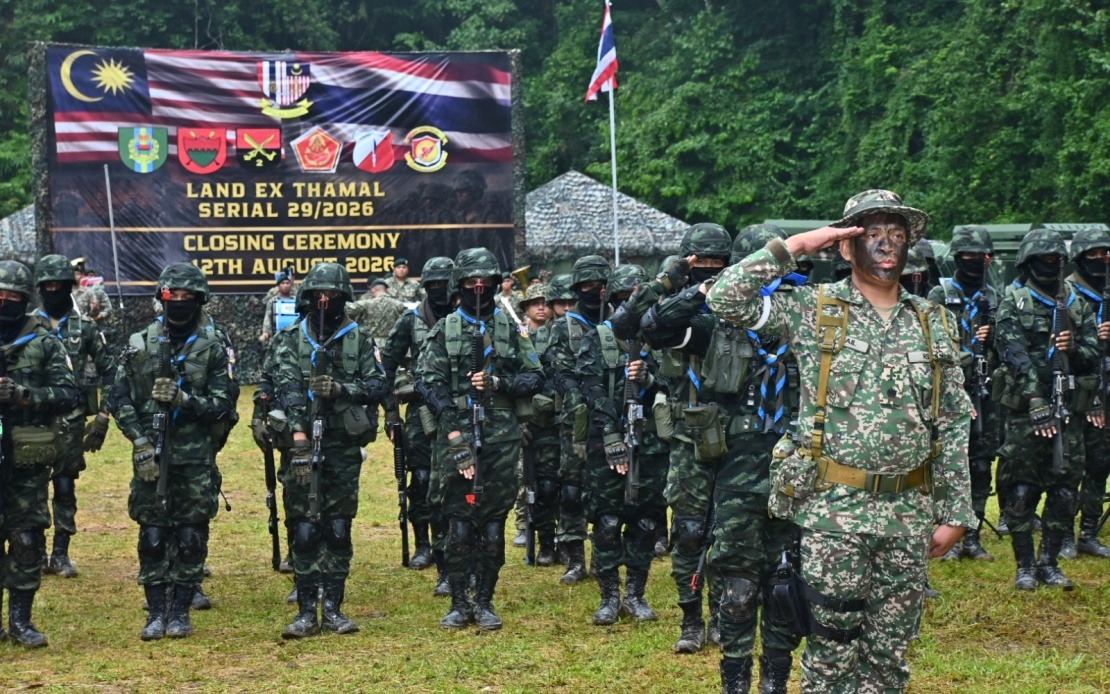
A comprehensive military training initiative bringing together 252 officers and personnel from the Malaysian Army and Royal Thai Army commenced in Gerik on August 5 and is set to deepen tactical proficiency while reinforcing the strategic partnership between the two Southeast Asian neighbours. The Exercise LAND THAMAL Series 29/2026 represents the latest iteration of a long-standing bilateral defence commitment, with 197 Malaysian troops and 55 Thai counterparts participating in coordinated field operations designed to test and refine their combined combat capabilities.
The scale and structure of this exercise underscores the maturity of Malaysia-Thailand defence relations, which have evolved significantly over the past two decades. Beyond the symbolic value of military cooperation, the exercise serves a practical purpose in addressing shared security challenges that transcend national borders. The Headquarters of the 2nd Malaysian Infantry Division outlined that the three-phase training framework—consisting of Cross Training Exchange, Field Training Exercise, and Combined Military Civil Action—creates multiple avenues for knowledge transfer and operational harmonisation between the two forces.
The tactical dimensions of the training are extensive and operationally relevant. Personnel engage in exercises covering combat drills, river and obstacle crossing techniques, deployment of temporary field installations, reconnaissance patrols, and coordinated assault operations against simulated adversary positions. This breadth of scenarios ensures that troops gain exposure to the full spectrum of land-based military operations they might encounter in real-world conditions. The emphasis on shared learning mechanisms acknowledges that military effectiveness increasingly depends on seamless coordination between allied forces, particularly in border regions where security challenges often require rapid bilateral response.
The exercise was formally inaugurated on August 5 at Gerik Airstrip through a joint ceremony overseen by Brigadier General Datuk Mohd Zaini Hashim, who commands the 30th Malaysian Infantry Brigade, and Senior Colonel Taweeporn Kanatong, leading the Thai 5th Infantry Brigade. During the opening proceedings, Taweeporn articulated the broader strategic rationale for such sustained cooperation, emphasising that LAND THAMAL extends beyond conventional military readiness to encompass disaster response, counter-insurgency operations, and regional stability preservation. The inclusion of natural disaster management in the exercise's stated objectives reflects the geopolitical realities of Southeast Asia, where transnational environmental crises increasingly demand coordinated military support.
The integration of a Combined Military Civil Action programme, branded as the Jiwa Murni Programme, represents a deliberate effort to embed military engagement within civilian communities. Thai and Malaysian personnel jointly conducted development activities at Sekolah Menengah Kebangsaan Sultan Idris Shah II in Gerik, demonstrating that defence cooperation extends beyond security frameworks to encompass humanitarian dimensions. This approach aligns with regional trends toward comprehensive security architecture that addresses civilian welfare alongside military capability development.
From a Malaysian strategic perspective, exercises of this magnitude with Thailand carry particular significance given the shared land border and historical security challenges in the southern border region. Enhanced interoperability with Thai forces creates practical advantages in coordinating responses to cross-border incidents, organised crime, and irregular armed groups operating in the Perlis-Yala corridor. The professional relationships forged during such exercises often translate into more efficient communication channels and mutual understanding during actual operational crises, potentially reducing response times and minimising miscalculation.
The emphasis on bilateral trust-building deserves careful attention, particularly in a region where military relations sometimes fluctuate with political transitions. Exercise LAND THAMAL's consistent implementation across multiple series indicates institutional commitment transcending electoral cycles, suggesting that defence cooperation between Malaysia and Thailand rests on institutional foundations rather than individual personalities or immediate political circumstances. This stability is valuable for regional security architecture, as it provides predictability for both countries' defence planning.
The participation structure itself reflects a careful balance of commitment. While the Malaysian contingent outnumbers Thai personnel by roughly four to one, the roughly equal representation of command-level officers from both nations ensures that decisions and lessons learned incorporate perspectives from both militaries. This balanced leadership approach prevents the exercise from appearing as one nation imposing operational doctrines upon another, instead positioning it as a genuine partnership where both armies contribute methodologies and expertise.
For Malaysian defence planning, such exercises generate valuable operational data regarding compatibility between Malaysian and Thai military equipment, communication systems, and tactical procedures. These practical insights inform future joint procurement decisions and standardisation efforts, ultimately reducing friction during potential combined operations. The exposure of junior and mid-ranking officers to Thai military practices creates a cohort of Malaysian military professionals with direct experience of allied tactical methodologies, individuals who may assume senior positions in coming decades and carry forward institutional knowledge of effective Malaysia-Thailand cooperation.
The timing of Exercise LAND THAMAL Series 29/2026 arrives amid broader regional security discussions about balancing strategic autonomy with alliance commitments. Malaysia's traditional non-aligned foreign policy stance coexists with practical defence partnerships like this exercise, demonstrating how countries can maintain strategic flexibility while building concrete military relationships addressing shared challenges. This model offers lessons for other Southeast Asian nations navigating similar positions in an increasingly multipolar strategic environment.
Looking forward, the institutional framework supporting LAND THAMAL suggests that Malaysia-Thailand defence cooperation will continue deepening regardless of short-term political fluctuations. The consistency with which both armies allocate resources and personnel to this exercise indicates recognition that regional security challenges demand sustained bilateral coordination. As Myanmar's instability and South China Sea tensions create dynamic security pressures throughout Southeast Asia, the Malaysia-Thailand partnership represented by exercises like LAND THAMAL provides a stabilising anchor for regional security architecture.

