Coronary artery disease caused by plaque buildup remains one of the leading health threats globally, and Malaysia is no exception given rising rates of metabolic disorders across the region. The challenge intensifies when patients develop severe calcification—a hardening process that makes traditional interventions substantially more difficult. A group of Malaysian cardiologists has begun investigating a novel approach to this problem, testing an advanced device that uses mechanical pressure rather than external energy sources to crack open obstructed arteries and restore blood flow to the heart.
Plaque accumulation inside coronary arteries develops gradually over years as fatty substances, cholesterol deposits, calcium mineral compounds, cellular debris, and fibrin protein gradually settle along vessel walls. This steady buildup progressively narrows the affected arteries, restricting the volume of oxygen-rich blood that reaches heart muscle tissue. When blockages become severe enough, patients face substantial risks of heart attacks, acute heart failure, and strokes—complications that can prove fatal or permanently disabling. The consequences extend beyond individual health outcomes, placing considerable burden on healthcare systems across Southeast Asia as populations age and lifestyle-related risk factors proliferate.
Cardiovascular specialists currently employ several established techniques to restore coronary blood flow. Percutaneous coronary intervention, coronary artery bypass grafting, and balloon angioplasty represent standard approaches that have saved countless lives. In cases involving soft plaque deposits, interventional cardiologists insert a balloon catheter into the narrowed vessel, inflate it to compress the soft material, and then deploy a mesh stent to maintain adequate vessel diameter and prevent re-blockage. However, when calcium deposits become extensive and hardened, these conventional methods encounter significant limitations. The calcified material resists compression and cannot be adequately cleared by standard balloon expansion alone.
Datuk Dr Tamil Selvan Muthusamy, a consultant cardiologist with extensive experience managing complex coronary disease, explains the technical complexities that severely calcified arteries present. When plaque becomes heavily calcified, the mineral deposits essentially turn the blockage into bone-like material that cannot be crushed using conventional pressure. This fundamental problem has driven development of specialized techniques including rotational atherectomy—which uses a rotating drill-like tool—high-pressure balloon angioplasty employing extreme inflation forces, and intravascular lithotripsy, which applies acoustic energy to fracture calcium deposits. Despite these advances, severe calcification continues to produce disappointing outcomes because the technical difficulties in delivering equipment and expanding stents adequately can result in incomplete vessel opening and higher rates of re-blockage.
Intravascular lithotripsy emerged as a significant breakthrough, offering a minimally invasive catheter-based method that generates sonic pressure waves capable of cracking calcium-laden plaque deposits. The traditional IVL approach uses an external ultrasound machine that generates acoustic pulses transmitted through a specialized catheter positioned at the blockage site. These acoustic waves create sufficient pressure to fragment calcium, potentially allowing better stent placement. However, this established IVL technology carries notable constraints. The number of ultrasound pulses available remains limited—older devices deliver eight pulses while newer models provide twelve—meaning clinicians must accomplish all calcium fracturing within that fixed pulse count. Additionally, the bulky catheter design creates insertion challenges, particularly when dealing with severely narrowed vessels where even minimal space exists for the device to pass through.
A further limitation affecting standard IVL involves the one-size-fits-all balloon design. Because coronary arteries naturally vary in diameter along their length, a single balloon sized for a particular vessel section may be too large or too small for adjacent segments. An artery might measure 3.5 or 4 millimetres in diameter at its opening, then gradually narrow to 3 millimetres or less further along. This variability means clinicians cannot optimize treatment for the entire blocked region using a single balloon, sometimes requiring multiple devices or additional techniques that increase procedure complexity and duration.
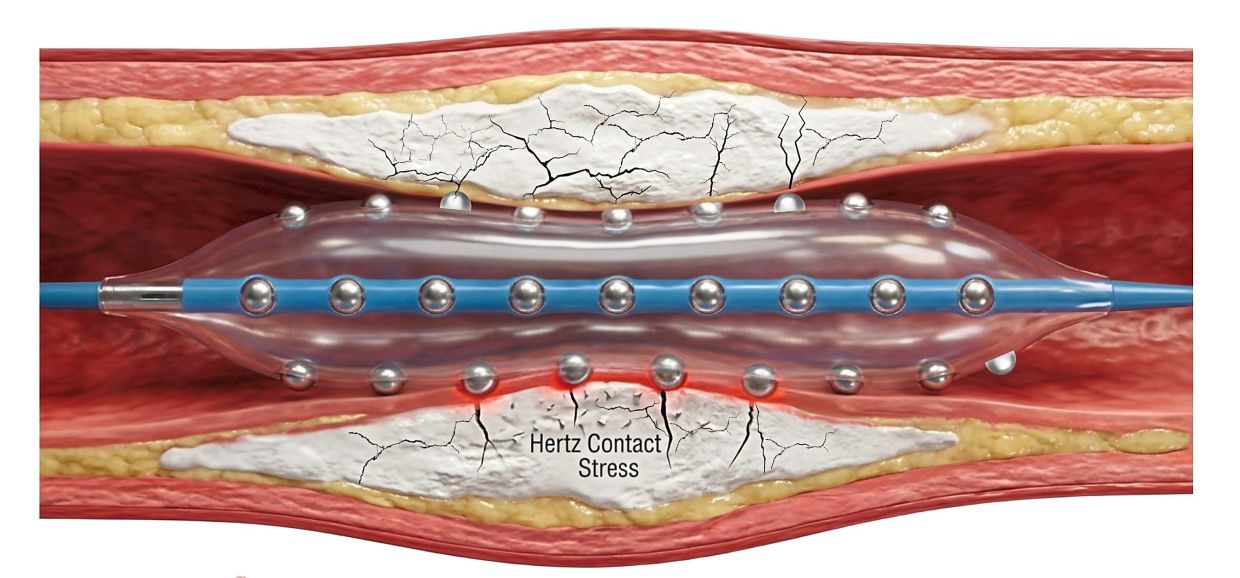
Recognizing these limitations, Dr Tamil Selvan and his research colleagues began investigating an innovative refinement of lithotripsy technology called the Hertz Contact-IVL System, which fundamentally changes how calcium fracturing occurs. Rather than depending on an external energy generator and acoustic waves, this advanced device employs a mechanical principle using a balloon embedded with tiny metallic hemispheres resembling stainless steel components. When the balloon contacts the hardened plaque surface and receives pressure, the hemisphere design multiplies and amplifies that pressure, creating intense focal forces that crack calcium without requiring external ultrasound generation. This mechanical amplification principle produces deep, wide fractures throughout the plaque while minimizing damage to surrounding healthy tissue, allowing arteries to expand properly so stents can be deployed with improved efficacy.
The mechanical design of Hertz Contact-IVL offers substantial practical advantages over conventional energy-based lithotripsy systems. By eliminating dependence on external energy sources and acoustic pulse limitations, the device achieves superior deliverability through even severely narrowed vessels, allowing a single balloon to effectively treat multiple vessel sections or extended blockage areas. This improved access and flexibility mean cardiologists can accomplish more thorough calcium removal and artery opening within a single procedure, reducing operative time and associated risks. The mechanical amplification approach also appears safer, as the localized pressure generation focused directly at the calcium-tissue interface creates predictable fracturing patterns without the off-target acoustic effects that can sometimes occur with traditional ultrasound-based lithotripsy.
Dr Tamil Selvan explains the fundamental mechanical principle underlying the new approach: instead of using external ultrasound sources, the specialized catheter incorporates a balloon with integrated tiny metallic hemispheres that function as mechanical amplifiers. When pressure is applied to this balloon surface contacting hardened plaque, the hemisphere geometry multiplies that pressure and transmits amplified force through the vessel wall. This mechanism accomplishes calcium fracturing through direct mechanical action rather than acoustic energy, fundamentally improving both the precision and effectiveness of the intervention. The practical implications prove significant for Malaysian cardiologists managing increasingly complex coronary disease in aging populations with multiple comorbidities.
Recognizing that the device's developer had conducted only limited studies across scattered US medical centers, Dr Tamil Selvan and his Malaysian colleague team determined that more robust clinical investigation was warranted. They initiated a larger, locally-based study specifically focused on comprehensively evaluating the Hertz Contact-IVL System's safety profile and clinical effectiveness. This research commitment reflects Malaysian cardiologists' growing role in advancing global cardiovascular medicine through rigorous investigation of emerging technologies. The study design allows thorough assessment of how this mechanical lithotripsy approach performs in treating Malaysian patient populations with calcified coronary disease, potentially establishing whether this innovation justifies broader clinical adoption.
The significance of this research extends beyond individual patient treatment to broader regional healthcare implications. As Southeast Asian populations experience rising rates of coronary artery disease alongside diabetes, hypertension, and obesity, interventional cardiologists increasingly encounter complex calcified coronary blockages resistant to standard treatment. Technologies enabling safer, more effective management of these difficult cases could substantially improve outcomes while reducing procedure-related complications and healthcare costs. Malaysia's leadership in evaluating advanced lithotripsy devices positions the country's cardiovascular specialists to contribute meaningfully to evolving treatment standards. Success with Hertz Contact-IVL could accelerate adoption of mechanical lithotripsy principles throughout regional healthcare systems, particularly benefiting patients in middle-income Southeast Asian countries where access to cutting-edge interventional techniques remains unevenly distributed.
The broader context for this research involves ongoing evolution of interventional cardiology as technologies continue advancing to address persistent treatment challenges. Severely calcified coronary arteries represent a frontier problem where incremental improvements in device design and mechanical principles translate directly into better patient outcomes. Dr Tamil Selvan's team contribution represents Malaysian medicine's growing engagement with global cardiovascular innovation, moving beyond passive adoption of foreign technologies toward active research participation. This collaborative approach—combining international technological innovation with rigorous local clinical investigation—exemplifies how Southeast Asian medical centers can strengthen their expertise while contributing valuable safety and efficacy data applicable to diverse patient populations. The Hertz Contact-IVL study represents exactly this kind of partnership, potentially establishing whether mechanical lithotripsy becomes a standard tool in interventional cardiologists' armamentarium across Malaysia and the broader region.

