Malaysia's top political leadership has rallied citizens to internalize the profound message of Hijrah—the Islamic concept of spiritual migration and personal transformation—as the nation commemorates Awal Muharram 1448H. Speaking in unison on this significant religious occasion, Deputy Prime Ministers and Cabinet ministers framed the Islamic New Year not merely as a calendar milestone, but as a timely catalyst for national introspection and collective action on the challenges confronting the country.
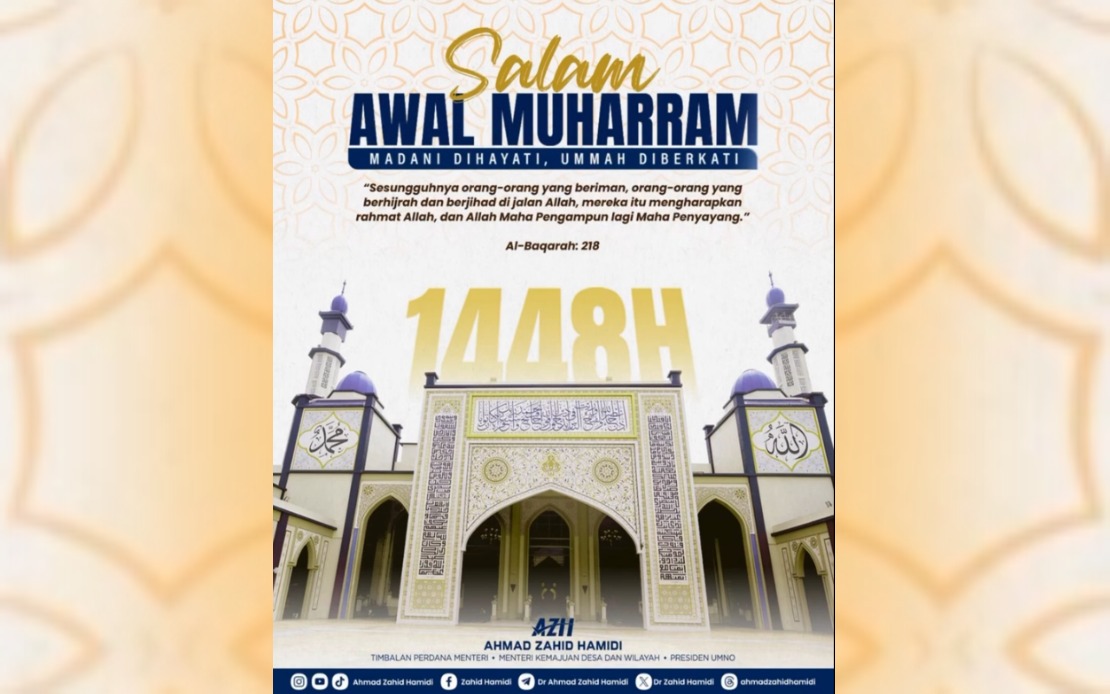
Deputy Prime Minister Datuk Seri Dr Ahmad Zahid Hamidi emphasized that the spirit of Hijrah transcends symbolic gestures, requiring concrete commitment to reform and self-improvement. In his address, he stressed that meaningful change demands more than rhetoric—it necessitates sustained effort, disciplined execution and unwavering determination to exceed one's previous achievements. The Hijrah principle, he elaborated, carries within it lessons about sacrifice and perseverance that should guide leaders and citizens alike in their professional endeavours and community engagement. Against the backdrop of a rapidly shifting global landscape, he positioned the Hijrah spirit as a call to courage: the boldness to undertake institutional reforms, confront systemic weaknesses and maintain an relentless pursuit of collective advancement.
Second Deputy Prime Minister Datuk Seri Fadillah Yusof expanded this interpretation, arguing that Maal Hijrah represents far more than a numerical shift in the Islamic calendar. Instead, he characterized it as a periodic summons to personal improvement, communal solidarity and heightened commitment to family, faith and nation. Crucially, Fadillah connected this religious observance to Malaysia's immediate economic circumstances, noting that the nation faces mounting pressures from global supply chain disruptions, inflationary pressures and macroeconomic uncertainty. In this context, he positioned the Hijrah spirit as offering practical wisdom—encouraging Malaysians to adopt greater fiscal prudence, embrace resource conservation and prioritize essentials over luxuries. This framing demonstrates how religious principles can be mobilized to address tangible policy challenges, from energy consumption to food security.
The emphasis on moderation and prudent resource management carries particular resonance for Malaysia's diverse population. Fadillah highlighted Islamic teachings on balanced living and the avoidance of waste across all dimensions of daily life. By advocating for disciplined energy usage, reduction of food and water wastage, and conscious spending habits, he implicitly acknowledged that individual behavioral changes, when aggregated across millions of households, can generate measurable improvements in household budgets and national resource efficiency. This micro-to-macro linkage—connecting household-level prudence to systemic resilience—offers a compelling narrative for addressing cost-of-living pressures that have become increasingly salient for Malaysian families.
A second critical theme emanating from the leadership chorus concerns national unity and social cohesion. Fadillah explicitly cautioned against allowing differences to fragment Malaysian society, reiterating that the nation's fundamental strength derives from its diverse population functioning as an integrated whole. He called for renewed emphasis on mutual respect, cooperative spirit and shared commitment to peaceful coexistence. This message carries weight in a Malaysian context where religious, ethnic and political divisions occasionally surface in public discourse. By anchoring unity rhetoric in religious principle—the Hijrah spirit of collective progress—leaders sought to elevate the unity message beyond partisan political appeal and ground it in spiritual and moral foundations.
Communications Minister Datuk Fahmi Fadzil approached the Hijrah observance through the lens of personal spiritual journey, characterizing the Islamic New Year as an occasion for believers to reassess their direction, renew their determination and deepen their faith commitment. His message emphasized three cardinal virtues: the courage to undergo self-directed transformation, the patience required to navigate adversity, and the sincerity that should animate all human endeavor. This articulation resonates with contemporary Malaysian audiences grappling with rapid social change, economic uncertainty and evolving professional demands. The framing of Hijrah as offering both spiritual sustenance and psychological resilience proved particularly apt.
Minister in the Prime Minister's Department (Religious Affairs) Zulkifli Hasan focused attention on the devotional dimensions of the occasion, urging Muslims to treat the first day of Muharram not as merely a public holiday affording respite from work, but as a pivotal moment for spiritual stocktaking and personal reformation (Islah). He provided specific guidance on Islamic prayers traditionally performed to mark the transition between lunar years, thereby offering concrete religious practices that families could undertake collectively. This pastoral approach—combining theological significance with practical ritual instruction—reflected an effort to deepen religious consciousness beyond political rhetoric.
The breadth of ministerial participation underscored the cross-portfolio nature of the Hijrah message. Beyond the two deputy prime ministers and religious affairs portfolio, representatives from agriculture, science and technology, women's affairs, education, national unity, investment, domestic trade, digital transformation, health, human resources and youth and sports all extended Maal Hijrah greetings. This comprehensive representation suggested that the Hijrah spirit was being positioned as relevant not to any single policy domain but to the entire machinery of government. Each ministry implicit acknowledged that the values of reform, discipline and collective endeavor apply across their respective jurisdictions—from agricultural productivity to technological innovation to youth development.
For Malaysian readers and the broader Southeast Asian context, this leadership chorus on Hijrah carries significance beyond ceremonial religious observance. In a region where governments frequently struggle to maintain institutional efficacy while managing economic volatility and social diversity, the Malaysian leadership's invocation of Hijrah principles—emphasizing personal accountability, systemic reform and unity amid difference—offers a culturally grounded framework for addressing contemporary governance challenges. The messaging implicitly acknowledges that sustainable national progress requires neither top-down mandates nor isolated individual action, but rather millions of citizens voluntarily embracing principles of responsibility, prudence and collective commitment.
Moreover, the timing of this collective appeal merits consideration. Delivered as Malaysia navigates post-pandemic economic recovery, confronts persistent cost-of-living pressures, and seeks to maintain social stability amid competing demands, the Hijrah message functions partly as a morale-building exercise and partly as a call to disciplined national effort. By framing economic prudence as a religious obligation and national unity as a spiritual imperative, leaders effectively mobilized moral and spiritual authority to reinforce policy preferences and behavioral change objectives.
The reception of these appeals among Malaysia's Muslim-majority population will likely vary based on individual levels of religious observance, economic circumstances and political orientation. Yet the consistent emphasis across multiple ministerial voices on themes of personal reform, collective responsibility and pragmatic adaptation suggests a deliberate effort to construct a unifying national narrative around Islamic principles that transcend partisan divides and speak to shared aspirations for stability and progress.
As Malaysia continues navigating complex domestic and regional challenges—from inflation management to infrastructure development to skills upgrading for the digital economy—the Hijrah spirit as articulated by the political leadership offers a recurring reminder that sustainable advancement requires more than policy mechanisms or resource allocation. It demands a cultural and spiritual dimension rooted in values of discipline, sacrifice, perseverance and unity that resonate across Malaysia's diverse communities and can be mobilized to sustain collective effort through difficult transitions.