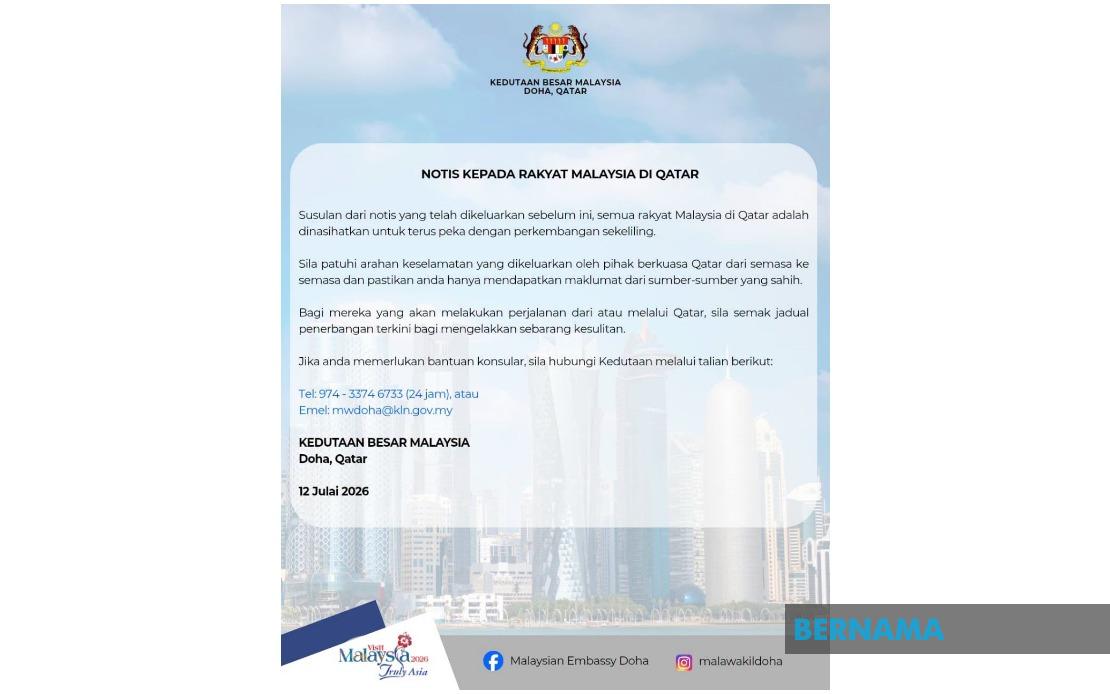
The Malaysian Embassy in Doha has issued fresh guidance to citizens residing in or transiting through Qatar, instructing them to adhere strictly to security protocols implemented by Qatari authorities in response to intensifying military confrontation between the United States and Iran. In a statement circulated through its official Facebook platform, the mission emphasised the importance of maintaining heightened personal awareness and exercising caution in daily activities throughout the emirate.
Residents are advised to remain informed through official and credible channels while scrupulously avoiding unverified sources of information that may circulate during periods of regional instability. The embassy's guidance reflects standard precautionary measures adopted by diplomatic missions when security risks elevate in their jurisdiction. Malaysian citizens who find themselves in need of emergency assistance or require consular support can reach the embassy's round-the-clock assistance line at +974-3374 6733 or communicate via email for urgent matters.
Those planning to depart from or pass through Qatar in the coming weeks are also urged to monitor current flight schedules closely, as regional tensions have begun affecting aviation operations. Airlines operating in the Gulf have implemented modified routing and scheduling protocols to account for the security environment, and travellers risk encountering unexpected delays or cancellations without prior knowledge of the latest operational changes. The advisory suggests checking with carriers and travel platforms regularly before embarking on journeys.
The embassy's alert follows a significant escalation in hostilities between Washington and Tehran that unfolded over the past week. On Sunday, American military forces executed their third major offensive operation against Iran within a span of seven days, responding to Iranian military action directed at commercial shipping navigating the Strait of Hormuz. The Iranian military's targeting of vessels in this vital international waterway represents a sharp departure from the relative restraint that had characterised the two nations' engagement following their June ceasefire agreement.
Iran's Islamic Revolutionary Guard Corps navy announced on Sunday that it has implemented a comprehensive closure of the Strait of Hormuz, one of the world's most strategically significant maritime passages through which approximately one-third of seaborne traded oil transits. The IRGC declared that the waterway would remain sealed to all commercial and naval traffic indefinitely, with officials explicitly tying the blockade to US military involvement in the region. This unilateral action effectively severs a critical chokepoint for global energy supply and international commerce, with profound implications for economies worldwide that depend on Gulf oil exports.
The current crisis represents a dramatic deterioration from the tentative peace framework that Tehran and Washington had established just weeks earlier. In June, after intensive negotiations facilitated by Pakistani intermediaries, both nations had signed a memorandum of understanding designed to terminate the conflict that originally erupted in late February. The accord contemplated an immediate cessation of military operations across all theatres, removal of the American naval blockade encircling Iran, and crucially, restoration of normal traffic through the Strait of Hormuz to facilitate resumed international trade.
Despite the existence of this formal agreement, both sides have progressively abandoned restraint, resuming military strikes ostensibly over disputes concerning commercial passage through the strategic waterway. The breakdown of the ceasefire underscores the fragility of diplomatic accords in an environment where deep strategic mistrust persists and hardline factions within both governments retain significant influence over operational decisions. The pattern of escalating exchanges suggests that disagreements over implementation details and compliance verification mechanisms have undermined the agreement's underlying consensus.
For Malaysia and broader Southeast Asia, this renewed Gulf conflict carries substantial economic consequences that extend far beyond the immediate region. Malaysian businesses dependent on energy imports face rising fuel costs and supply uncertainty, while the country's shipping and logistics sectors confront navigational hazards and insurance premium increases. The closure of the Strait of Hormuz would necessitate alternative routing for regional commerce, dramatically increasing transit times and costs for regional trading partners including Malaysia, Singapore, and Vietnam.
The situation also reflects broader instability patterns afflicting the Middle East that increasingly affect Southeast Asian security and prosperity. Malaysia's significant Muslim population and historical connections to the Arab world mean that regional conflicts carry particular resonance domestically. Furthermore, Malaysia's role as a significant trading nation with substantial Gulf commercial interests—encompassing petrochemicals, financial services, and labour exports—makes regional stability directly relevant to national interests.
The Malaysian government has adopted a cautiously neutral diplomatic posture toward the US-Iran conflict, consistent with its non-aligned foreign policy tradition. However, the embassy's security alert demonstrates that practical concerns for citizen welfare increasingly override broader geopolitical positioning. The advisory serves as a reminder that even as Malaysia pursues balanced regional diplomacy, the safety of its nationals abroad demands immediate, pragmatic responses to emerging threats.
Looking forward, observers will monitor whether the renewed military escalation represents a temporary spike in an otherwise fragile but persistent ceasefire, or signals a complete collapse of the June agreement. Should hostilities intensify further, the economic fallout through disrupted energy supplies and maritime commerce could reverberate throughout Southeast Asia for months. Malaysian policymakers and business leaders are undoubtedly closely tracking developments that could significantly affect inflation rates, supply chain costs, and regional economic stability in coming quarters.

