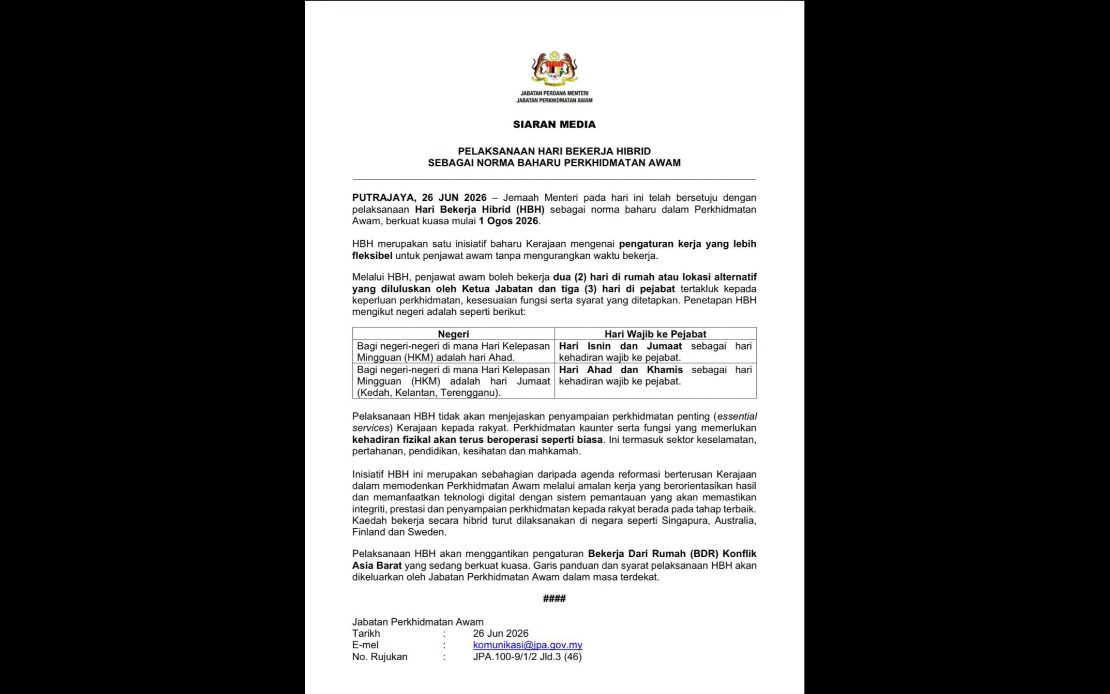
Malaysia's public sector is poised for a significant operational restructuring as the Cabinet moves to introduce a hybrid work framework that fundamentally reshapes how the nation's 1.6 million civil servants balance office and remote responsibilities. The Public Service Department announced on June 26 that the new Hybrid Work Day system will commence on August 1, establishing a formal policy that builds on pandemic-era flexibility while reinstating structured office presence across government agencies.
Under the framework, civil servants will spend two days working remotely—either from home or from alternative locations designated by their departmental heads—while maintaining a mandatory three-day weekly office schedule. This arrangement supersedes the previous Work From Home policy that had operated with varying degrees of formality since the COVID-19 pandemic accelerated digital work practices. The structure balances employee preferences for flexibility with government concerns about maintaining operational cohesion and service delivery standards, though implementation will depend heavily on individual agency requirements and job classifications.
The hybrid model introduces conditionality that may prove crucial to its practical application. Service demands, functional suitability, and departmental protocols will determine eligibility, meaning frontline agencies cannot simply adopt the arrangement wholesale. The PSD emphasised that essential services requiring physical presence—spanning security, defence, education, health, and the judiciary—will continue operating on conventional schedules. Counter services, citizen-facing functions, and security-sensitive operations remain unaffected by the new arrangement, ensuring public access to critical government services remains unchanged.
Geographic variation presents a notable administrative challenge within the framework. States observing Sunday as their official weekly rest day must designate Monday and Friday as mandatory office-attendance days, effectively bracketing the working week. Conversely, states where Friday serves as the statutory holiday—specifically Kedah, Kelantan, and Terengganu—must anchor office presence on Sunday and Thursday instead. This regional customisation acknowledges Malaysia's diverse observance patterns while attempting to standardise the hybrid approach nationally, though implementation complexity increases substantially when factoring multiple state-level variations.
Policymakers framed this initiative as component of broader public service modernisation, emphasising how hybrid arrangements align with contemporary management philosophy emphasising results-based accountability rather than presenteeism. The government suggests that flexible location work, paired with expanded digital infrastructure adoption, can enhance productivity while reducing real estate and operational costs. However, Malaysian observers should note that this rationale differs markedly from the pandemic's emergency rationale—the Cabinet is now positioning remote work as a permanent structural feature rather than a temporary accommodation.
The department is establishing monitoring mechanisms to ensure service quality and integrity standards remain uncompromised during the transition. This oversight layer reflects legitimate concerns about maintaining governance standards and preventing service degradation, particularly in functions where direct citizen interaction or confidential handling remains essential. The specificity regarding monitoring suggests that agency heads will retain significant discretion regarding remote-work approval, potentially creating inconsistency across different government departments and state administrations.
International precedent appears to have influenced the policy direction, with the PSD citing hybrid arrangements successfully implemented in Singapore, Australia, Finland, and Sweden. These reference points carry particular significance for Malaysia, particularly Singapore's experience as a comparable developed city-state with similarly dense public administration. However, Malaysian implementation contexts differ substantially—including infrastructure accessibility, technological readiness across regions, and cultural attitudes toward workplace supervision—meaning direct transplantation of foreign models may require substantial localisation.
The August 1 implementation date provides a five-week transition window for agencies to develop operational guidelines, train supervisory staff, and establish technological frameworks supporting remote work. The PSD committed to issuing detailed implementation guidelines before the launch, though ambiguity remains regarding enforcement consistency across different ministries and state-level civil services. This timeline pressure may advantage larger agencies with existing digital infrastructure while disadvantaging smaller departments requiring substantial technology investment.
For Malaysian employers and workers, the hybrid announcement signals shifting expectations about workplace presence as a performance indicator. Private sector organisations have increasingly adopted similar arrangements, creating pressure on government to remain competitive in talent retention. The policy potentially addresses civil service recruitment and retention challenges, particularly among younger professionals accustomed to remote-work flexibility. However, tension may emerge between remote-work preferences and career advancement patterns, where physical office presence traditionally correlates with visibility and promotional opportunities.
Regional economic implications warrant consideration, particularly for office-dependent commercial ecosystems in major cities. Reduced weekday office attendance could affect food service businesses, transportation networks, and commercial real estate demand in traditional business districts. However, the policy's emphasis on mandatory three-day office presence suggests impact will likely be moderate compared to wholesale remote-work adoption, maintaining reasonable foot traffic and commercial activity around government office concentrations.
The framework's success ultimately depends on implementation fidelity and supervisory acceptance. Middle-management resistance to remote-work arrangements remains a potential obstacle in hierarchical bureaucratic environments where direct observation traditionally functioned as performance assurance. The PSD's commitment to results-based evaluation rather than presence-based assessment represents a philosophical shift requiring cultural reorientation across numerous government agencies.
Further guidance will emerge as the August 1 launch approaches, with specific protocols addressing accountability frameworks, technology access standards, and remote-work eligibility criteria. The policy represents Malaysia's formal embrace of post-pandemic work evolution, acknowledging that significant operational shifts can coexist with maintained service delivery standards. How agencies operationalise these arrangements will reveal whether hybrid work genuinely enhances public sector modernisation or becomes merely symbolic policy change.

