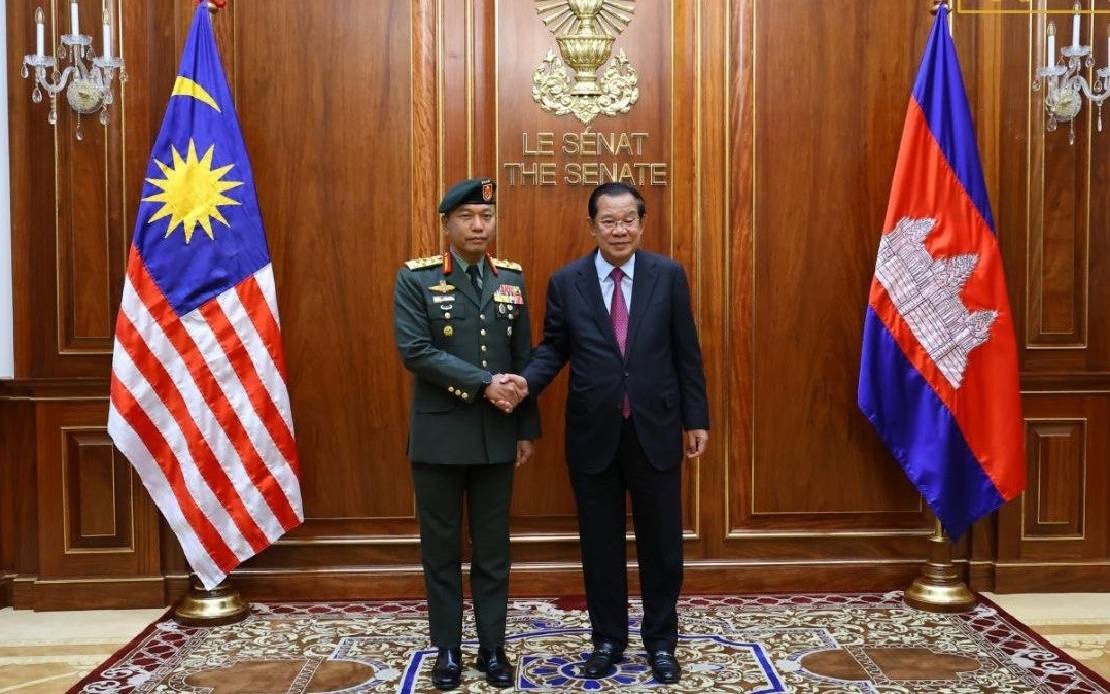
General Tan Sri Malek Razak Sulaiman, Malaysia's Chief of Defence Force, has wrapped up a four-day visit to Cambodia that underscores the two countries' shared commitment to strengthening defence ties and promoting regional stability. The high-level delegation, invited by General Vong Pisen, Commander-in-Chief of the Royal Cambodian Armed Forces, engaged in a series of strategic discussions with Cambodia's military and civilian leadership from July 8 to 11, signalling the importance both nations place on deepening their security partnership.
The Malaysian defence chief's itinerary reflected the multifaceted nature of contemporary security cooperation in Southeast Asia. Beyond protocol-heavy bilateral meetings with his Cambodian counterpart and Deputy Prime Minister Tea Seiha, Malek Razak travelled to Banteay Meanchey province on the Cambodia-Thailand border to gain firsthand insight into the regional security landscape. This field visit demonstrates Malaysia's practical interest in understanding Cambodia's security challenges and the broader stability dynamics affecting the Greater Mekong Subregion, an area increasingly significant to Malaysian strategic interests.
During formal talks, both delegations articulated a vision of defence collaboration grounded in ASEAN principles and shared concerns about maintaining peace across Southeast Asia. Malaysia and Cambodia identified multiple channels through which to deepen their military relationship, including the implementation of existing bilateral defence frameworks and the expansion of military-to-military exchanges. The emphasis on professional military education and training opportunities reflects a recognition that capacity-building initiatives create sustainable foundations for defence cooperation, moving beyond symbolic gestures toward practical institutional development.
Malek Razak's public statements reveal that the discussions extended beyond conventional bilateral concerns to encompass the broader architecture of regional security. The Malaysian general highlighted ASEAN-led defence platforms as crucial mechanisms for addressing what both nations characterise as "emerging security challenges." This framing is particularly relevant given Southeast Asia's current security environment, marked by maritime disputes, transnational crime, cyber threats, and great power competition. Cambodia's strategic location along major shipping routes and its borders with Thailand and Vietnam position it as significant to Malaysia's broader regional security calculus.
The reaffirmation of commitment to regional peace and stability carries particular weight in the context of contemporary Southeast Asian geopolitics. While Malaysia and Cambodia may not share immediate territorial concerns, their cooperation signals to larger powers that ASEAN member states remain committed to managing regional affairs through established institutional mechanisms rather than external intervention. This messaging matters as external actors increasingly seek to expand their influence across the region, making intra-ASEAN defence relationships a counterweight to destabilising external pressures.
Malaysia's outreach to Cambodia also reflects a deliberate strategy of maintaining balanced engagement across ASEAN. As Malaysia navigates complex relationships with larger regional powers and manages its own domestic security priorities, investing in defence ties with fellow Southeast Asian states reinforces the principle of non-aligned regionalism that underpins ASEAN's founding ethos. Cambodia, having experienced decades of conflict, shares Malaysia's interest in cementing institutional safeguards against regional instability.
The bilateral frameworks discussed during the visit encompass practical areas where Malaysian and Cambodian armed forces can contribute meaningfully to mutual security. Joint training exercises, personnel exchanges, and collaborative responses to transnational challenges such as human trafficking, drug smuggling, and piracy represent concrete applications of defence cooperation that extend beyond political symbolism. These initiatives also generate professional relationships among military personnel that facilitate information-sharing and coordinated responses to crises.
The emphasis on strengthening institutional collaboration carries implications for ASEAN's collective security architecture. As individual member states deepen bilateral defence relationships, they incrementally strengthen the overall cohesion and operational capacity of the regional grouping. When Malaysia and Cambodia enhance their military education exchanges or coordinate on border security matters, they contribute to a network of relationships that can be mobilised for collective ASEAN responses to regional contingencies.
For Malaysian readers and policymakers, this engagement underscores the government's commitment to active regional diplomacy and the recognition that Southeast Asian security cannot be divorced from broader considerations of political stability and economic prosperity. Cambodia's development trajectory and security environment directly affect regional dynamics that impact Malaysia's own strategic interests, from maritime safety to counterterrorism cooperation. The visit therefore represents not merely a courtesy exchange but a practical investment in regional order.
The visit also positions Malaysia as a reliable and engaged ASEAN partner at a time when the grouping faces questions about its cohesion and effectiveness. By investing diplomatic and military resources in relationships with all member states, Malaysia reinforces ASEAN's collective identity and capacity to manage regional affairs. This approach contrasts with strategies that might prioritise relationships with extra-regional powers, instead betting on the durability and utility of Southeast Asian institutional frameworks.
Looking forward, the defence cooperation outlined during this visit provides a template that Malaysia could expand with other ASEAN partners. The specific mechanisms discussed—professional military education, training exchanges, institutional collaboration—are scalable approaches that strengthen regional security architecture incrementally. As new security challenges emerge in Southeast Asia, from climate-related threats to digital warfare, having robust bilateral defence relationships provides the foundation for coordinated regional responses.
The Malaysian defence chief's visit ultimately reflects a vision of Southeast Asian security grounded in mutual respect, institutional engagement, and recognition of shared interests in regional peace. While not attracting the international headlines commanded by great power rivalries, such bilateral exchanges represent the unglamorous but essential work of building the relationships and institutional capacity that underpin regional stability. For Malaysia and Cambodia, this visit reinforces that their security is fundamentally interconnected and best served through sustained, high-level engagement.

