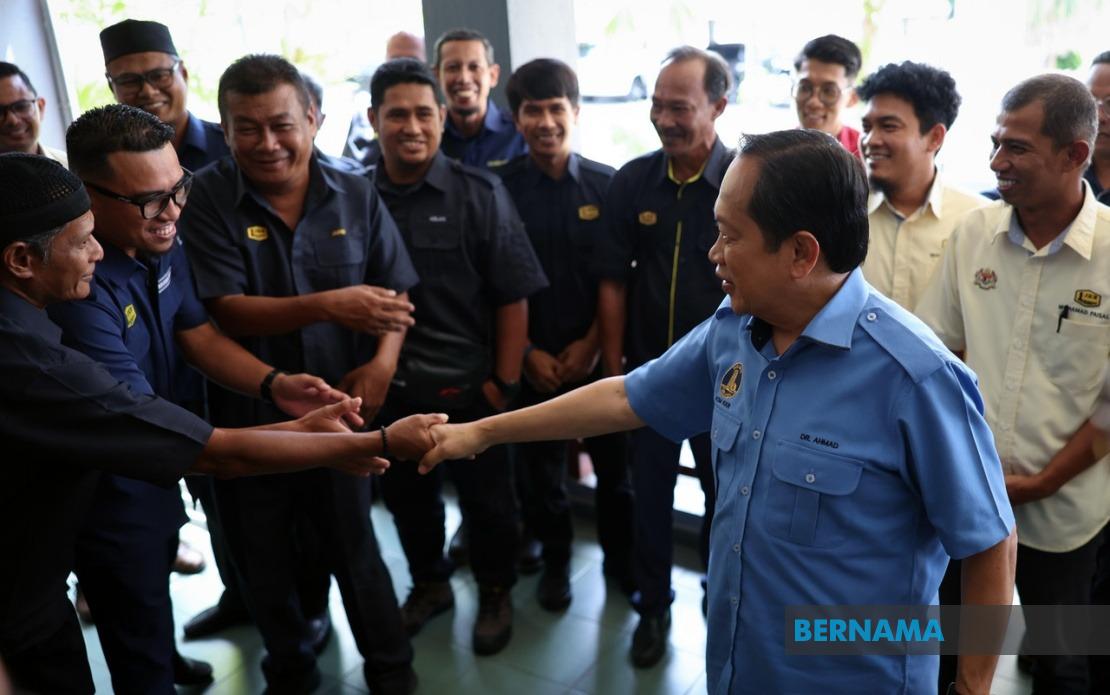
Malaysia's ambitious push to rapidly expand classroom capacity through prefabricated construction methods is maintaining its accelerated timeline, with Deputy Works Minister Datuk Seri Ahmad Maslan declaring that all projects will be ready for the 2027 Year One enrolment cycle. During a site inspection in Alor Gajah on August 6, Ahmad underscored the government's commitment to deploying the Modular Precast System (MPS)—an innovative approach that has emerged as a cornerstone of the Program Cakna MADANI initiative designed to address infrastructure gaps across the nation's education sector.
The MPS methodology represents a significant departure from conventional construction practices, enabling developers to fabricate building components in controlled factory environments before transporting and assembling them on school grounds. This approach dramatically compresses project timelines while maintaining structural integrity and durability. Ahmad cited the technology's proven track record in China, where modular techniques have achieved remarkable speed benchmarks—constructing ten-storey buildings in under 29 hours—demonstrating that rapid deployment need not compromise quality or longevity. The system's appeal extends beyond speed; financial efficiency and extended lifespan create a compelling case for wider application across Malaysia's infrastructure pipeline.
Ahmad credited his own initiative in championing the MPS concept, having proposed the framework to Prime Minister Datuk Seri Anwar Ibrahim in 2023. The Deputy Minister characterised the innovation as a natural evolution of construction methodology, arguing that prefabrication reduces material waste, minimises on-site labour coordination challenges, and produces buildings capable of withstanding decades of use. While current deployment focuses on supplementary classroom blocks, Ahmad envisioned broader implementation encompassing permanent institutional structures, suggesting the model could eventually reshape how Malaysia develops its entire educational estate.
Within Alor Gajah district specifically, the Public Works Department (JKR) is orchestrating a substantial educational infrastructure programme worth approximately RM12.05 million. This envelope encompasses fourteen schools requiring additional Year One classroom capacity under the Program Cakna MADANI framework. Simultaneously, the department is constructing two covered multipurpose facilities—one multipurpose hall and one multipurpose court—at separate institutions, with combined expenditure reaching RM1.83 million. These complementary investments recognise that modern schools require multifunctional spaces for assemblies, sports activities, and community engagement, reflecting contemporary understanding of holistic educational environments.
Beyond the classroom expansion initiative, JKR's Alor Gajah operations encompass five additional Federal building projects valued at RM22.6 million, demonstrating the breadth of concurrent infrastructure activity across the district. Renovation work targets deteriorating structures at Sekolah Kebangsaan Kampung Tengah and Sekolah Kebangsaan Kuala Linggi, addressing safety and pedagogical concerns accumulated through deferred maintenance. The programme also includes constructing a replacement canteen facility at Sekolah Ramuan Cina Besar and completing the Lesung Batu Mosque, reflecting recognition that educational campuses serve broader community functions. Additionally, the government is upgrading training infrastructure at the Alor Gajah National Youth Skills Institute (IKTBN), specifically refurbishing the Hospitality Department's facilities to align with industry standards and student expectations.
Maintenance allocations represent another critical funding stream, with RM5.1 million committed to preserving existing Federal buildings operated by educational institutions and agencies under the Ministry of Education, the Ministry of Natural Resources and Environmental Sustainability, and the Ministry of Health. This preventive approach acknowledges that infrastructure deterioration accelerates exponentially without regular upkeep, ultimately increasing long-term replacement costs. By distributing resources across maintenance, renovation, and new construction, the government attempts to balance immediate classroom capacity requirements with sustainable stewardship of existing assets.
The timing of these initiatives assumes particular significance for Malaysia's education system, which faces mounting pressure as student populations fluctuate across regions. Urban migration patterns, demographic shifts, and differential birth rates have created spatial mismatches between classroom availability and enrolment demand in various districts. Program Cakna MADANI directly addresses these imbalances by channelling targeted resources to schools facing capacity constraints. The 2027 Year One intake represents a critical inflection point; ensuring adequate facilities by that date prevents overcrowding scenarios that undermine teaching quality and student welfare.
From a regional perspective, Malaysia's adoption of modular construction methodology positions the nation within broader Southeast Asian trends toward industrialised building systems. Countries across the region increasingly recognise that traditional construction cannot sustain infrastructure expansion rates demanded by urbanisation and population growth. By validating MPS through educational infrastructure, Malaysia establishes replicable models that could extend to healthcare facilities, government offices, and residential developments. This systemic learning creates potential for accelerated development across multiple sectors while generating cost savings that free budgetary resources for other developmental priorities.
The cost efficiency embedded within the MPS framework carries particular resonance for developing economies managing constrained fiscal space. Lower material waste, reduced on-site labour requirements, and faster project completion translate into measurable savings that enhance value-for-money metrics. Ahmad's emphasis on durability ensures that financial efficiency does not become false economy; buildings engineered to withstand decades of intensive use avoid premature replacement cycles that ultimately consume more resources than initial construction. This perspective reflects mature infrastructure thinking that balances upfront expenditure against lifecycle costs.
Implementation challenges inevitably accompany such programmes. Quality assurance mechanisms must verify that factory-manufactured components meet specifications, transportation logistics require careful coordination, and on-site assembly demands appropriately trained labour. Nonetheless, Ahmad's explicit commitment to December completion suggests government confidence in overcoming these hurdles. Regular progress inspections and adaptive management reflect learning from initial projects, strengthening execution capacity as the programme scales across additional districts and educational institutions.
The broader narrative underlying these initiatives reflects government determination to demonstrate tangible delivery on infrastructure commitments. Educational facilities enjoy widespread public concern; parents, teachers, and community leaders scrutinise classroom conditions with understandable anxiety about student welfare and learning outcomes. Visible progress toward completion inspires confidence in government capability and prioritisation of education sector needs. Conversely, delays or cost overruns fuel public scepticism regarding institutional competence. Ahmad's public timeline therefore carries weight extending beyond technical project management into political credibility and constituent satisfaction.
Looking forward, the success or relative underperformance of MPS implementation will inform Malaysia's infrastructure strategy across subsequent administrations. If projects complete on schedule and demonstrate anticipated cost advantages without quality compromises, the model gains momentum for expanded deployment. Conversely, difficulties or disappointing outcomes may constrain enthusiasm and redirect resources toward conventional construction methodologies. Either trajectory will carry implications for national development pace, particularly as Malaysia aspires to achieve developed-economy status requiring world-class infrastructure standards. The classroom construction programme thus functions as both immediate educational intervention and strategic pilot determining Malaysia's longer-term developmental approach.

