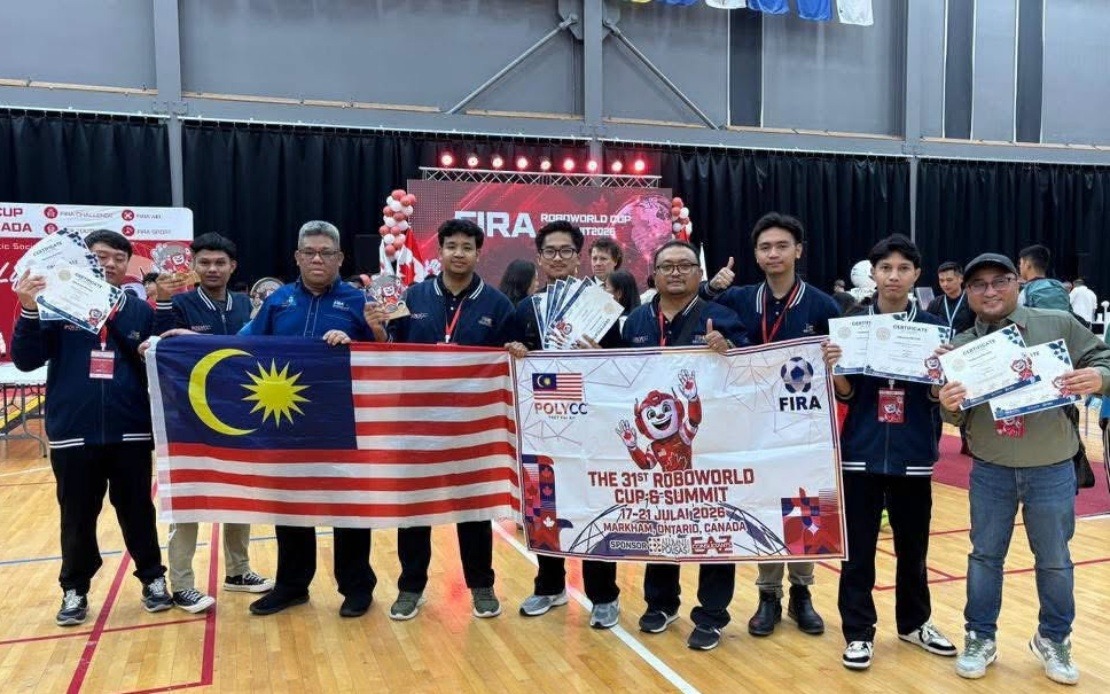
Malaysia's Technical and Vocational Education and Training sector has demonstrated its growing prowess on the global stage, with the country's polytechnic and community college teams returning from Canada with a haul of 14 medals at the 31st FIRA RoboWorld Cup & Summit 2026. Higher Education Minister Datuk Seri Dr Zambry Abd Kadir has publicly commended the contingent for exceeding initial expectations, securing six gold medals alongside five silver and three bronze in a competition held in Ontario from July 17 to 21.
The competitive results signal a marked improvement in Malaysia's standing within international robotics circles. The national POLYCC contingent, drawing talent from Sultan Idris Shah Polytechnic, Port Dickson Polytechnic and Sultan Haji Ahmad Shah Polytechnic, navigated three demanding competition categories—HuroCup, FIRA Air and Autonomous Car Challenge—demonstrating versatility across different robotics disciplines. The diversity of events underscores the breadth of technical expertise being cultivated within Malaysia's polytechnic education system.
When contextualised against Malaysia's previous participation, the results paint an encouraging trajectory for the TVET ecosystem. At the 2025 edition held in South Korea, the same contingent secured five gold, three silver and five bronze medals. The latest showing represents a significant uplift in gold-medal performance, climbing from five to six, whilst maintaining strength across silver medal positions. This incremental but consistent improvement suggests that Malaysia's polytechnic institutions are refining both their training methodologies and student selection processes.
Datuk Seri Dr Zambry's commentary extends beyond mere celebration of medals. In his official statement, he framed the achievement as validation of Malaysia's capacity to produce globally competitive human capital within the TVET domain. This positioning carries strategic importance for a nation actively seeking to differentiate itself in the knowledge economy and to strengthen its reputation as a source of technically skilled professionals capable of meeting international standards. The minister's emphasis on innovation and excellence reflects broader governmental priorities around skills development and economic positioning.
The significance of this victory becomes more apparent when considering the competitive landscape of international robotics competitions. Events such as the FIRA RoboWorld Cup attract contingents from technologically advanced nations with substantial resources dedicated to robotics research and education. That Malaysian teams composed of polytechnic students—institutions with more limited budgets than traditional universities—are securing gold medals against such competition suggests effective resource allocation and pedagogical innovation at the institutional level.
For Malaysia's TVET sector, recognition at prestigious international forums carries tangible benefits beyond prestige. Success in robotics competitions typically enhances institutional visibility, helping to attract both domestic and international student enrolments. It also strengthens the narrative that polytechnic qualifications represent a credible pathway to technical excellence, which remains an ongoing challenge in a region where university degrees often carry greater social prestige. Malaysian employers increasingly recognise TVET graduates' practical capabilities, and international competition victories reinforce this credibility among potential recruits.
The three participating institutions—Sultan Idris Shah Polytechnic, Port Dickson Polytechnic and Sultan Haji Ahmad Shah Polytechnic—now carry enhanced reputation within their respective regions and the broader Malaysian education landscape. These successes often translate into stronger relationships with industry partners, improved funding allocations and increased institutional autonomy in developing specialised programmes. For students at these facilities, competing at such venues provides invaluable experience with cutting-edge technology and exposure to peers from advanced economies, fostering networks that extend beyond graduation.
From a Southeast Asian perspective, Malaysia's robotics achievements contribute to the region's collective technological narrative. As nations across ASEAN compete for position within the Fourth Industrial Revolution landscape, TVET excellence in robotics serves as a visible marker of readiness for advanced manufacturing and automation sectors. This has particular relevance given the region's aspirations around Industry 4.0 adoption and the critical shortage of technicians capable of managing sophisticated automated systems.
The robotics domain itself warrants attention as an educational frontier. Robotics competitions require students to synthesise knowledge across multiple disciplines—mechanical engineering, electrical systems, programming and problem-solving—making them exceptionally valuable as pedagogical tools. Malaysian teams' competitive success suggests that polytechnic educators are effectively developing such interdisciplinary competencies, moving beyond traditional siloed technical training toward more integrated skill development.
Datuk Seri Dr Zambry's call for continued excellence and profile-raising reflects a minister invested in the transformational potential of TVET education. His framing of sporting achievement as evidence of systemic capability offers a different lens for policymakers and stakeholders to view technical education—not as a fallback option, but as a source of genuine competitive advantage. This rhetorical shift carries importance for perceptions among secondary school students and families as they navigate education choices.
Looking forward, maintaining momentum from such international successes requires sustained investment in facilities, coaching expertise and student support systems. The improvement from the 2025 to 2026 competitions, whilst encouraging, remains incremental. Substantial further advancement would require deeper engagement with industry partners for mentorship and resources, potentially stronger partnerships with leading robotics centres globally, and strategic decisions about which competition categories to prioritise based on institutional strengths and resource availability.
Ultimately, Malaysia's polytechnic contingent's performance at the FIRA RoboWorld Cup represents validation of a long-term bet on technical education. As the nation navigates economic transitions and workforce demands shift toward advanced technical roles, such visible international achievements serve both practical and symbolic purposes—demonstrating that Malaysia's TVET system can produce globally competitive talent whilst simultaneously inspiring future cohorts to pursue technical excellence within polytechnic programmes.

