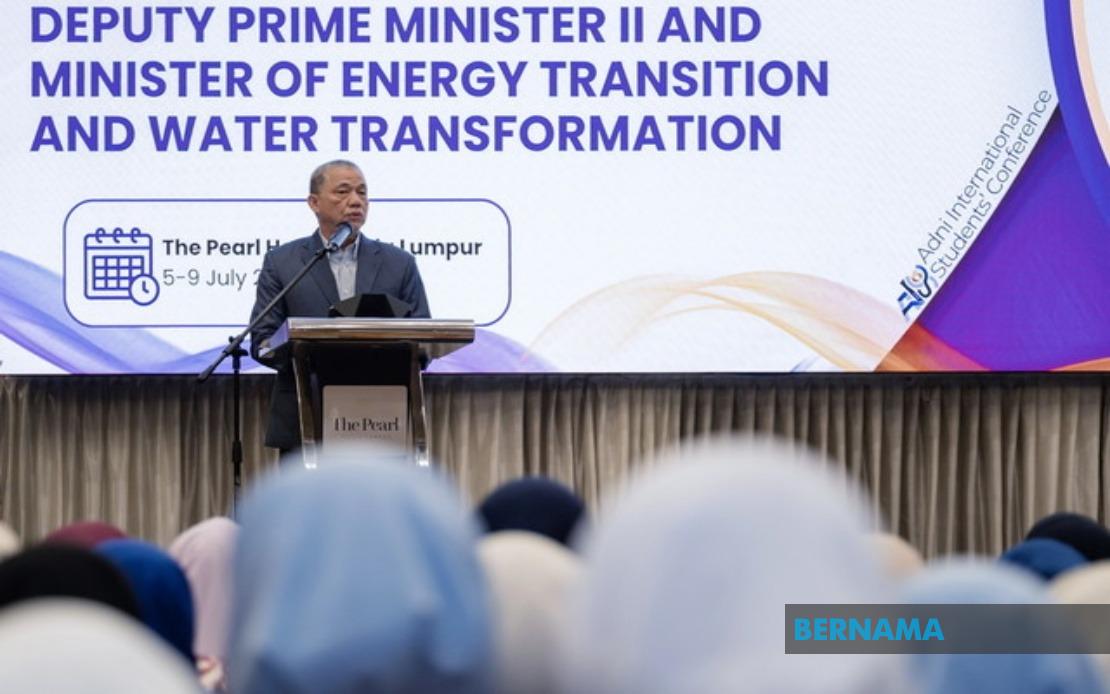
Malaysia's trajectory over coming decades will hinge not primarily on financial performance or technological prowess, but fundamentally on nurturing capable, principled citizens equipped for an intricate world, according to Deputy Prime Minister Datuk Seri Fadillah Yusof. Speaking at the opening of the ADNI International Students' Conference (AISC) 2026 in Kuala Lumpur, Fadillah articulated a vision of national progress anchored in human development rather than conventional measures of advancement. His remarks signal a strategic pivot within the MADANI Government's policy framework toward investing heavily in education, ethics and character formation as primary drivers of competitive advantage.
Fadillah outlined the specific attributes Malaysia must cultivate in its population to remain relevant globally. Citizens require proficiency in analytical reasoning, the ability to articulate ideas persuasively across cultural boundaries, and resilience in adapting to unprecedented shifts in employment, technology and social structures. These competencies, he suggested, form the bedrock upon which economic prosperity and technological innovation ultimately rest. The deputy premier's emphasis on soft skills and adaptability reflects broader recognition among policymakers that manufacturing capacity and digital infrastructure, while necessary, prove insufficient without a workforce capable of creative problem-solving and ethical decision-making in complex scenarios.
The challenges confronting Malaysia and the region—from climate disruption to pandemic preparedness, from industrial transformation driven by artificial intelligence to widening socioeconomic divisions—cannot be resolved unilaterally by government action or through technological solutions alone, Fadillah cautioned. Rather, these interconnected problems demand coordinated responses spanning multiple sectors and constituencies. Governments, universities, corporations, grassroots organisations and emerging generations must forge genuine partnerships that pool expertise, resources and commitment toward shared objectives. This systemic approach contrasts sharply with siloed policy-making and reflects a maturation in how Malaysian leadership conceptualises development challenges.
Fadillah grounded his argument in Malaysia's historical philosophy, invoking the legacy of the nation's third Prime Minister Tun Hussein Onn. That legacy emphasises that genuine national strength derives not from military might or wealth concentration, but from the cohesion, integrity and collective character of the population. Technology facilitates connectivity between devices and networks, but only shared ethical frameworks, reciprocal respect and institutional trustworthiness can meaningfully bind societies together. This distinction underscores why technical expertise unmoored from moral grounding risks creating sophisticated systems that exacerbate rather than resolve social fractures.
The MADANI Government's commitment to placing human capital at the centre of its development agenda represents a deliberate recalibration of national priorities. Rather than perpetuating past approaches emphasising infrastructure accumulation and headline GDP growth, the administration signals that sustainable prosperity requires systematic investment in education quality, physical and mental wellbeing, ethical formation, artistic expression and environmental stewardship alongside social harmony. Fadillah characterised true development as inherently multidimensional, encompassing not only income generation but also cultural flourishing, community resilience and equitable opportunity distribution.
The AISC 2026 gathering itself embodied the principles Fadillah articulated, bringing together approximately 150 students from Malaysia and across Southeast Asia, including representatives from Thailand, the Philippines and Indonesia. The conference's thematic focus—'Thriving Together: Diversity, Education and Wellness in a Digital World'—directly mirrors the United Nations Sustainable Development Goals, particularly those emphasising quality education, inclusive growth, institutional accountability and collaborative partnerships. Such regional assemblies serve dual purposes: they create platforms for young people to engage substantively across cultural and national boundaries, strengthening interpersonal ties that may later influence bilateral relations and transnational problem-solving.
Fadillah stressed that opportunities for rigorous intellectual exchange and exposure to different worldviews constitute essential ingredients in forming citizens equipped for global engagement. Young people who participate in serious cross-cultural dialogue develop not only technical knowledge but also the cultural humility and perspective-taking capacity necessary for functioning effectively in multinational environments. These experiences cultivate what educators term 'global mindedness'—the ability to recognise universal human concerns while respecting cultural particularities and local contexts. Simultaneously, sustained engagement with peers from other nations strengthens personal identity and attachment to one's own values, paradoxically deepening rootedness even as it broadens horizons.
A particularly striking element of Fadillah's address involved his explicit recognition of artificial intelligence's rapidly expanding capabilities while asserting categorical boundaries that technology cannot and should not transgress. Machines may eventually exceed human intelligence in specific domains—processing speed, pattern recognition, information synthesis—yet wisdom represents a fundamentally different faculty grounded in experience, judgment and understanding of human consequence. Similarly, technological systems lack the capacity for genuine compassion, the ability to feel and act on authentic concern for another's wellbeing. By drawing these distinctions clearly, Fadillah implicitly cautioned against technological determinism and reminded his audience that human qualities—wisdom, compassion, moral discernment—remain irreplaceable and must therefore be cultivated intentionally rather than assumed to emerge spontaneously.
The deputy premier's framing carries particular resonance for Malaysia and broader Southeast Asia, where rapid digitalisation and rapid integration into global value chains create genuine anxieties about cultural erosion, social dislocation and intergenerational disconnection. By positioning human capital development as compatible with and indeed essential to technological adoption, Fadillah articulated a path forward that rejects false choices between modernisation and cultural preservation. Malaysia can embrace digital transformation while simultaneously strengthening ethical frameworks, deepening democratic participation, and reinforcing the civic bonds that enable societies to manage disruptive change without fragmenting into competing tribal identities.
Looking forward, the deputy prime minister's emphasis on human capital development should influence resource allocation decisions across education, skills training, youth development and community engagement. Universities and vocational institutions require investment not merely in physical facilities and digital infrastructure, but in faculty quality, curriculum relevance and learning environments that develop critical thinking alongside domain expertise. Public health and wellbeing initiatives merit parity with infrastructure spending, recognising that population health directly enables economic participation and social stability. Civil society organisations that facilitate civic engagement and cross-generational dialogue deserve sustained support and policy space to operate effectively. These investments may deliver returns more slowly than infrastructure projects yet ultimately determine whether Malaysia possesses the human capacity to navigate technological disruption, environmental constraints and social pressures that will define the next two decades.

