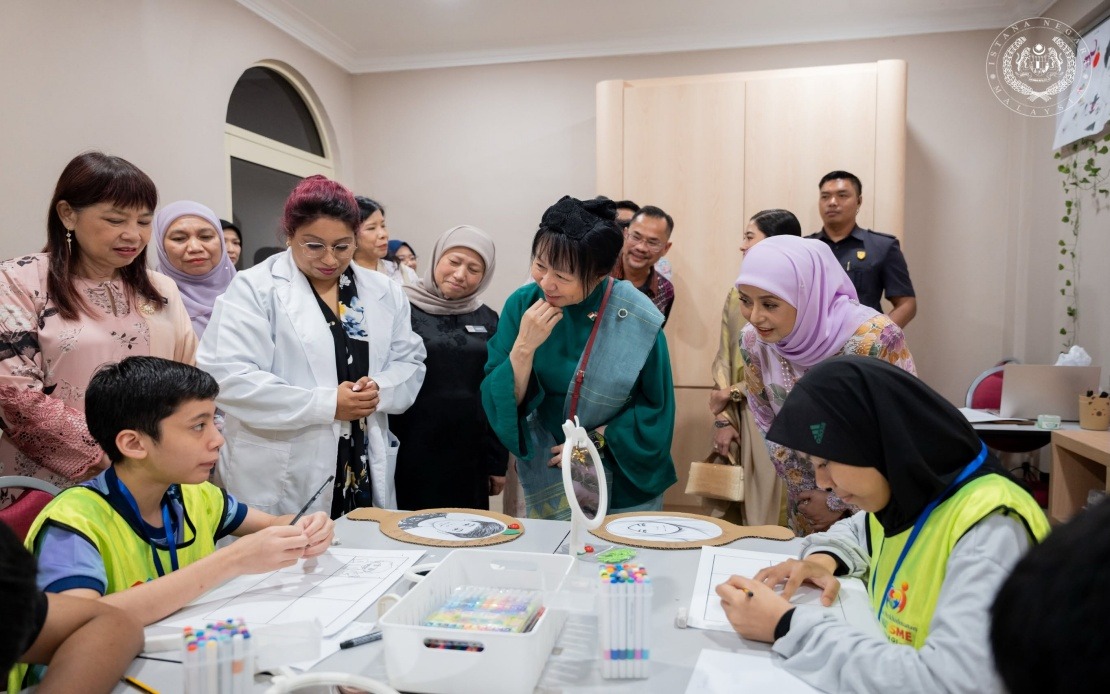
Her Majesty Queen Raja Zarith Sofiah of Malaysia received Singapore First Lady Jane Ittogi Shanmugaratnam at the Bangi Autism Service Centre on July 14, marking a significant diplomatic engagement during President Tharman Shanmugaratnam's ongoing state visit to the country. The occasion underscored both nations' commitment to social welfare and disability support services, with the engagement coordinated at the highest levels of Malaysian leadership and ceremonial hierarchy.
The welcoming ceremony reflected the formal nature of the bilateral visit, with Tunku Tun Aminah Sultan Ibrahim joining the Queen in greeting the First Lady. The gathering also included Prime Minister's wife Datuk Seri Dr Wan Azizah Wan Ismail, Women, Family and Community Development Minister Datuk Seri Nancy Shukri, and other senior government officials. This assembly of prominent figures underscored the Malaysian government's emphasis on the autism support sector as a priority development area worthy of high-level political attention during an important diplomatic engagement.
The touring delegation examined multiple therapeutic and developmental facilities within the centre, including the Activities of Daily Living (ADL) Room, Occupational Therapy Room, and gymnasium facilities. These facilities exemplify the centre's comprehensive approach to supporting individuals with autism through practical life skills training and therapeutic interventions. The detailed facility tour allowed the visitors to observe firsthand how integrated therapeutic environments support individual development and independence for autistic persons, providing concrete examples of effective service delivery models.
Minister Nancy Shukri provided crucial statistical context during her remarks, revealing that 93,199 individuals with autism spectrum disorder had been formally registered with the Social Welfare Department as of June of the preceding year. This substantial figure demonstrates the significant prevalence of autism within Malaysia's population and underscores the scale of support services required. The minister projected that registration numbers would continue escalating as public awareness campaigns gain traction and diagnostic services become more accessible across different regions and socioeconomic groups.
The trajectory of autism case identification in Malaysia reflects broader regional patterns of improved diagnostic recognition and reduced stigma surrounding neurodevelopmental conditions. As screening tools become more widely available through primary healthcare facilities and community health workers, more families gain access to early identification and intervention services. This expanding awareness particularly benefits lower-income populations previously underserved by specialized diagnostic facilities concentrated in urban centres. The growth in registered cases therefore represents progress in identifying previously undiagnosed individuals rather than necessarily indicating rising incidence rates.
The Bangi centre operates through a collaborative partnership model combining government resources with non-governmental expertise, specifically incorporating the National Autism Society of Malaysia (NASOM) and the Damansara Damai Community-Based Rehabilitation Centre (PDK). This public-private partnership structure has become increasingly prevalent across Southeast Asian social welfare systems, leveraging NGO specialization and community trust alongside government resources and institutional stability. Such arrangements enable service provision at scale while maintaining programme flexibility and responsiveness to evolving community needs that purely bureaucratic structures sometimes struggle to address.
The partnership approach reflects Malaysia's broader policy direction toward collaborative governance in social development sectors. By integrating NASOM's autism-specific expertise and community connections with the Damansara Damai centre's rehabilitation capabilities, the Bangi facility can provide more holistic support spanning diagnostic, therapeutic, educational, and vocational dimensions. This integration also facilitates knowledge transfer between specialized NGOs and government agencies, strengthening the overall institutional capacity for autism service delivery across the public system.
Diplomatically, the First Lady's visit reinforced Malaysia-Singapore bilateral engagement beyond traditional economic and security frameworks, extending into social policy and community development domains. Both nations face similar demographic pressures and rising healthcare costs, making shared learning on cost-effective service delivery models mutually beneficial. The exchange of best practices in autism support and community-based rehabilitation represents the type of soft cooperation that builds sustained goodwill and institutional relationships between neighbouring governments.
Singapore's experience with early intervention programmes and integrated special education systems offers relevant models for Malaysian policymakers expanding autism support infrastructure. Conversely, Malaysia's experience managing services across more geographically dispersed and economically diverse populations provides insights applicable to Singapore's efforts reaching immigrant communities and lower-income populations. Such bilateral learning opportunities extend the value of state visits beyond ceremonial functions to include practical policy collaboration and institutional strengthening.
The visit concluded by mid-morning, maintaining the efficient scheduling typical of high-level diplomatic engagements with multiple programmed events. Despite its brevity, the centre visit accomplished multiple objectives simultaneously: demonstrating political commitment to autism support services, facilitating bilateral learning between two sophisticated regional welfare systems, and providing international visibility to the Bangi centre's work. This visibility potentially influences domestic funding allocations and public perception of autism services as deserving continued investment and policy attention.
For Malaysia's autism support sector, the high-level international attention generated by the visit carries practical implications beyond symbolic value. Increased political visibility often translates to enhanced budget allocations, workforce development priorities, and policy reforms. The presence of the Queen and First Lady signals to Malaysian society that autism support warrants engagement from the nation's highest levels, potentially reducing stigma and encouraging greater service utilization among families hesitant to access support services. Within Southeast Asia, the visit reinforces Malaysia's positioning as a regional leader in community-based rehabilitation approaches, attracting technical partnerships and development cooperation from international organizations and neighbouring governments.
Looking forward, the momentum generated by this high-level engagement presents opportunities for accelerating autism service expansion across Malaysia's less-developed regions. The collaborative partnership model demonstrated at Bangi offers a replicable template for establishing similar centres in other states, particularly where NGO capacity and government commitment can be aligned. Enhanced bilateral cooperation with Singapore could facilitate training exchanges for Malaysian service providers, introduce evidence-based intervention methodologies, and provide technical assistance for scaling successful programmes. As autism prevalence continues rising regionally, Malaysia's demonstrated commitment to integrated, community-based support services positions it as a constructive force in developing Southeast Asian approaches to neurodevelopmental disability support.

