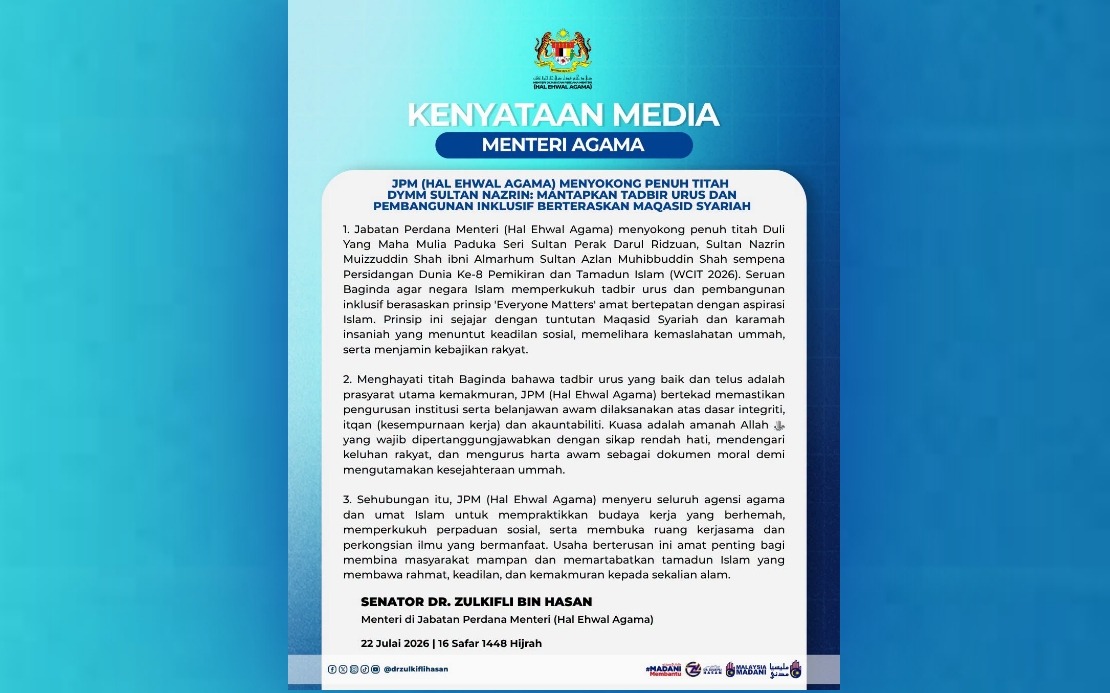
The Prime Minister's Department (Religious Affairs) has committed to reshaping how religious institutions are managed across Malaysia, adopting a governance model centred on integrity, accountability and public welfare. This pivot reflects guidance offered by Sultan Nazrin Shah during his address at the 8th World Conference on Islamic Thought and Civilisation, where the Perak ruler emphasised that good governance and inclusive development should be anchored on the principle of "Everyone Matters" — a framework equally applicable to Muslim nations and secular societies alike.
Minister in the Prime Minister's Department (Religious Affairs) Dr Zulkifli Hasan stated that the department views Sultan Nazrin's governance philosophy not merely as political rhetoric but as a foundation deeply rooted in Islamic teaching. The "Everyone Matters" approach, he explained, aligns seamlessly with Maqasid Syariah — the overarching objectives of Islamic law — and the concept of karamah insaniah, or human dignity. This alignment is significant because it positions modern governance standards within an Islamic ethical framework rather than presenting them as Western imports or secular impositions.
In his royal address, Sultan Nazrin articulated a vision of public service that transcends sectarian boundaries. He described how effective governance manifests when civil servants treat every citizen with equal regard regardless of racial, religious or political identity. According to the Sultan, such non-discriminatory service delivery embodies national unity and reflects a humility in leadership that prioritises listening to citizens' concerns before formulating policy. This perspective carries particular weight in Malaysia's context, where religious affairs intersect with sensitive questions of identity, minority rights and social cohesion.
The Sultan also addressed the interconnectedness of modern economies and societies, cautioning against isolationist approaches to development. His argument that no nation can insulate itself from global trade, investment and knowledge flows underscores why institutional governance must be inclusive and transparent. In Malaysia's case, where religious institutions receive public funding and wield significant influence over community life, these principles become even more pressing. Poor governance in such bodies can erode public trust not only in those institutions but in government legitimacy more broadly.
Dr Zulkifli positioned his department's commitment around three operational pillars: institutional management rooted in integrity, itqan — an Islamic concept denoting excellence and meticulous care in execution — and rigorous accountability mechanisms. This framing rejects any notion that religious governance might operate outside conventional standards of financial transparency or performance measurement. Instead, it argues that Islamic principles demand even higher standards, since authority is characterised as an amanah, or sacred trust from Allah requiring humble exercise and constant attention to public welfare.
A crucial element of the minister's statement concerns the moral framework underlying public resource management. He argued that handling state funds should not be treated as a technical administrative function but as a moral obligation toward the ummah, the broader Muslim community. This perspective invites religious officials to regard themselves as custodians of collective welfare rather than managers of institutional interests, potentially shifting incentives away from self-preservation and toward genuine public service.
Beyond institutional structures, Dr Zulkifli called on religious agencies and Muslim leaders to foster a workplace culture characterised by courtesy and professionalism. This appeal for cultural change reflects recognition that governance improvements require shifts in human behaviour and interpersonal relations, not merely policy revision. The emphasis on strengthening social unity and promoting collaboration across institutional boundaries suggests an understanding that religious organisations operate within broader ecosystems and cannot function optimally in isolation from civil society and government agencies.
For Malaysia, where religious administration falls largely under state authorities with the federal government maintaining coordinating responsibilities, this framework carries implications for Centre-state relations. States like Selangor, Johor and Kedah, which administer their own Islamic institutions, might be expected to adopt similar governance standards, potentially creating pressure for more consistent application of principles across the federation. This could either enhance national coherence or trigger disputes over religious autonomy versus centralised standards, depending on how implementation unfolds.
The emphasis on knowledge sharing and collaborative practice also hints at an openness to learning from international best practices in religious governance. Several Muslim-majority nations and minority Muslim communities globally have experimented with governance models that blend Islamic principles with transparency mechanisms, stakeholder consultation and professional management standards. Malaysia's engagement with such models could position its religious institutions as leaders in institutional reform across the Islamic world, particularly important as Muslim-led societies increasingly face questions about reconciling tradition with contemporary governance expectations.
Sultan Nazrin's framework and the Religious Affairs Ministry's endorsement represent a significant rhetorical and policy shift in how Malaysia positions religious governance. Rather than defending religious institutions as exempt from secular accountability standards, this approach argues that Islamic principles themselves demand rigorous governance and inclusive decision-making. Whether this translates into substantive institutional change will depend on consistent implementation, adequate resourcing for oversight mechanisms and genuine commitment from religious leaders to embrace accountability culture.
The timing of this governance initiative carries weight given broader Malaysian conversations about institutional reform and public trust. Recent years have witnessed questioning of various government institutions' effectiveness and transparency. Religious institutions, given their cultural significance and influence over personal and community life, face particular scrutiny. A credible commitment to governance reform in this domain could restore confidence, while superficial implementation risks deepening scepticism about whether institutions genuinely prioritise public welfare over institutional interests.
Looking forward, the test of these governance commitments will lie in measurable outcomes: whether budget transparency improves, whether complaints mechanisms become more responsive, whether religious officials genuinely consult stakeholders before major decisions, and whether institutional cultures shift toward accountability. The framework is intellectually coherent and rhetorically compelling. The challenge now is translating principle into practice across Malaysia's complex mosaic of federal and state religious authorities, each with distinct histories, capacities and political contexts. Success could establish a governance model worthy of international study; failure risks deepening public cynicism about institutional reform promises.

