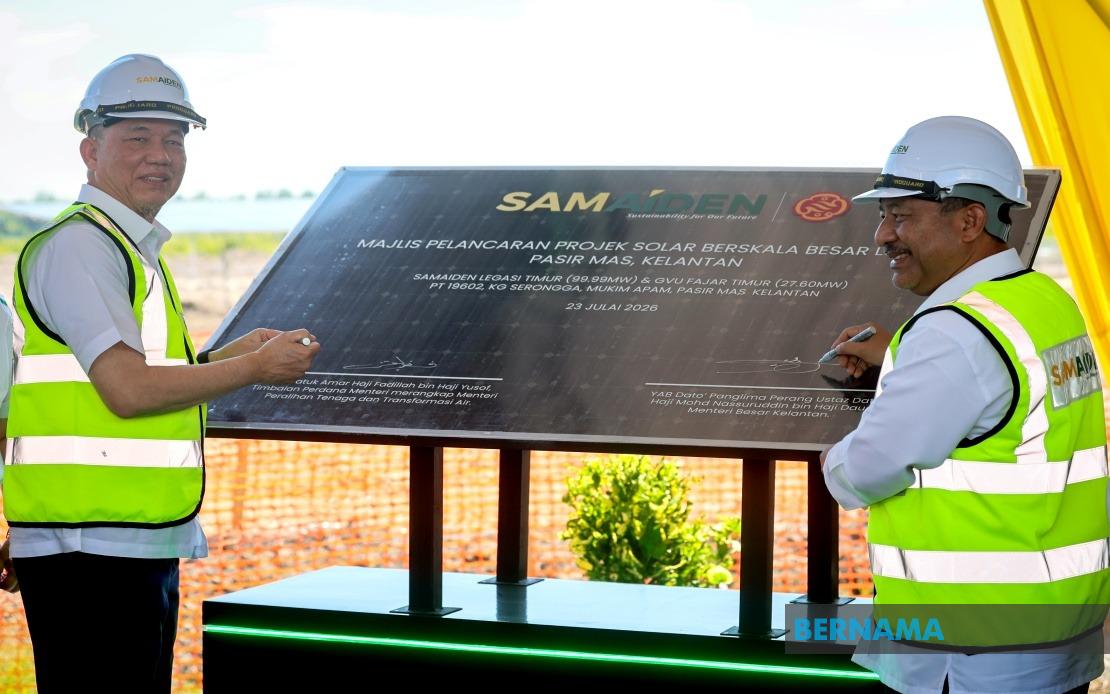
Malaysia's energy transition is accelerating faster than many regional neighbours, with renewable energy now comprising nearly 32 per cent of the country's installed capacity as of June. Deputy Prime Minister Datuk Seri Fadillah Yusof announced this milestone during the launch of the Large-Scale Solar Project (LSS5) in Pasir Mas, Kelantan, signalling that the nation is solidly positioned to meet its 35 per cent renewable energy target by 2030 and maintain momentum towards a 70 per cent renewable energy mix by 2050. This trajectory reflects measurable progress under Malaysia's National Energy Transition Roadmap (NETR), which has already delivered a 31 per cent renewable energy capacity by December 2025, exceeding the government's interim expectations.
For Malaysian investors and industrial planners, the implications are substantial. The government's structured approach to energy transition—balancing security, affordability, and sustainability—provides the certainty that major economies increasingly demand. Fadillah, who also holds the portfolio of Minister of Energy Transition and Water Transformation (PETRA), framed renewable energy expansion not as a mere environmental preference but as essential strategic infrastructure. Energy security in an era of volatile fossil fuel markets, coupled with the rising cost of imported energy, makes renewable capacity a competitive advantage. Simultaneously, meeting global climate commitments opens access to international capital markets increasingly focused on environmental, social, and governance criteria, attracting the high-quality foreign direct investment that Malaysia seeks to sustain its manufacturing and tech sectors.
The Kelantan project exemplifies how renewable energy development translates into tangible regional benefits. LSS5 is designed to bolster the state's electricity supply while creating employment opportunities, stimulating local economic activity, and fostering a network of supporting industries. For Kelantan specifically, which has historically lagged more developed Malaysian states in industrial diversification, such projects represent genuine pathways to competitive advantage. The state government, led by Menteri Besar Datuk Mohd Nassuruddin Daud, views renewable energy infrastructure as foundational to repositioning Kelantan as an investment destination grounded in sustainability and innovation. The narrative shift is significant: renewable energy is no longer positioned merely as climate action but as an economic development engine capable of attracting capital and creating skilled employment.
Kelantan's renewable energy potential remains substantially underexploited relative to available resources. The state possesses extensive suitable land and enjoys supportive governance frameworks that permit rapid private sector participation. By encouraging rooftop solar installations through PETRA's Solar ATAP Programme across residential, commercial, and religious properties, the state can achieve distributed generation without competing for large tracts of agricultural land. This decentralised approach proves particularly valuable in densely populated areas and reduces transmission losses, enhancing grid efficiency. For property owners and businesses, participation in such programmes offers long-term energy cost reduction alongside potential revenue from surplus generation fed into the national grid, improving financial resilience against future electricity price volatility.
The LSS5 launch itself serves as a confidence signal within Malaysia's investment community. Large-scale solar projects require substantial upfront capital and depend upon stable, predictable regulatory frameworks, transparent power purchase agreements, and reliable grid infrastructure. The willingness of private developers to commit significant resources to Kelantan demonstrates that the state, in collaboration with federal agencies, has successfully created the institutional certainty necessary to underpin major renewable investments. This institutional maturity is increasingly critical as competition for renewable energy investment intensifies across Southeast Asia, where investors evaluate not only physical resources but also governance quality and regulatory consistency. Fadillah's emphasis on collaboration between federal and state governments and the private sector reflects recognition that energy transition succeeds through aligned incentives rather than government mandate alone.
Malaysia's renewable energy progress also carries regional significance. As the ASEAN bloc commits to deeper decarbonisation and energy independence, Malaysia's demonstrated capacity to mobilise investment, develop grid infrastructure, and achieve measurable capacity growth provides a credible model for peer nations facing similar transition challenges. Thailand, Vietnam, and Indonesia all face comparable pressure to increase renewable energy deployment, yet each grapples with different land constraints, grid maturity, and institutional capacity. Malaysia's balanced approach—neither rushing renewables deployment at unsustainable speed nor delaying transition—illustrates pragmatic energy policy that sustains economic momentum whilst meeting environmental obligations. This positioning enhances Malaysia's soft power within ASEAN discussions on climate and energy policy.
The emphasis on affordability and energy security within Malaysia's transition framework addresses a legitimate concern facing Southeast Asian policymakers. Overly rapid renewable energy deployment, without corresponding grid modernisation and storage capacity, risks supply volatility and price inflation affecting manufacturers and households alike. Malaysia's phased approach, with intermediate targets at 2030 before the ambitious 2050 goal, permits coordinated development of supporting infrastructure including battery storage, smart grid technologies, and demand management systems. For Malaysian manufacturing—particularly energy-intensive sectors such as semiconductor fabrication, chemical processing, and refining—reliable, competitively priced electricity underpins competitiveness. The transition roadmap's explicit commitment to cost affordability alongside capacity expansion addresses this industrial requirement directly.
The investment climate for renewable energy hardware and services stands to broaden considerably as capacity targets accelerate. Companies specialising in solar panel installation, grid balancing systems, energy storage solutions, and grid monitoring technology will find growing demand within Malaysia's energy sector. Local enterprises can develop supply chain capabilities and technical expertise, capturing value beyond simple installation services. International technology providers increasingly establish regional manufacturing and support hubs in Southeast Asia; Malaysia's articulated renewable energy roadmap creates business certainty that encourages such investments. Over the medium term, these secondary industries generate employment in skilled technical fields and engineering, supporting Malaysia's efforts to develop high-value economic activities beyond traditional manufacturing.
Kelantan's role in this broader transition carries particular significance given the state's historical economic composition. Agricultural land and fishing remain important sectors, but renewable energy facilities can coexist with or replace less productive land uses, particularly in areas unsuitable for agriculture due to soil quality or flooding risk. The state government's framing of renewable energy as a vehicle for sustainable economic diversification rather than a competing land use signals sophisticated policy thinking. For rural communities, solar projects can provide lease income from land owners, local employment during construction and operation, and tax revenue for municipal development. Community relationships remain crucial; Menteri Besar Mohd Nassuruddin's emphasis on environmental protection and strong community relations suggests awareness that renewable energy projects succeed or fail based upon local acceptance and tangible benefit-sharing.
The pathway to Malaysia's 2030 and 2050 renewable energy targets remains achievable but not inevitable. Reaching 35 per cent by 2030 requires sustained investment in grid infrastructure, regulatory certainty, and competitive power procurement processes. The achievement of 31 per cent capacity by December 2025 indicates that Malaysia is tracking appropriately, yet complacency carries risks. Grid stability as renewable penetration increases demands sophisticated balancing technologies and possibly expanded natural gas capacity serving as flexible backup during periods of low solar generation. Battery storage technology continues advancing, making longer-duration storage economically viable, but requires continued investment. Malaysia's success depends upon maintaining policy consistency across electoral cycles and government transitions, ensuring that private investors' confidence in the regulatory framework endures.
Looking forward, Malaysia faces strategic questions about the composition of its renewable energy mix beyond 2030. Solar dominates current expansion, reflecting technological maturity and falling costs, yet wind energy remains underdeveloped despite Malaysia's coastal geography and potential for offshore wind resources. Hydroelectric capacity, historically important, faces constraints from competing water demands and environmental considerations. Bioenergy and waste-to-energy opportunities exist but remain relatively marginalised in current planning. Diversifying renewable sources reduces technological and weather-related risks, strengthening grid resilience. The integration of regional electricity trade within ASEAN, facilitated by improved interconnections, could permit Malaysia to leverage its comparative advantages in solar generation whilst importing complementary renewable sources from peers with stronger wind or hydroelectric resources. Such regional integration would amplify the strategic and economic benefits flowing from Malaysia's energy transition investments.

