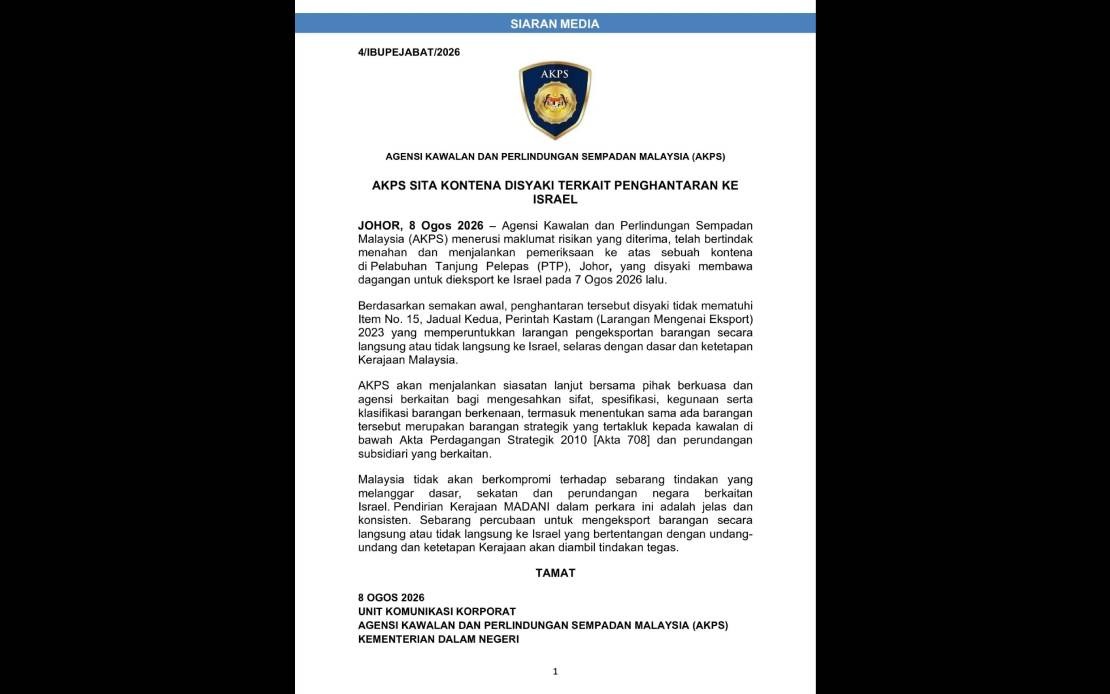
Prime Minister Datuk Seri Anwar Ibrahim has publicly lauded the Malaysian Border Control and Protection Agency (AKPS) for its prompt intervention in detaining a shipment at the Port of Tanjung Pelepas in Johor, which authorities suspect contained goods destined for Israel. The seizure, carried out yesterday, represents a tangible application of Malaysia's long-standing policy against facilitating trade with the Israeli regime, a position the Prime Minister reinforced in a social media statement released today.
The confiscated container allegedly violated provisions under Item No. 15 of the Second Schedule of the Customs (Prohibition of Exports) Order 2023, which explicitly forbids the direct or indirect export of merchandise to Israel in accordance with Malaysian government directives. This legal framework underscores the systematic nature of Malaysia's trade restrictions, moving beyond rhetorical opposition to establish enforceable customs protocols that target Israel-bound commerce across all Malaysian ports and maritime terminals.
Anwar's public endorsement of the seizure carries significance beyond routine border enforcement. The Prime Minister articulated that the action exemplifies Malaysia's determination to prevent the nation's infrastructure—particularly its strategically important ports—from becoming conduits for international commerce that could buttress or sustain what he characterizes as the Israeli regime's actions against Palestinian populations. This framing positions Malaysia's trade controls as humanitarian measures rather than merely political gestures, connecting border enforcement to broader questions of complicity in international conflicts.
The government's invocation of The Hague Group in justifying the seizure signals Malaysia's alignment with international mechanisms designed to address Palestinian rights and Israeli accountability. By anchoring its domestic trade restrictions to multilateral frameworks, Malaysia attempts to situate its policies within a broader global context, suggesting that the nation is not acting in isolation but rather participating in coordinated international pressure on the Israeli state through economic means.
Crucially, AKPS confirmed that the detained shipment was subjected to inspection protocols, indicating that Malaysia has developed operational capacity to identify and intercept Israel-bound goods. This suggests the agency possesses either intelligence networks to flag suspicious shipments or documentary screening procedures sophisticated enough to detect attempts to route goods to Israel through intermediary destinations. The specificity of the Port of Tanjung Pelepas as the location further emphasizes that Malaysia's largest container port remains under close scrutiny for potential violations.
The seizure also reflects the maturation of Malaysia's trade restrictions since December 2023, when the government implemented a comprehensive ban preventing Israeli vessels and cargo-carrying ships from accessing Malaysian ports. Initially, such prohibitions risked remaining symbolic without enforcement infrastructure; the AKPS action demonstrates that Malaysia has transitioned toward active policing of these restrictions. This enforcement capability carries implications for Malaysian shipping companies, logistics operators, and exporters, all of whom must now navigate increasingly stringent compliance requirements.
For Malaysia's regional position, the seizure reinforces the nation's identity as a vocal advocate for Palestinian causes within ASEAN and the broader Global South. Unlike some regional peers that maintain strategic ambiguity regarding Israeli relations to preserve economic or diplomatic flexibility, Malaysia has chosen explicit alignment with Palestinian advocacy. This positioning carries both diplomatic costs—potentially complicating relations with Israel-aligned states—and domestic political benefits, given the strong Palestinian solidarity sentiment within Malaysian society and among Islamic organizations.
The incident also carries implications for Malaysia's trading partners and international businesses operating through Malaysian ports. Multinational corporations and trading houses must now account for Malaysia's export restrictions as a logistical constraint, potentially rerouting Israel-bound goods through alternative ports in neighboring countries. This creates competitive pressure on rival maritime hubs in Singapore and other regional competitors, though it may simultaneously deter some international commerce through Malaysian terminals if compliance verification becomes burdensome.
Anwar's emphasis on Malaysia upholding "principles of humanity, justice and international law" frames the trade restrictions as expressions of universal values rather than sectarian or ideological preferences. This rhetorical strategy attempts to appeal beyond Malaysia's Muslim-majority society to international audiences concerned with human rights and humanitarian law. However, the framing also invites scrutiny into whether Malaysia applies similar trade and diplomatic measures consistently across all global conflicts, a question that critics have raised regarding Malaysia's approach toward other geopolitical disputes.
The coordinated messaging between AKPS and the Prime Minister's office suggests that the seizure was not merely operational happenstance but rather a deliberate policy statement. By highlighting the action through official government channels and ministerial commentary, Malaysian authorities amplified its symbolic value, signaling to both domestic constituencies and international observers that the nation takes its Israel-related restrictions seriously. This public dimension transforms a single customs enforcement action into a broader assertion of national policy priorities.
Moving forward, the seizure may prompt Malaysian exporters to scrutinize their supply chains more carefully, particularly companies involved in transshipment of electronics, chemicals, or dual-use technologies that could plausibly be destined for Israel. The incident also likely encourages intelligence and customs agencies to allocate resources toward identifying obfuscated trade routes, given that sophisticated traders may attempt to disguise Israel-bound shipments using false documentation or indirect routing patterns. The effectiveness of Malaysia's enforcement regime will ultimately depend on the AKPS's capacity to sustain investigation and interdiction efforts beyond high-profile individual cases.
Ultimately, the Port of Tanjung Pelepas seizure demonstrates that Malaysia has converted its anti-Israel trade policy from declaratory statements into operational reality. Whether this enforcement remains consistent and comprehensive, or whether it becomes concentrated on periodically publicized cases designed to satisfy domestic political constituencies, will determine the genuine impact of Malaysia's restrictions on Israel-bound commerce transiting Southeast Asia.

