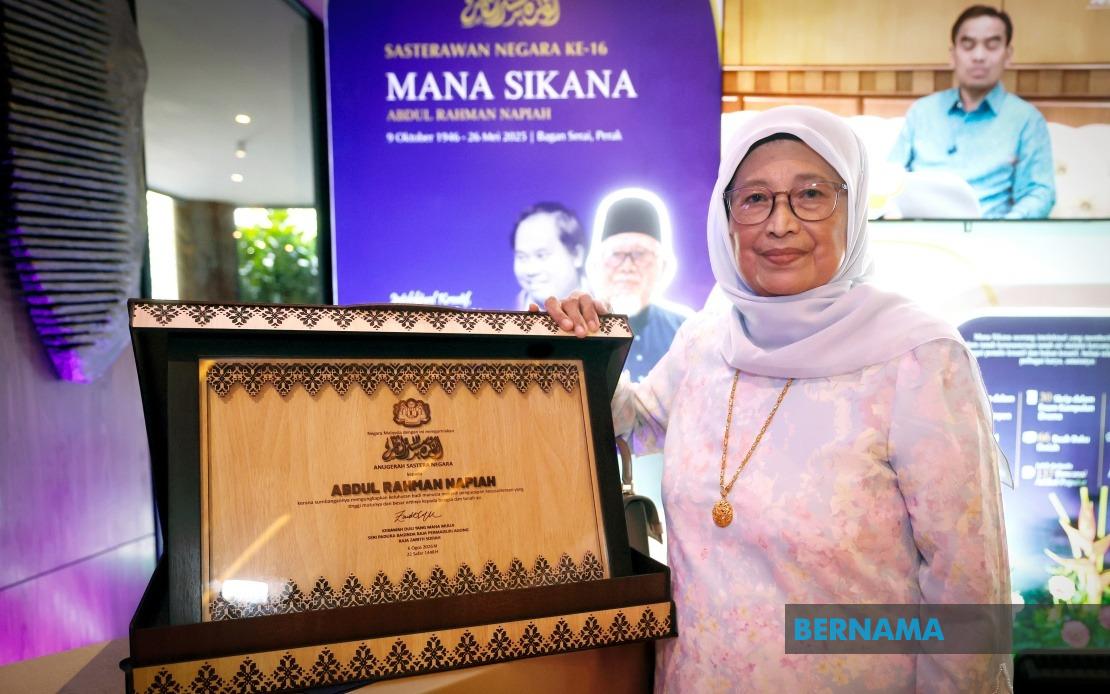
Malaysia's literary community has gained belated but significant recognition of one of its most prolific figures with the conferment of the 16th National Laureate award upon the late Dr Abdul Rahman Napiah, better known by his pen name Mana Sikana. The honour, presented at a ceremony in Kuala Lumpur on August 6 by Her Majesty Raja Zarith Sofia, Queen of Malaysia, came in the form of an acceptance by Mana Sikana's widow, Salmah Ali, 82, who described the award as a long-overdue acknowledgement of her husband's exceptional lifetime devotion to advancing Malaysia's literary traditions.
Mana Sikana, who passed away in May last year at the age of 80 following heart complications, had been informed before his death of the possibility of receiving this nation's most prestigious literary award. According to Salmah Ali, her husband had harboured hopes of receiving such recognition, given the breadth and depth of his professional accomplishments across multiple domains of literary and academic endeavour. The timing proved tragically poignant—on the very day he suffered the health crisis that would ultimately claim his life, Mana Sikana had been presenting a working paper to Dewan Bahasa dan Pustaka, Malaysia's premier language and literary institution, before experiencing the stomach complications that necessitated hospitalisation.
The trajectory of Mana Sikana's career exemplified a rare combination of creative production, scholarly rigour, and institutional influence. Born in Bagan Serai, Perak, on October 9, 1946, he initially established himself as a classroom educator before transitioning into higher education and academic research. His literary accolades began accumulating from his school years, establishing a pattern of recognition that would continue throughout his professional life. Beyond the confines of Malaysia, his creative works found audiences across Singapore, where during his time in Johor Bahru he actively produced drama content for both radio and television broadcasters. Malaysian broadcasting networks similarly showcased his dramatic compositions with regularity, even as he maintained his teaching responsibilities.
Mana Sikana's academic credentials grew increasingly impressive as he pursued postgraduate studies at Universiti Kebangsaan Malaysia, ultimately attaining the rank of professor—a distinction that reflected not merely his scholarly output but his recognised authority in literary studies and theory. His influence extended into the Indonesian academic sphere, where he served as a visiting lecturer at multiple universities, demonstrating the regional significance of his intellectual contributions. During his tenures at various institutions including UKM, Nanyang Technological University in Singapore, and Universiti Pendidikan Sultan Idris, he shaped generations of students and contributed substantially to the development of literary discourse within Southeast Asian higher education.
Education Minister Fadhlina Sidek, who attended the award ceremony, characterised the selection of Mana Sikana as recognition of his foundational role in strengthening Malaysian literature through multiple interconnected channels. His work encompassed not merely the creation of literary texts but the establishment and development of literary theory, the practice of sophisticated critical analysis, and the broader cultivation of academic discourse around the literary arts. This multifaceted contribution distinguished him from practitioners focused solely on creative output, positioning him instead as an intellectual architect who shaped how literature was understood, studied, and produced within Malaysian institutions.
For Salmah Ali, receiving the award on her husband's behalf proved an emotionally complex experience. She conveyed pride and satisfaction that the nation had finally formally recognised her husband's extraordinary contributions to Malaysian cultural life, yet the occasion was simultaneously shadowed by the profound absence of the man being honoured. Her recounting of how Mana Sikana had desired this recognition, and how close he came to receiving it during his lifetime, underscored the bittersweet nature of posthumous honours—achievements that arrive too late for the honoured individual to experience directly.
Beyond his professional accomplishments, Mana Sikana's legacy extended into his family domain. He maintained a commitment to transmitting his literary knowledge and passion to his four children and twelve grandchildren, suggesting that his influence on Malaysian letters would persist through familial transmission of values and understanding. This generational continuity represents an often-overlooked dimension of cultural contribution, wherein intellectual traditions are perpetuated through informal family channels alongside formal institutional structures.
The National Laureate award represents Malaysia's highest recognition of literary excellence and service to the nation's cultural development. By honouring Mana Sikana in this category, the conferring authorities acknowledged that his impact transcended individual creative works to encompass the systematic advancement of literary institutions, academic standards, and the intellectual foundation upon which contemporary Malaysian literature rests. For Malaysian readers and literary scholars, this recognition signals the nation's commitment to preserving and honouring those whose contributions have fundamentally shaped the landscape of Malay-language and English-language literature within the country.
The presentation ceremony, attended by Education Minister Fadhlina Sidek alongside Her Majesty Raja Zarith Sofia, reflected the institutional significance attached to this award within Malaysia's cultural hierarchy. Such high-level participation demonstrates how literary achievement and academic contribution intersect with matters of national cultural policy and official recognition. For the broader Southeast Asian literary community, Mana Sikana's elevation to National Laureate status affirms the region's engagement with literary scholarship and creative production as matters worthy of state-level acknowledgement and commemoration.

