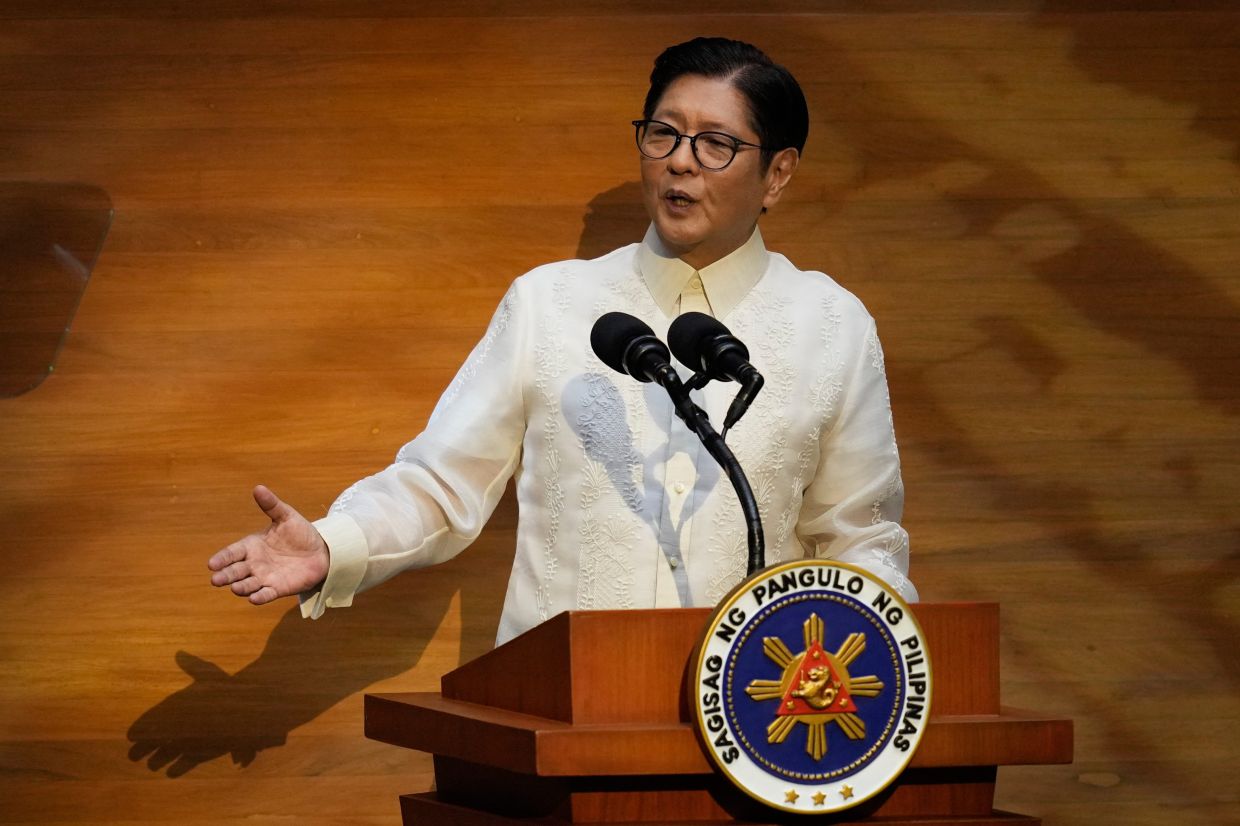
Philippine President Ferdinand Marcos Jr. has publicly rebuked China during his state of the nation address, pledging to uphold a landmark 2016 arbitration ruling that rejected Beijing's expansive territorial claims in the South China Sea. Although the president refrained from naming China directly, his pointed remarks about protecting the arbitration award and defending Filipino dignity were met with loud applause from lawmakers, signalling broad domestic support for standing firm against external pressure. The carefully worded speech underscores growing tensions between Manila and Beijing over competing maritime interests in one of the world's most strategically important waterways.
Marcos's rebuke came at a particularly charged moment in regional relations. Last week, the Philippine government lodged a formal diplomatic protest after China Daily, a state-controlled Chinese media organisation, published AI-generated animations portraying Filipinos as monkeys in cartoons designed to mock the 2016 arbitration decision. The imagery prompted Marcos to summon Chinese Ambassador Jing Quan to his office, and Manila officially condemned the depictions as racist and dehumanising, demanding their immediate removal. Although Beijing's Foreign Ministry spokesperson Lin Jian later claimed the video did not represent China's official position, the incident highlighted the inflammatory rhetoric that has begun characterising exchanges between the two nations on maritime disputes.
The 2016 arbitration ruling, which the Philippines initiated in 2013 following a tense standoff involving Chinese and Philippine vessels near a contested shoal, remains a source of profound friction. The international tribunal rejected China's sweeping historical claims over the South China Sea, establishing what Marcos described as a definitive benchmark for interpreting the 1982 United Nations Convention on the Law of the Sea. Beijing has consistently refused to accept the decision, dismissing it as a political farce disguised as legal proceedings. In his latest remarks, the Philippine leader committed his government to defending the ruling through every available peaceful and legal mechanism, explicitly rejecting any notion of capitulation and declaring that Filipinos "do not yield."
For Southeast Asia and the broader Indo-Pacific region, Marcos's unwavering stance on the arbitration award carries significant implications. The South China Sea remains one of the world's most critical maritime routes, with trillions of dollars in annual commerce passing through its waters. Beyond the Philippines, Vietnam, Malaysia, Brunei, and Taiwan maintain overlapping territorial claims that intersect with Chinese assertions. Increasingly frequent confrontations involving Chinese, Philippine, and Vietnamese forces underscore how the dispute has evolved from a diplomatic disagreement into a recurring flashpoint for military incidents. Malaysia has watched these developments with particular concern, given its own maritime interests and the potential for miscalculation to destabilise the entire region.
Domestically, Marcos faced equally serious political matters during the address. The president disclosed that a special anti-graft prosecutor would soon file formal corruption charges against former House of Representatives Speaker Martin Romualdez, his own cousin and a key political ally. Although Marcos refrained from naming Romualdez explicitly, lawmakers understood his reference immediately, and the announcement drew considerable attention given the family connection. The move represents a significant political decision, with Marcos emphasising that he serves as president for the nation rather than for family loyalties, a statement that underscores the gravity with which he has approached this matter.
Roumualdez, who stepped down as House speaker last year but continues serving as a congressman, has been implicated in a sprawling corruption scandal involving kickbacks from flood control projects. Multiple lawmakers, including sitting and former senators, a previous public works secretary who served under Marcos himself, along with numerous government engineers and construction company executives, have already been charged and detained in connection with the alleged large-scale embezzlement scheme. The former speaker has consistently maintained his innocence and pledged to demonstrate that he violated no laws, insisting he will prove his case when charges are formally filed.
The scale of the alleged corruption has proven staggering. Government authorities have recovered or frozen approximately 25 billion pesos, equivalent to roughly 410 million dollars, in cash and property belonging to various suspects connected to the flood control projects scandal. Some of these recovered assets have already been returned to the national treasury, representing a significant recovery effort by Marcos's anti-corruption apparatus. The president has positioned the pursuit of these cases as central to his administration's commitment to genuine reform, though the involvement of his own relative inevitably complicates the political optics.
The timing of Marcos's simultaneous engagement on maritime sovereignty and domestic corruption reflects the complex pressures facing his presidency. International observers have noted that maintaining credibility on anti-graft initiatives while demonstrating resolve against Chinese incursions helps strengthen the president's standing both domestically and among regional partners concerned about the rule of law. By advancing charges against a political ally, Marcos projects determination to pursue accountability regardless of personal relationships, a posture that could enhance his administration's appeal to countries seeking a reliable, principled partner in regional affairs.
The president's commitment to the arbitration ruling also resonates with sentiment among Southeast Asian nations increasingly concerned about Beijing's assertiveness in disputed waters. The South China Sea disputes have become a defining geopolitical challenge for the region, with countries like Vietnam and the Philippines bearing the brunt of Chinese pressure through confrontations between civilian and paramilitary vessels. Malaysia, which maintains interests in the northern portions of the disputed waters, has sought to balance economic ties with China against its need to protect legitimate maritime claims. Marcos's public defence of the arbitration award signals that the Philippines will not be intimidated into abandoning its legal position, potentially encouraging other claimant states to maintain their own stands.
Looking forward, the implications of Marcos's speech extend well beyond Philippine borders. His administration's simultaneous emphasis on both maritime sovereignty and judicial accountability demonstrates an attempt to anchor his presidency in rule-of-law principles while confronting regional security challenges. The move against Romualdez, despite family ties, suggests Marcos is willing to absorb short-term political costs to establish credibility on governance. Meanwhile, his firm stance on the arbitration ruling indicates that Manila will continue seeking international support and exploring every diplomatic and legal avenue to uphold the decision, even as China maintains its defiant position. For Malaysia and other regional players, this Philippine assertiveness may influence calculations about their own strategies for managing maritime disputes and governance standards in an era of rising great power competition.

