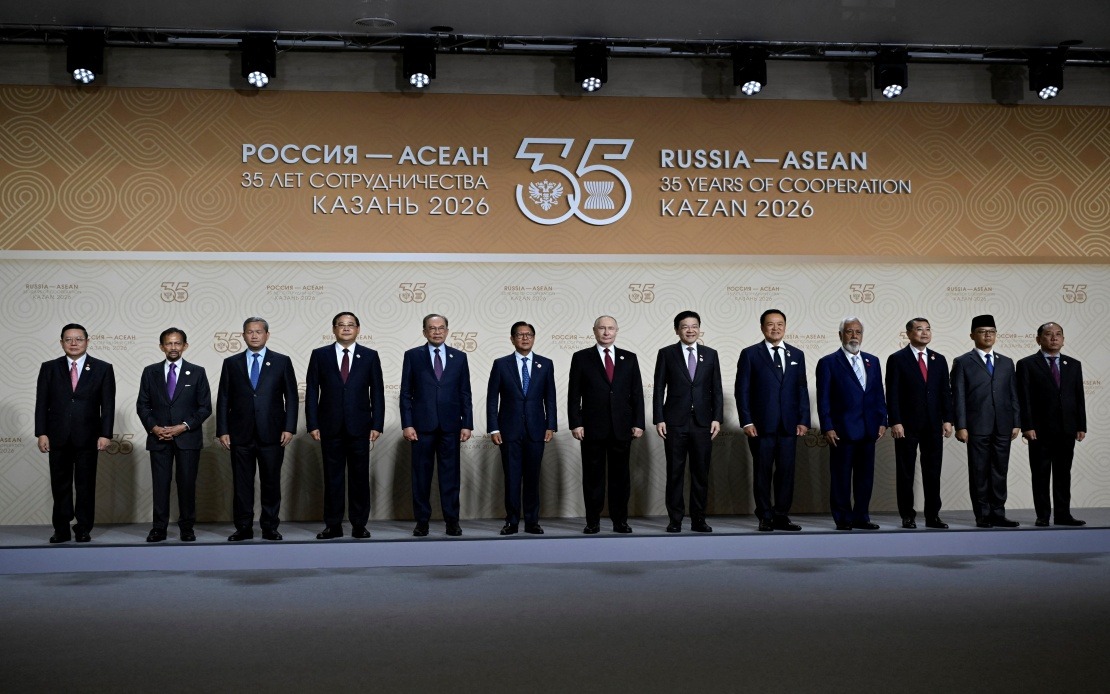
Philippine President Ferdinand R. Marcos Jr has called for ASEAN and Russia to pursue a more ambitious partnership agenda, arguing that three decades of diplomatic relations have barely scratched the surface of what the regional bloc and Moscow could achieve together. Speaking following his participation in the ASEAN-Russia Commemorative Summit in Kazan, Marcos told Russia Today that while bilateral and multilateral ties have developed steadily, the pace of cooperation has remained modest, with considerable variation across individual Southeast Asian member states in their level of engagement with Moscow.
The Philippine leader identified a fundamental disconnect between the progress made and the potential available, suggesting that traditional economic frameworks have constrained the partnership's growth. He emphasised that ASEAN-Russia relations have historically operated within conventional commercial and diplomatic channels that do not reflect the contemporary landscape of global cooperation. This acknowledgement carries particular weight given the Philippines' own position as ASEAN chair and its efforts to navigate complex geopolitical relationships across the Asia-Pacific region during a period of significant strategic realignment.
Marcos pointed specifically to emerging technological domains as the primary engine for future expansion, listing advanced technology, artificial intelligence, data centre development, and power generation as sectors where ASEAN and Russia have barely begun collaborative work. The emphasis on these frontier areas reflects a broader strategic calculation that traditional resource-based trade and conventional infrastructure projects no longer represent the most valuable avenues for partnership. Instead, the Philippine leader suggested that both parties should recognise Russia's expanding capabilities and competitive advantages in these innovation-driven fields and leverage them to generate mutual economic benefits.
The president's framing of this challenge as one rooted in historical oversight rather than diplomatic failure is noteworthy. By characterising AI, data centres, and energy innovation as areas that "simply did not exist" in previous decades, Marcos positioned the underdeveloped state of ASEAN-Russia cooperation less as a consequence of geopolitical tension or strategic misalignment and more as a result of changing global circumstances. This narrative allows for a renewed engagement narrative without requiring either side to acknowledge past policy shortcomings, potentially making deeper cooperation more politically palatable across the diverse ASEAN membership.
Marcos also offered an interpretation of ASEAN's evolving role that has implications for Malaysia and other regional powers. He described the bloc as "growing up fast" and diversifying its partnership portfolio beyond traditional Cold War-era alignments. This characterisation reflects a conscious effort to position ASEAN as a maturing actor with agency in shaping its own strategic relationships, rather than as a passive recipient of great power competition. For Malaysian policymakers and business leaders, this outlook suggests that ASEAN countries have considerably more latitude to pursue bilateral and multilateral arrangements than historical narratives might indicate, provided such engagement serves concrete national interests.
The commemorative summit itself, celebrating over 35 years of ASEAN-Russia dialogue relations, generated several framework documents designed to operationalise the expanded partnership vision. These include the Kazan Declaration 2026, a Comprehensive Plan of Action spanning 2026 to 2030, and separate cooperation agreements focused on cultural exchange and energy development. The multi-year planning horizon embedded in these documents indicates that both sides envision sustained commitment rather than episodic engagement, a significant signal given the often unpredictable nature of geopolitical alignments in Southeast Asia.
For regional observers and Malaysian stakeholders particularly, the emphasis on energy cooperation warrants close attention. Southeast Asia faces mounting pressure to transition away from fossil fuel dependency while simultaneously meeting rapidly growing electricity demand driven by economic development and industrial expansion. Russian expertise in nuclear power technology, renewable energy systems, and energy infrastructure could prove valuable to ASEAN nations pursuing diversified energy portfolios. However, such cooperation also raises questions about technology transfer, regulatory frameworks, and compliance with international non-proliferation standards that Malaysia and other regional nations would need to carefully evaluate.
Marcos's reference to the partnership representing a "new day" marked by expanding dialogue and shifting priorities carries undertones that go beyond economic calculation. His observation that ASEAN engagement patterns are changing "very much" in terms of "who we deal with around the world" suggests recognition that the regional bloc is consciously recalibrating its international relationships. This repositioning occurs within a context where traditional Western-led multilateral institutions have proven less responsive to Southeast Asian concerns, and where the distribution of economic and technological power has shifted significantly over the past decade.
The president's acknowledgement of momentum stemming from a "bipolar world" provides crucial insight into how ASEAN leaders perceive the current international environment. Rather than viewing bipolarity as constraining regional autonomy, Marcos appears to suggest that it creates space for ASEAN manoeuvre by allowing individual member states and the bloc collectively to maintain relationships with multiple major powers. This interpretation differs sharply from earlier regional fears about being forced into zero-sum geopolitical alignments, instead positioning ASEAN as a beneficiary of competitive great power engagement.
The timing of this summit and Marcos's emphasis on untapped potential in ASEAN-Russia cooperation reflects broader strategic recalibrations occurring across Southeast Asia. Malaysia, alongside other ASEAN members, has consistently sought to maintain balanced relationships with major powers, and the Philippine leader's advocacy for deeper engagement with Russia on technology and energy fronts suggests that such positioning enjoys support among regional governments. However, the actual implementation of expanded cooperation will depend on whether individual ASEAN members, including Malaysia, can identify specific projects and partnerships that deliver tangible benefits without generating domestic political controversy or international complications.
Looking forward, the success of this renewed ASEAN-Russia partnership agenda will depend significantly on translating high-level political statements into concrete commercial arrangements and technical collaboration. The energy and technology sectors offer genuine opportunities for mutual gain, particularly given ASEAN's infrastructure needs and Russia's technical capabilities. Yet progress will require addressing practical challenges including sanctions regimes affecting some Russian sectors, ensuring technology transfer arrangements satisfy international standards, and building investor confidence in long-term partnership stability. For Malaysia and other regional nations, the coming years will test whether the "new day" Marcos envisions can translate rhetorical potential into substantive economic and technological partnerships.

