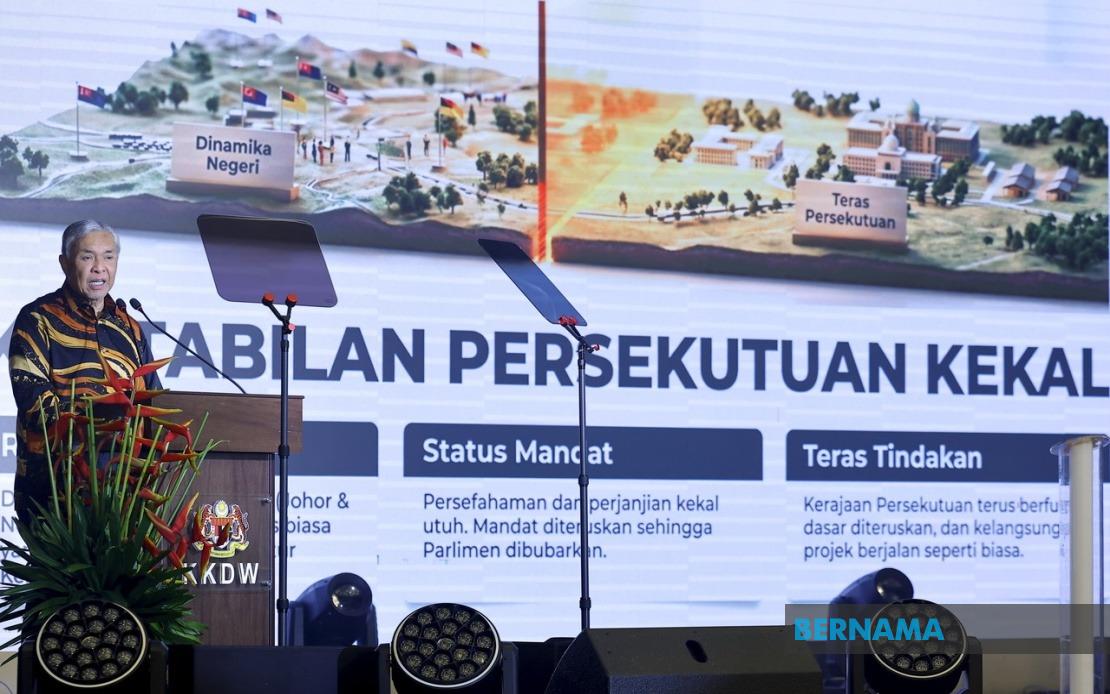
Melaka's Barisan Nasional coalition is preparing for an ambitious campaign in the forthcoming 16th state election, with party leadership committing to contest and win all 21 state seats currently held by the ruling bloc. The announcement comes as the coalition seeks to consolidate its grip on the resource-rich state following a period of political volatility that has marked Malaysian electoral politics in recent years. BN chairman Datuk Seri Dr Ahmad Zahid Hamidi disclosed the strategy during a media engagement at the Rural and Regional Development Ministry's monthly assembly in Putrajaya, indicating that Melaka Chief Minister Datuk Seri Ab Rauf Yusoh had communicated the resolute determination to him directly.
The decision reflects confidence within Melaka's BN machinery, which has maintained control of the state assembly despite broader political uncertainties affecting Malaysia's federal landscape. Ab Rauf Yusoh, who simultaneously holds the position of Melaka BN chairman, has emerged as a stabilising figure in state administration, and his commitment to defending every single seat signals a party leadership united behind a maximalist electoral strategy. This approach contrasts with historical patterns where coalitions typically write off a handful of marginal constituencies or concede ground to coalition partners, opting instead for territorial completeness across the 21-member assembly.
The Melaka political scene holds particular significance within the broader Malaysian context. The state represents one of BN's more reliable strongholds on the peninsula, serving as a testing ground for coalition politics and a bellwether for national electoral trends. The state has historically rotated power between different factions of the ruling alliance, yet the current BN administration has consolidated support across major demographic and geographic divisions. Success in defending all seats would not merely constitute a local victory but would send powerful signals about BN's capacity to mobilise voters and maintain its traditional constituencies against opposition pressure.
However, Ahmad Zahid's subsequent remarks introduced an important caveat to the comprehensive electoral ambition. While the target is to contest all 21 seats independently, the BN chairman acknowledged that the coalition remains fundamentally open to negotiating power-sharing arrangements with potential allies, provided such agreements receive approval from the central leadership. This nuanced position reflects the calculus of coalition politics in contemporary Malaysia, where single-party dominance has given way to multi-bloc competition, and strategic partnerships often prove electorally advantageous even when formal mergers do not occur.
The conditional nature of this openness matters significantly for understanding BN's strategic flexibility. Historical precedent shows that Malaysia's major coalitions frequently adjust seat allocations to accommodate partners and maximise overall seat gains rather than pursuing unilateral total dominance. The statement that discussions with other parties would take place, subject to central endorsement, indicates that Melaka BN leadership operates within a structured decision-making framework where state-level autonomy exists but ultimate authority rests with higher party organs. Such arrangements have historically facilitated smoother campaigning and prevented internal conflicts that might undermine coalition cohesion.
The timing of this announcement carries implications for several other Malaysian states approaching their own electoral cycles. Melaka's explicit commitment to contest comprehensively may influence how rival coalitions position themselves, potentially forcing opposition parties to adopt more aggressive strategies or compelling other BN-led states to articulate their own electoral targets. The statement effectively transforms Melaka into an early indicator of coalition confidence levels across Malaysia's federal system, where state-level contests frequently preview national sentiment and test emerging political alignments.
From an organisational perspective, defending all 21 seats demands substantial ground-level infrastructure, candidate selection processes that satisfy diverse stakeholder constituencies, and coordinated campaign messaging across multiple constituencies with varying demographic profiles. The announcement of this ambitious target implicitly confirms that Melaka's BN has completed preliminary assessments suggesting viability for comprehensive defence. Such assessment typically involves analysing constituency-level voting patterns, demographic shifts, opposition candidate strength, and local grievance landscapes that might advantage or disadvantage incumbent representatives.
The regional dimension of Melaka's electoral cycle extends beyond the state itself. The state borders Johor, another major BN stronghold, and maintains economic linkages with both federal territories and Selangor. Electoral outcomes in Melaka therefore influence perceptions of BN strength across the southern peninsula and may affect how coalition politics unfolds in neighbouring jurisdictions. A comprehensive BN victory would reinforce perceptions of the coalition's organisational capacity precisely at a moment when federal politics remains fluid and subject to shifting alliances.
For Malaysian voters in Melaka, the BN's comprehensive target suggests a party organisation confident in its ability to deliver governance outcomes voters value. The emphasis on defending all seats, combined with the openness to coalition discussions, presents a message of both consolidation and pragmatism. This positioning attempts to appeal simultaneously to traditional BN supporters seeking stability and continuity, and to voters concerned about coalition fragmentation or political paralysis that might result from overly rigid electoral commitments.
The statement by Ahmad Zahid also reflects broader patterns within BN's contemporary strategy, which emphasises recapturing lost support and consolidating existing strongholds rather than pursuing territorial expansion alone. With federal politics remaining contested and opposition coalitions fractured, state-level victories assume heightened importance as concrete demonstrations of BN's continuing electoral viability. Melaka's targeted defence of all 21 seats represents one component of this multi-state strategy designed to stabilise the coalition's foundational support base.
Looking forward, the actual electoral campaign in Melaka will test whether this ambitious target translates into concrete results. Opposition parties, aware of BN's stated intentions, will likely direct resources toward constituencies where sentiment appears most fluid or where demographic changes might advantage challengers. The election itself will reveal whether voter confidence in Melaka's BN administration remains sufficiently strong to deliver the sweeping victory now promised, and whether the coalition's conditional openness to partnership arrangements ultimately shapes the final seat allocation.

