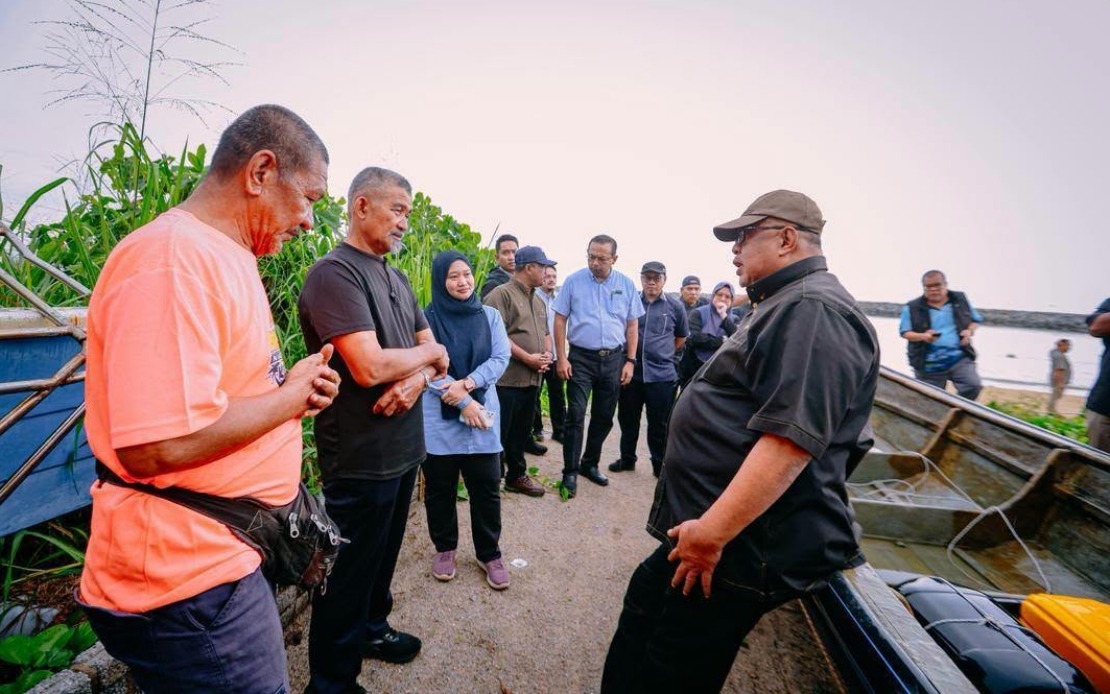
Melaka Chief Minister Datuk Seri Ab Rauf Yusoh has mandated immediate intervention from the Public Works Department (JKR) and the Drainage and Irrigation Department (DID) to tackle mounting problems confronting the fishing community at Pasir Gembur in Tanjung Bidara. The directive emerged following a comprehensive site inspection where the Chief Minister assessed progress on a new fishermen's complex development and engaged directly with residents about their grievances and operational difficulties.
The coastal fishing settlement has faced persistent complications affecting livelihoods, particularly centring on waterway accessibility and vulnerability to tidal flooding. These challenges have hindered both daily fishing operations and broader efforts to modernise local infrastructure. The decision to order a coordinated response from multiple agencies signals recognition at the state administration level that piecemeal efforts have proven insufficient to resolve the interconnected problems facing this traditionally marginalised maritime community.
Central to the government's response is DID's assignment to conduct a detailed feasibility analysis regarding channel deepening between Pasir Gembur and Batu Tenggek. Deepening this waterway would enhance boat manoeuvrability during low tide periods and improve access to fishing grounds, directly benefiting operators who have struggled with navigation constraints. Such improvements would reduce operational downtime and enable more consistent income generation for households dependent on marine resources.
JKR has been tasked with identifying an alternative location for the proposed fishermen's complex that would substantially diminish exposure to seawater intrusion and high-tide flooding. The original site selection apparently failed to adequately account for tidal dynamics and coastal water management principles. Relocating the facility to higher ground or better-protected terrain would safeguard valuable infrastructure investments and ensure the complex functions reliably throughout seasonal weather variations.
The state government has simultaneously implemented stricter regulatory controls over coastal development. Ab Rauf announced that no further private construction will be permitted within the designated coastal wave-breaker zone. Existing structures and any future installations within the broader coastal reserve must now obtain a Temporary Occupation Licence (TOL) from the Land Administrator and secure clearance from relevant technical authorities. This framework aims to prevent haphazard development that exacerbates environmental degradation and physical hazards.
These regulatory measures reflect an evolving understanding of coastal zone management challenges across Southeast Asia. Rapid, unplanned construction in sensitive maritime areas frequently generates unintended consequences—increased erosion, compromised drainage systems, and amplified flood vulnerability. By imposing licensing requirements and environmental review processes, Melaka appears to be learning from coastal management failures observed elsewhere in Malaysia and the region.
Ab Rauf characterised his visit as substantively different from ceremonial political engagement. He emphasised that meeting with residents and personally observing conditions enabled identification of genuine concerns rather than relying solely on bureaucratic reports. This emphasis on ground-level understanding reflects a broader shift toward responsive governance where decision-makers recognise that effective policy-making demands direct exposure to community realities. For fishing communities accustomed to administrative neglect, such visible attention may signal enhanced prospects for meaningful resolution.
The Chief Minister framed the intervention within the broader state narrative of "Melaka Sayang Rakyat" (Melaka Cares for the People), portraying targeted infrastructure investment and responsive problem-solving as expressions of genuine commitment to constituent welfare. This rhetorical positioning acknowledges that governance effectiveness ultimately rests on demonstrable action addressing concrete difficulties rather than aspirational statements. The allocation of agency resources and the specification of measurable tasks represent tangible steps that can be tracked and evaluated by affected communities.
For Malaysia's fishing sector more broadly, the Melaka initiative carries relevant implications. Artisanal and small-scale fishing communities throughout the country grapple with similar infrastructure inadequacies, inadequate drainage systems, and insufficient access to modern processing and marketing facilities. Policy responses that integrate hydrological engineering, spatial planning, and regulatory frameworks offer potentially transferable models. The emphasis on inter-agency coordination also addresses a chronic challenge in Malaysian governance where sectoral fragmentation frequently undermines comprehensive problem-solving.
The specific focus on channel deepening reflects technical recognition that waterway management constitutes a foundational requirement for coastal fishing viability. Maritime communities depend on reliable water access for vessels of varying sizes; channels silted by sediment accumulation or inadequate maintenance create operational bottlenecks that disproportionately disadvantage smaller operators. Investment in dredging and channel maintenance therefore represents essential infrastructure investment yielding direct economic benefits measurable in catch volumes and operational efficiency.
Implementation timelines and resource allocation will ultimately determine whether these announced measures translate into sustained improvements. Coastal infrastructure projects frequently experience delays due to bureaucratic coordination challenges, seasonal constraints, and budgetary fluctuations. The Melaka government's internal commitment to rapid follow-up action will be tested as these initiatives progress through planning and execution phases. Success will require sustained political attention extending beyond initial announcements, ensuring that agencies maintain momentum on assigned tasks.
The regulatory framework governing coastal development carries longer-term significance for environmental protection and resilience. Uncontrolled construction in coastal zones amplifies vulnerability to climate-related hazards including elevated sea levels and increased storm surge. Stricter controls on wave-breaker zone development and mandatory environmental clearances represent preventive measures addressing escalating coastal risks. As Southeast Asia confronts mounting climate-related pressures, such governance frameworks become increasingly critical for protecting both economic livelihoods and physical safety of maritime communities.

