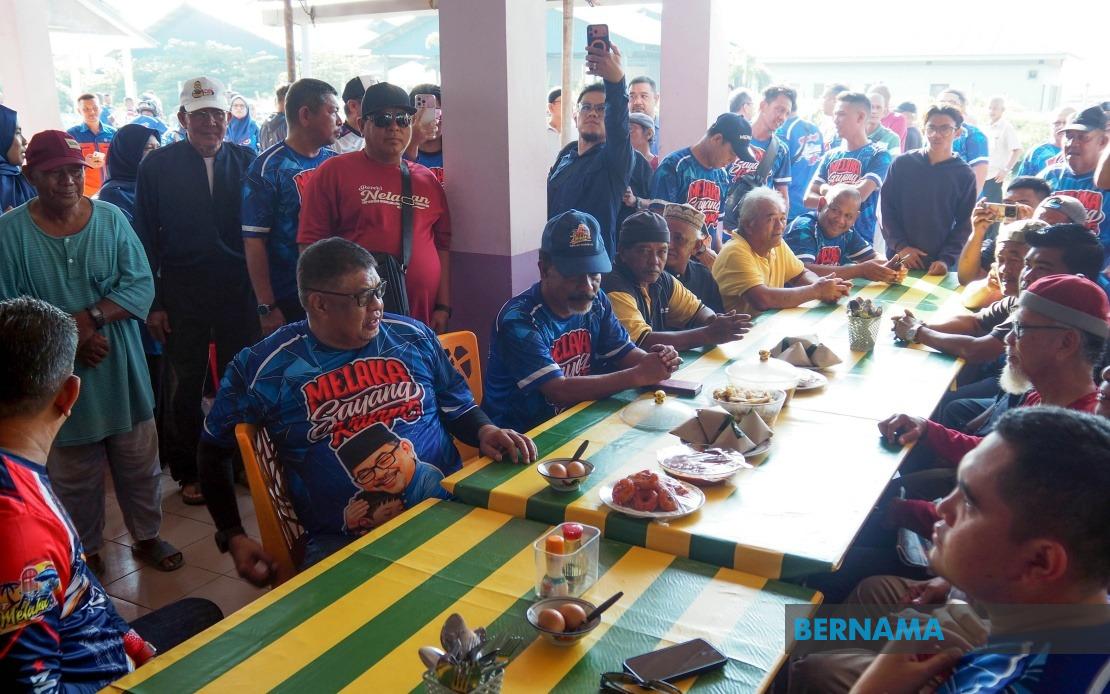
The Melaka government has unveiled a substantial welfare initiative targeting the state's fishing community, combining social security protection with technological advancement to address long-standing challenges in the maritime sector. Chief Minister Datuk Seri Ab Rauf Yusoh announced the multi-faceted programme during the Jelajah Ketua Menteri Sayang Rakyat grassroots engagement tour at Kuala Sempang Jetty in the Merlimau constituency, signalling a strategic shift towards modernising traditional livelihoods while strengthening social safety nets.
The centrepiece of the initiative extends Social Security Organisation (PERKESO) coverage to all registered fishermen, addressing a critical protection gap that has left maritime workers vulnerable to occupational hazards and income loss. This move represents recognition that fishing remains one of Malaysia's most physically demanding and unpredictable occupations, with workers facing risks from treacherous sea conditions, equipment failure, and volatile catch yields. By bringing fishermen into the formal social security system, the state government aims to provide accident coverage, disability benefits, and income protection—safeguards that have long been unavailable to those reliant on informal or self-employed maritime work.
Complementing the social security expansion, the government will equip registered fishermen with fish finders, technology that fundamentally transforms how catches are located and harvested. Fish finders use sonar technology to detect underwater fish schools and water conditions, replacing the traditional reliance on experience, intuition, and environmental observation that has characterised the sector for generations. For individual fishermen, the cost of acquiring such equipment privately ranges between RM1,000 and RM2,000—a substantial barrier that effectively locks traditional fishing communities out of technological advancement. By subsidising or providing these devices directly, Melaka is attempting to bridge the productivity gap between small-scale artisanal fishermen and larger commercial operations.
During the same engagement session, the government distributed RM21,400 across 107 registered fishermen through the 'Bantuan Jaring Nelayan' scheme, providing RM200 to each recipient. While the per-person allocation is modest, the scheme acknowledges the chronic cash flow challenges facing subsistence-level fishing households, where weather disruptions, fuel costs, and equipment maintenance frequently create cash shortages between productive seasons. The distribution also served a broader public benefit agenda, with 360 kilogrammes of fish—valued at RM3,600—distributed to residents at approximately 1.5 kg per person, demonstrating an attempt to connect community welfare with food security outcomes.
Fishermen themselves have responded positively to the announcements, with working maritime professionals highlighting the practical value of technological adoption. Amirul Shah Fuad Shah, a 35-year-old fisherman with over two decades of maritime experience, emphasised that fish finders would eliminate the guesswork historically embedded in locating productive fishing grounds. The ability to identify fish concentrations with precision rather than casting nets broadly into waters based on estimation alone translates directly into more efficient resource use, shorter working hours, and improved catch consistency—factors that cumulatively enhance household income stability in an occupation characterised by volatility.
The PERKESO provision particularly resonates within ageing fishing communities where occupational longevity has historically meant extended exposure to risk without corresponding social protection. Md Khalil Md Jadi, chairman of Kampung Sempang Fishermen's Association at 67 years old, represents a demographic that has shouldered maritime livelihoods throughout productive lifespans without formal safety net coverage. For association members and similar grassroots organisations across coastal Melaka, formal social security eligibility represents delayed but significant recognition that fishing constitutes legitimate occupational work deserving systematic protection—a principle that extends beyond individual welfare to validate traditional maritime cultures.
The broader significance of Melaka's announcement extends beyond immediate beneficiary populations to reflect evolving state-level approaches to sectoral modernisation in Malaysia. Rural and maritime economies across Southeast Asia face persistent challenges reconciling traditional livelihoods with contemporary economic pressures, technological disruption, and climate volatility. Melaka's dual strategy—combining technological enablement with social protection expansion—suggests recognition that sustainable sectoral transformation requires simultaneous investment in both productive capacity and household resilience. Without PERKESO coverage, technological gains could translate into longer working hours extracting marginal productivity gains without improving underlying household security.
The 'Jelajah Ketua Menteri Sayang Rakyat' engagement framework through which these initiatives were announced deserves analytical attention within Malaysian governance contexts. By positioning policy decisions within direct grassroots encounters rather than formal legislative processes, the approach emphasises responsive governance responsive to identified community needs rather than predetermined bureaucratic agendas. Chief Minister Ab Rauf Yusoh's explicit rejection of office-based policymaking in favour of field-based need assessment reflects broader trends within Malaysian state governance toward localised consultation and targeted intervention, though questions remain regarding the sustainability and inclusivity of decisions made through touring formats rather than comprehensive sectoral reviews.
Implementation challenges likely lurk beneath the optimistic announcements. Ensuring that all registered fishermen effectively access PERKESO coverage requires seamless administrative coordination between state authorities and the national social security apparatus, with particular complications arising for informal fishermen or those with irregular registration status. Fish finder distribution logistics—encompassing procurement, quality assurance, training, and maintenance support—demand ongoing state capacity that may exceed current institutional frameworks. Additionally, technological adoption success depends on whether fishermen receive adequate training in equipment operation and data interpretation, factors not explicitly addressed in public announcements but critical for realising productivity gains.
From a regional perspective, Melaka's initiatives reflect emerging recognition across Southeast Asian maritime economies that traditional fishing sectors require active policy support to remain viable amid globalisation, climate change, and industrial fishing competition. Countries including Thailand, Vietnam, and Indonesia face comparable pressures within fishing communities, with technology adoption and social protection increasingly viewed as complementary rather than competing policy priorities. Melaka's experiment in combining both dimensions could offer instructive lessons for other Malaysian states or regional neighbours weighing similar interventions, particularly regarding sequencing, funding mechanisms, and institutional arrangements for translating announced benefits into sustained household improvements.
The announcement's emphasis on registered fishermen introduces an equity dimension worthy of scrutiny. Formal registration status correlates with resource access, regulatory compliance capacity, and information networks—assets often concentrated among relatively established maritime workers rather than marginalised or newly-entering cohorts. Targeting registered fishermen exclusively, while administratively convenient, potentially excludes vulnerable populations within broader fishing communities who operate outside formal classification systems. Whether subsequent programme expansions will extend coverage to unregistered but economically dependent maritime workers remains unclear from current policy statements.
Looking forward, Melaka's initiatives represent a substantive state-level commitment to fishing community welfare that extends beyond typical election-cycle promises or symbolic gestures. The combination of permanent social security integration with technological capacity-building suggests medium-term institutional thinking rather than short-term political positioning. However, realising announced benefits requires sustained follow-through, adequate resourcing, and ongoing community engagement—variables that will determine whether these initiatives fundamentally improve maritime livelihoods or remain unrealised policy announcements.

