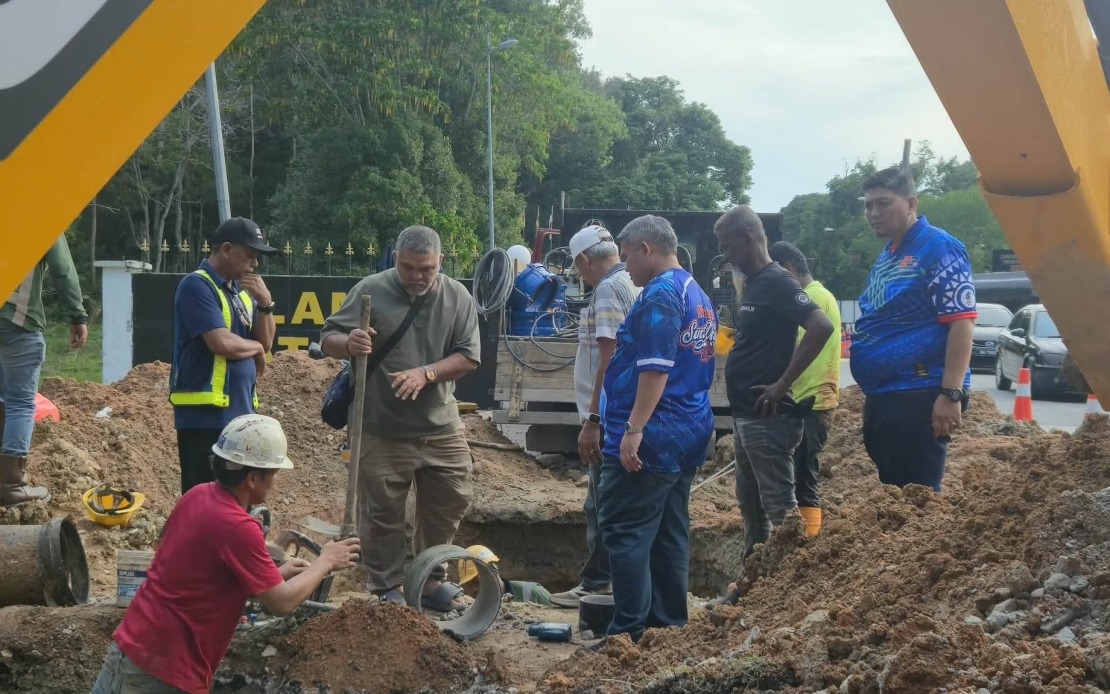
The Melaka state government is taking immediate action to resolve a water crisis affecting thousands at Kem Terendak military camp following a catastrophic pipe failure in Sungai Udang. Through Syarikat Air Melaka Berhad (SAMB), authorities have put forward plans for a temporary water storage facility at the camp as an interim solution while longer-term infrastructure improvements are underway. The proposal represents an urgent response to a situation that has left military personnel, their families, and schoolchildren without adequate water supplies for nearly a week.
Datuk Rais Yasin, the state assemblyman for Sungai Udang and senior executive councillor overseeing housing and local government affairs, outlined the government's strategy during a visit to the camp on July 20. He explained that the temporary tank initiative is necessary to bridge the gap until the Development and Upgrade of the Water Reticulation System project concludes in April 2028. This major infrastructure programme, once complete, will fundamentally reconfigure water distribution networks at the military installation and eliminate the recurring vulnerabilities that have plagued the facility.
The immediate trigger for this crisis was a substantial pipe rupture along Jalan Kampung Payasum in Sungai Udang, which cut off water to the entire camp. Officials initially estimated that emergency repairs would be finished by late evening of July 20, though full restoration of normal supply would require an additional one to two days. This extended timeline underscores the severity of the damage and the complexity of repairs to major water infrastructure serving a large military establishment.
The scale of the disruption is considerable. Approximately 2,000 military personnel and civilian households stationed at Kem Terendak have been severely affected by the supply interruption. Adding to the burden, five educational institutions within the camp grounds—including a MARA Junior Science College—have also struggled to maintain basic operations without reliable water access. Schools face particular challenges during water crises, as they must maintain hygiene standards and sanitation facilities for hundreds of students daily.
To mitigate immediate hardship while repairs proceed, SAMB has deployed an emergency water delivery programme since July 19. The authority is supplying approximately 25,000 gallons of water daily, transported via 25 tanker lorries to various distribution points throughout the camp. Additionally, water containers have been delivered to schools to ensure educational activities can continue with minimal disruption. Despite these efforts, Rais acknowledged that the emergency supply falls short of total demand, given the large population affected by the blackout.
A significant constraint on resolving this crisis is institutional jurisdiction. Water supply issues at Kem Terendak fall under the authority of both the Public Works Department and the Ministry of Defence (Mindef), rather than the state government alone. Consequently, Melaka's proposed temporary tank initiative requires formal approval from Mindef before construction can commence. This bureaucratic requirement reflects the complex overlapping responsibilities that characterise military infrastructure management in Malaysia, where civilian authorities and defence establishments must coordinate on shared facilities.
Despite these jurisdictional complexities, Rais emphasised the state government's commitment to supporting affected residents. He pledged that SAMB would formally submit the temporary tank proposal to Mindef while simultaneously identifying suitable locations for the facility. Beyond the tank proposal, the government is also exploring the deployment of mobile water tankers as a complementary measure, ensuring multiple avenues of relief for the affected population. The multi-pronged approach suggests recognition that any single solution may prove inadequate given the emergency's scope.
The presentation of two 5,000-litre water tanks from SAMB to Kem Terendak provided tangible evidence of state support during the crisis. Lt Col Annuar Kaliman, commanding officer of Terendak Garrison Headquarters, and Datuk Mohd Saleh Jusman, SAMB's chief executive officer, joined Rais in acknowledging both the severity of the situation and the importance of inter-agency cooperation. This symbolic handover, though representing a modest contribution relative to total demand, signalled the government's willingness to provide immediate relief even as longer-term solutions are negotiated.
Rais offered a formal apology to all residents and families affected by the supply disruption, recognising the genuine hardship caused by the extended outage. This acknowledgement is significant, as military personnel and their dependents rely on government services in enclosed environments where alternative water sources are typically unavailable. The disruption affected not only drinking and cooking water but also sanitation facilities critical to maintaining health and dignity within the camp community.
The Kem Terendak water crisis illustrates broader infrastructure vulnerabilities affecting Malaysian public facilities. The occurrence of major pipe bursts at seemingly routine intervals suggests that ageing water distribution networks across the country may be approaching capacity or experiencing deterioration. For military establishments particularly, such disruptions can impact operational readiness alongside affecting resident welfare. The April 2028 completion date for the comprehensive reticulation system upgrade represents both a commitment to modernisation and an acknowledgement that current infrastructure is inadequate for long-term reliability.
This incident carries implications for other Malaysian municipalities facing similar water supply challenges. The integrated response—combining emergency supply measures, temporary infrastructure solutions, and approval-seeking for permanent upgrades—provides a template for addressing crises in complex institutional environments. The reliance on Ministry of Defence approval also highlights how defence considerations sometimes supersede purely civilian administrative frameworks, a reality that shapes infrastructure governance across Southeast Asia's militaries.
For residents of Kem Terendak, the immediate relief from SAMB's emergency supplies and the state government's proactive stance offer some reassurance, even as the restoration process continues. The proposal for a temporary tank, pending Defence Ministry approval, suggests that authorities are treating this crisis as requiring more than simply repairing the current pipe failure. The longer view toward April 2028 represents a recognition that fundamental infrastructure renewal is necessary to prevent recurring disasters that disrupt the lives of thousands of military families and schoolchildren.

